 Lightning Tracker
App Store
Storm basics
Deadliest lightning strike in history: Dronka, Egypt, 1994
November 19, 2026 · 6 min read
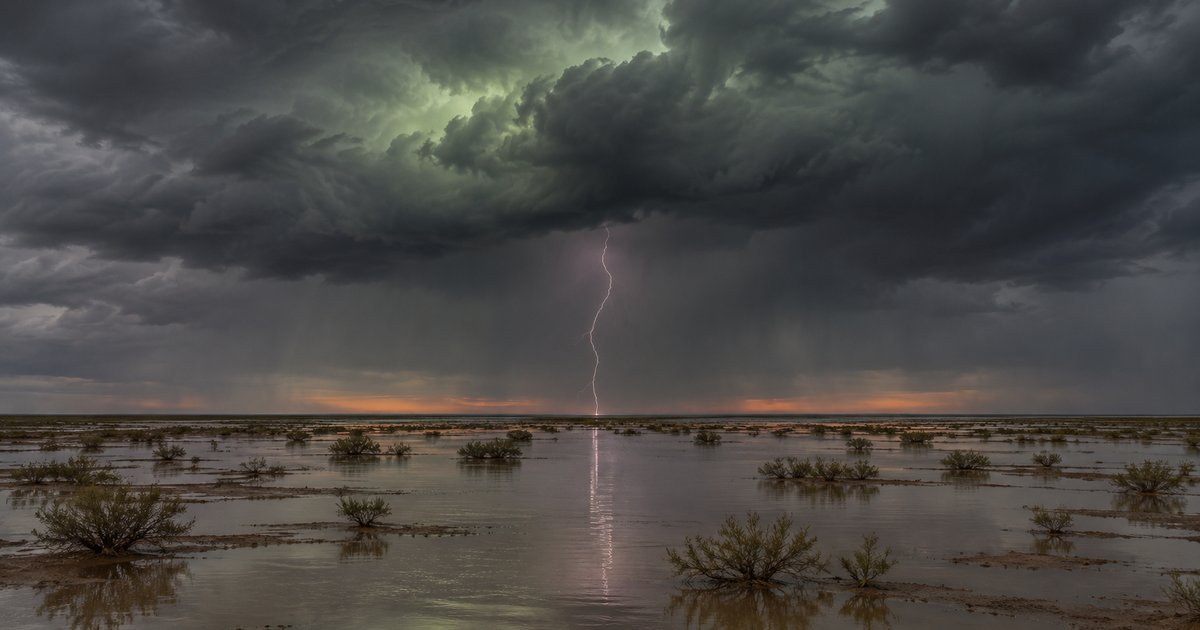
The deadliest lightning event on record is the one at Dronka (also spelled Durunka), Egypt, on November 2, 1994, which the World Meteorological Organization counts at 469 deaths but classifies as an indirect strike: lightning ignited fuel tanks during a flood, and the water carried the burning fuel into the village. The most people killed by a single flash itself, in the WMO’s records, is 21, in a hut in Zimbabwe in 1975.
The WMO keeps two lightning death records, and they measure different things
The World Meteorological Organization (WMO) lists one record for the most people killed by lightning and a separate one for the most killed by a single flash. The international panel that evaluated both, in a 2017 paper in Weather, Climate, and Society, accepted the 469 people killed in a lightning-caused oil tank fire in Dronka, Egypt, on November 2, 1994, as the highest mortality from an indirect strike. It accepted the flash that killed 21 people in a hut in Manica Tribal Trust Lands, Zimbabwe (then eastern Rhodesia), on December 23, 1975, as the highest mortality directly associated with a single flash.
A WMO press release dated July 31, 2025 repeats both records in the same terms: “Direct strike: 21 people killed by a single flash of lightning” in a hut in 1975, and “Indirect strike” for the 469 people killed at Dronka. The same release gives the WMO’s records for the longest flash, 515 miles (829 km), and the longest-lasting one, 17.102 seconds. The panel considered only events after 1873, the year the WMO’s predecessor was formed, so an older disaster blamed on lightning is not ranked against Dronka by this record.
The place name is spelled two ways. The WMO archive writes “Dronka (alternatively Durunka),” and news reports from November 1994 used both.
The 21-death Zimbabwe record rests on one news report and a Guinness entry
The 2017 panel paper reproduces a Salt Lake City Tribune item of December 25, 1975, attributed to Reuters and Rhodesian police: lightning killed 21 people when it struck a hut in which they were seeking shelter from rain, the dead included 14 children, and three people survived. The paper calls this the least officially documented of the five mortality investigations. Reuters told the researchers it no longer had the story, and Guinness found the earliest printed entry for the record in an edition distributed in 1977 but no longer holds the original evidence. The committee accepted the record until more information is obtained or an event with a greater death toll is uncovered.
Lightning ignited fuel tanks at Dronka while floodwater rose around them
The WMO archive describes the Dronka event as a set of very severe thunderstorms that caused much damage and flash flooding. In its account, a flash of lightning ignited three oil storage tanks, each holding about 5,000 tons of aircraft or diesel fuel, which is about 15,000 tons across the three (our arithmetic). The tanks sat on a railway line that collapsed as floodwaters built up behind it, and the floodwaters swept the blazing fuel into the village.
An unsigned report carried by The Moscow Times on November 3, 1994 gave the setting. Lightning struck a complex of eight fuel tanks on Wednesday morning, it said, after a thunderstorm had raged across much of Egypt for up to five hours. Three of the tanks, each holding about 5,000 tons of fuel for the army, exploded and spilled burning fuel into the village, about 200 miles (320 kilometers) south of Cairo. The report counted more than 200 houses destroyed and at least 20,000 people leaving for the provincial capital, Assiut.
Early accounts did not agree on every detail. The Associated Press, in a report dated November 4, 1994, said the heaviest rains in 60 years had lashed normally arid Egypt, and described a train carrying fuel oil that derailed on track loosened by the downpour, with electrical wires setting the oil ablaze. It put the town’s population at 22,000. The WMO archive quotes the researcher Grazulis (1997) describing a village of 10,000. The AP account differs from the WMO’s on how the fire started, so the WMO’s lightning cause rests on its committee’s review, not on that first-week report.
Reported Dronka death tolls ran from 200 to more than 500
The WMO archive says the news coverage right after the event contained many death tolls, ranging from 200 to over 500. The table sets out the figures this page checked, each with its source and date.
| Source and date | What it reported |
|---|---|
| The New York Times, Nov. 2, 1994 (as quoted by the WMO) | At least 200 killed in southern Egypt |
| United Press International, Nov. 2, 1994 (as quoted by the WMO) | 292 deaths from the oil depot fire and torrential rains, in two provinces |
| The Moscow Times, unsigned report, Nov. 3, 1994 | More than 410 killed in southern Egypt: 229 bodies received by hospitals from Dronka, 122 more still on the ground there, and 63 flash-flood deaths elsewhere |
| Associated Press, Nov. 4, 1994 | At least 475 killed in Durunka; 258 bodies in morgues and about 220 victims still buried in the ruins |
| Grazulis, 1997 (as quoted by the WMO) | 430 killed |
| Torres-Sanchez, 2002 (as quoted by the WMO) | 530 killed |
| Egyptian Ministry of Health and Population document (as quoted by the WMO) | Hospitals received 469 bodies from Dronka; floods killed an additional 63 in Assiut and neighboring provinces |
The Moscow Times figures for Dronka add to 351 (229 plus 122), and adding the 63 flood deaths gives 414, which the report rounded to “more than 410” (our arithmetic). The WMO says much of the spread came from whether a count separated the deaths from the oil tank fire from the deaths in the flash flooding that the same storms caused. Many studies after 2000 cite 469 without a reference, the archive notes, until a committee member found the Ministry of Health and Population document that gives it. The WMO took 469 as the death toll for the record.
The figure comes from a count of bodies received by hospitals from the village. It is not a count of people whom lightning struck, and the WMO archive does not break the 469 down by cause of death.
A direct strike and an indirect one are different events
The National Weather Service describes a direct strike as one in which a person becomes part of the main lightning discharge channel. It says most direct strikes happen to victims in open areas and that they are less common than the other ways lightning injures people, but potentially the most deadly. Direct strikes are one of five ways lightning reaches a person. The WMO’s record uses “direct” more broadly, for the deaths directly associated with a single flash as opposed to deaths from a fire that a flash started, so it does not say which of those ways the current reached the 21 people in the hut (our reading).
Dronka is in a different category. The WMO labels it an indirect strike and describes the cause as a lightning-caused oil tank fire. Lightning supplied the ignition, and the fire and the floodwater did the rest. A headline that says lightning “killed 469 people” can be read as one bolt reaching 469 people. The WMO’s wording does not say that, and the one-flash record is 21.
The distinction matters when death counts are compared. The National Weather Service’s page of 2026 U.S. lightning fatalities labels its state-by-state table “Direct Fatalities Only,” as of its September 22, 2026 update. Setting a yearly U.S. count beside Dronka’s 469 would therefore put a direct count beside an indirect one.
The same WMO release names the places that protect people from lightning
The WMO press release that lists both records also quotes committee member Walt Lyons on where to go. He says the only lightning-protected locations are substantial buildings with wiring and plumbing, not structures such as a beach shelter or bus stop. A fully enclosed metal-topped vehicle is the second reliable location, he adds, and dune buggies and motorcycles do not count. With reliable lightning data showing lightning within about 6 miles (10 km), he says, go to the building or the vehicle.
Lightning Tracker, an iPhone app, can alert you when a strike is detected inside a radius you set for each place; the default is 10 miles (16 km).
Not a substitute for official weather warnings.
If you hear thunder, seek shelter even if the app shows no nearby strike.
Sources
- World Meteorological Organization, World Weather and Climate Extremes Archive, World: Highest Mortality Due to Lightning
- Cerveny et al., WMO Assessment of Weather and Climate Mortality Extremes: Lightning, Tropical Cyclones, Tornadoes, and Hail, Weather, Climate, and Society, 2017
- Cerveny et al., WMO Assessment of Weather and Climate Mortality Extremes (full text, NOAA Institutional Repository)
- World Meteorological Organization, WMO certifies megaflash lightning record in USA, July 31, 2025
- The Moscow Times archive, Floods, Inferno Kill Over 400 in Egypt, November 3, 1994
- The Associated Press, Blazing floodwaters claim Egyptian town, November 4, 1994 (Arizona Daily Wildcat archive)
- National Weather Service, Lightning Science: Five Ways Lightning Strikes People
- National Weather Service, Lightning Fatalities in 2026