 Lightning Tracker
App Store
Storm basics
Five ways lightning strikes people
November 11, 2026 · 3 min read
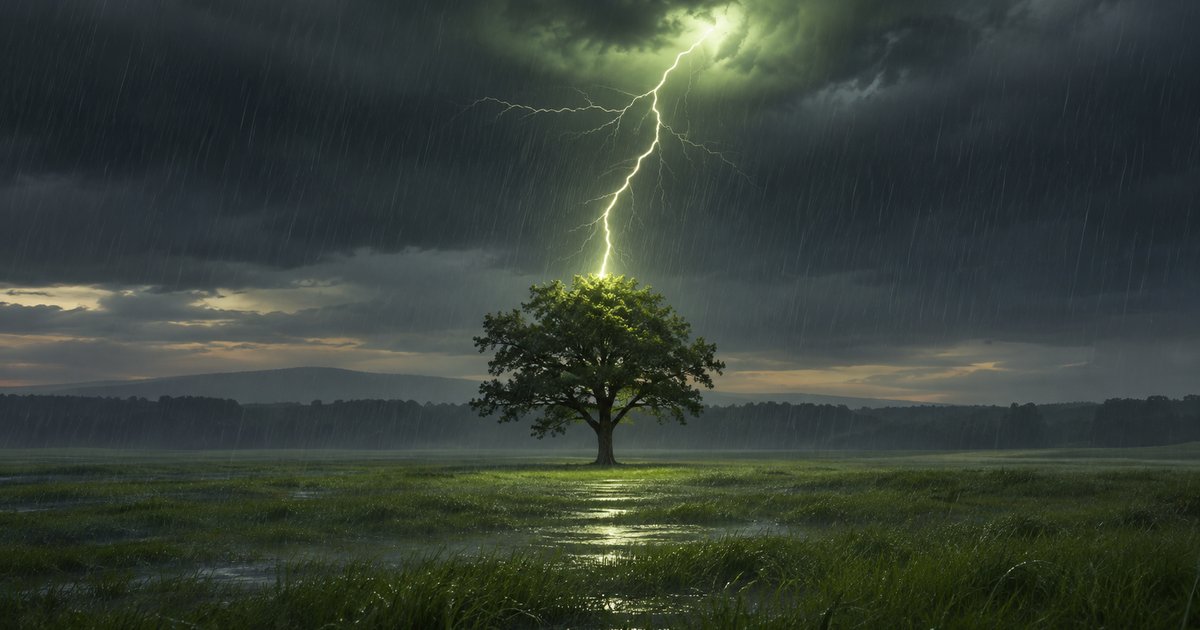
Being "struck by lightning" usually brings to mind a bolt landing on a person. That is the rarest of the five ways lightning injures people, according to the U.S. National Weather Service. Most victims are hurt by current that reaches them some other way, which is why staying out of the open is not enough on its own.
1. Direct strike
The person becomes part of the lightning channel. Some of the current flashes over the skin and some passes through the body, usually through the heart and the nervous system. Direct strikes happen mostly to people in open areas. They are less common than the other types but potentially the most deadly. The branching skin marks sometimes reported after a strike are examined in Lichtenberg figures.
2. Side flash
Lightning hits something taller nearby, most often a tree, and part of the current jumps to a person standing within a foot or two of it. This is the typical injury of someone who took cover under a tree from rain or hail, and it is why a tree is never shelter.
3. Ground current
When lightning hits the ground or a tree, the current spreads outward through and along the surface. A person nearby can pick it up through the contact point closest to the strike, usually one leg, and lose it through the point farthest away, with the current passing through the body in between. The NWS says ground current causes the most lightning deaths and injuries. It is especially dangerous to anyone lying down, and it kills many farm animals each year, because a large animal's body spans a wide stretch of ground. Can lightning travel underground? The National Weather Service says lightning current spreads in and along the ground surface, rather than deep into the soil. The Lightning Protection Institute says current spreading near the surface can return into a building along metal pipes. How far can lightning travel in the ground? The CDC says ground current can be deadly more than 100 feet (30 meters) from a strike. The NWS cites a Sandia measurement of ground-surface arcing at least 66 feet (20 meters) from a strike; a 2016 veterinary review describes a model of current through a four-legged animal at 33 feet (10 meters). These are observations and a model, not a protective cutoff: no source gives a universal distance from a ground strike that protects a person.
4. Conduction
Lightning can travel long distances through wires and metal. Metal does not attract it, but it gives it a path to follow: in one NWS example, lightning hit a wire fence and the current travelled along it and killed a group of cows. Conduction causes most indoor lightning casualties, through anything plugged into an outlet, faucets and showers, corded phones, and windows and doors.
5. Streamers
As the lightning channel nears the ground, short upward discharges called streamers rise from trees, people and other objects. One of them connects to complete the strike. When the main channel discharges, the other streamers nearby discharge too, and a person who was part of one can be injured or killed. This is the least common of the five.
The CDC says about 10 percent of people struck by lightning die. That share covers all strike mechanisms, not just direct strikes.
What the death records add
The five types explain how current reaches a person; the death records show when. The National Lightning Safety Council, reviewing media reports of U.S. lightning deaths from 2006 through 2025, found that many victims were heading for shelter or were only steps from it when they were struck, and that direct strikes are a greater threat in open areas such as sports fields or on the water. Some victims were struck on a walk to shelter that started too late. Who gets struck by lightning? breaks the deaths down by activity.
What protects against all five
Each type needs you to be outside or touching a conductor. A substantial building with wiring and plumbing protects against all five as long as you stay away from plumbing, anything plugged in, and concrete floors and walls. A hard-topped metal vehicle with the windows closed is the fallback. Where to shelter from lightning explains why picnic shelters, tents and dugouts do not count.
It is not always possible to know which of the five struck a person, and it does not change the response. Call 911, start CPR if needed and use an AED if one is close: what to do in the first minutes.
All five reach people near a strike, not only under it. Lightning Tracker, an iPhone app, alerts you when a strike is detected inside a radius you set for each place, 10 miles (16 km) by default, and starts a 30-minute wait after the last one.
Not a substitute for official weather warnings.
If you hear thunder, seek shelter even if the app shows no nearby strike.
Sources
- National Weather Service, Five Ways Lightning Strikes People
- National Weather Service, Understanding Lightning: Ground Current
- Lightning Protection Institute, Lightning Protection Overview
- U.S. Centers for Disease Control and Prevention, Frequently Asked Questions About Lightning
- Schulze et al., Electrical Injuries in Animals, Veterinary Pathology (2016)
- National Weather Service, Dr. Lightning’s Guide: Lightning Victims (PDF)
- National Weather Service, Lightning Myths
- National Lightning Safety Council, J. Jensenius, A Detailed Analysis of Lightning Deaths in the United States from 2006 through 2025 (PDF, March 2026)