 Lightning Tracker
App Store
Home and everyday
Can lightning strike a house? Showers, plumbing and wiring
November 11, 2026 · 10 min read
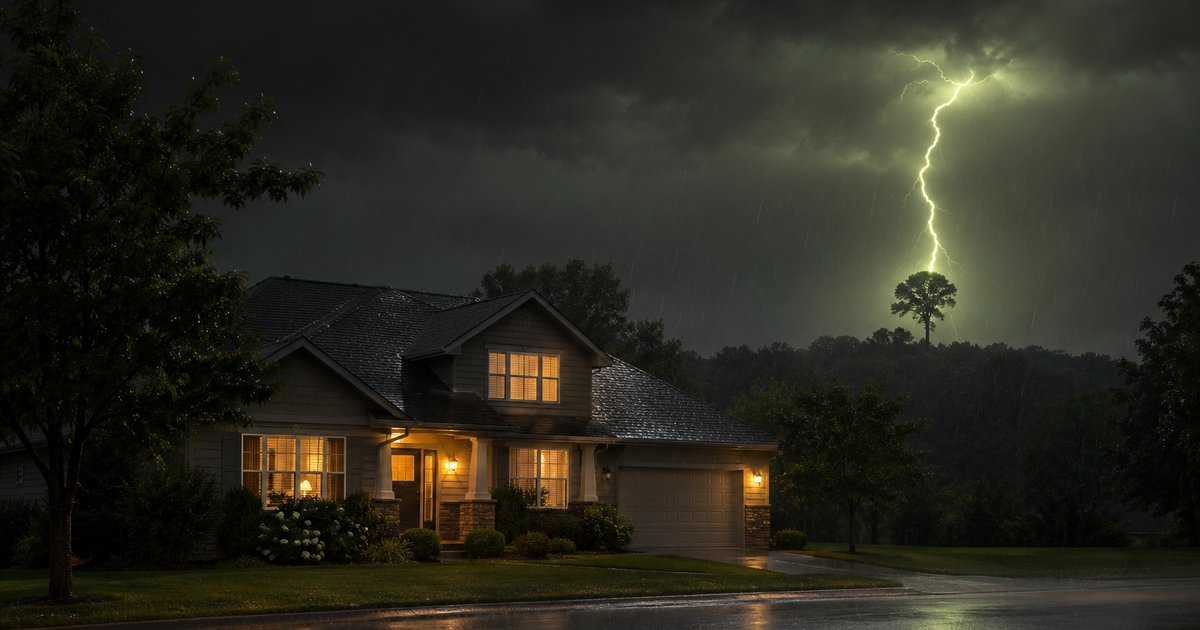
Yes. Lightning strikes houses, and it can also reach a house without hitting it, by traveling through the wires, pipes or ground connected to it. The U.S. National Weather Service (NWS) lists a substantial building as one of its two shelter options, so a house protects people far better than the outdoors does. It does not make the plumbing, wiring and phone lines inside harmless, though, and no source used here gives a clean count of how often people are hurt indoors.
A house can be hit directly, and wires, pipes and the ground carry strikes in too
The NWS lists three main ways lightning enters a structure: a direct strike, wires or pipes that run in from outside, and the ground. Once inside, the NWS says, it can travel through the electrical, phone, plumbing and radio or television reception systems, and through metal wires or bars in concrete walls and floors.
The NOAA National Severe Storms Laboratory (NSSL) adds a neighborhood version. Lightning can hit a pole or a tree, and the current can then travel to several nearby houses and enter them through wiring or plumbing. A house can therefore be damaged by a strike on something that is not part of it. Five ways lightning strikes people explains the same routes from the point of view of a person.
| Route | What carries it | What the source says |
|---|---|---|
| Direct strike | The building itself | NSSL: once the channel is within roughly a hundred yards of the ground, objects such as trees, bushes and buildings send up sparks to meet it. |
| Wires or pipes from outside | Power, phone and cable lines, water pipes | NSSL: a strike on a pole or tree can send current to several nearby houses through wiring or plumbing. |
| The ground | Current spreading through the soil | NWS: ground current can travel in garage floors that contain conductive materials. |
Height, shape and isolation decide which building is hit, not the metal in it
The NWS says height, a pointy shape and isolation are the dominant factors in where a bolt lands, and that metal makes no difference to the location. Metal matters afterward, because it conducts current once lightning arrives. NSSL describes the same pattern: tall objects such as trees and skyscrapers are more likely than the ground around them to produce the connecting spark, yet lightning can still hit an open field with a tree line close by. NSSL adds that local ground conditions, such as the salt or moisture content of the soil, rock, standing water, or pipes and other metal in the ground, might make one spot more likely than another.
How often does lightning strike a house? No agency publishes a yearly rate for houses. By that logic a house standing alone on open ground fits the NWS description better than one among taller trees. The only odds on the NSSL FAQ page are for people, not houses: one in 1.2 million per year for an individual in the U.S., according to the NWS.
On lightning rods, an undated NWS Gray, Maine statement says they protect a home from a direct strike but do not prevent the home from being struck, and that a complete protection system is needed to help prevent surges and possible fires from lightning entering through wires and pipes.
Insurance claims show lightning damage to homes is common, though a claim is not a strike
The Insurance Information Institute (Triple-I) reported that U.S. lightning-caused homeowners insurance claims rose 11.6 percent in 2025, from 55,537 to 61,986. Their value rose 59.4 percent to $1.65 billion, and the average claim cost $26,616. The table shows 2021 to 2025.
| Year | Claims | Value of claims | Average cost per claim |
|---|---|---|---|
| 2021 | 60,851 | $1,313.1 million | $21,578 |
| 2022 | 62,189 | $950.2 million | $15,280 |
| 2023 | 70,787 | $1,239.7 million | $17,513 |
| 2024 | 55,537 | $1,035.3 million | $18,641 |
| 2025 | 61,986 | $1,649.8 million | $26,616 |
A claim counts a policyholder's loss, not a lightning flash, and the Triple-I page does not say how many claims followed direct hits and how many followed surges or other routes. The table also shows that counts and costs move separately: 2024 had the fewest claims of the five years, and 2025 had the highest average cost.
Fire departments report thousands of lightning house fires a year, and some start out of sight
Can lightning start a house fire? Yes. The NWS says lightning causes house fires, and NFPA's historical fire department estimates below count thousands of home structure fires started by lightning each year from 2012 to 2014. A fire may begin in a concealed space, as the documented cases below show.
The National Fire Protection Association (NFPA) estimated 5,100 home structure fires started by lightning in 2012, 3,800 in 2013 and 3,900 in 2014, based on national fire incident data and its annual fire department survey, and not counting certain confined fires. For 2014 it gave 35 civilian injuries and $408 million in direct property damage as reported; its estimates of deaths in these fires were too low and unstable to publish. That report stops at 2014, so these are not current-year counts.
Lightning is a small share of all home fires. In an earlier NFPA report covering 2002 to 2005, it started 1 percent of reported home structure fires and accounted for 4 percent of their direct property damage. Many strikes on houses end without fire: NFPA estimated that fire departments answered 10,200 lightning strikes that did not result in fire in 2003, and 62 percent of them, about 6,300, were at homes.
A fire can begin where nobody sees it. The 2008 NFPA report reprints a 2003 account of a Connecticut building of eight townhouses, where lightning damaged cedar siding and started a fire in a concealed chimney space that spread into wall and ceiling voids; a resident found it about 15 minutes after seeing the flash. On September 2, 2026, the Delaware State Fire Marshal's Office determined that lightning struck a single-family house in Dover and started a fire in the attic space, with heavy fire damage estimated at $750,000 and no injuries. The day before, it traced a basement fire in an occupied Dover home to a lightning strike; damage there was minor.
Most lightning deaths near homes happen just outside them, and indoor injuries lack a clean count
The NWS says conduction causes most indoor lightning casualties, through anything that plugs into an outlet, faucets and showers, corded phones, and windows and doors. The National Lightning Safety Council (NLSC) counted 492 lightning deaths in the U.S. from 2006 through 2024, and its report sorts them by activity (work, routine or leisure) with no separate indoor category. Among the routine-activity deaths it lists as examples are lowering the blinds on a window and talking on a corded phone. For people killed around their home, business or neighborhood, it says most were only steps from shelter, and some had walked outside just before the strike.
The evidence on indoor injuries is contested. A medRxiv preprint posted in October 2023 reviewed 15 articles on indoor lightning deaths and injuries, most of them retrospective reviews of records and news reports. It concluded that indoor injuries are exceedingly rare and that indoor deaths are essentially non-existent in modern times, and it argued that U.S. guidance may make indoor spaces look hazardous. A preprint has not been peer reviewed, and it is not an agency position.
Other pages go the other way. A Cleveland Clinic article dated August 22, 2023 says one-third of all lightning injuries occur indoors and links the figure to a CDC page without naming a study; the research for this article could not trace the number to a dataset. The same article says the plumbing warning holds for plastic pipes too, because water conducts. The NWS pages used here do not separate pipe materials. The NWS Lightning Indoors page, read for this article on November 6, 2026, still lists the paths described next.
The NWS asks people indoors to stay off a short list of conductive paths
Can you shower during a thunderstorm? No: the NWS says to avoid plumbing, and the CDC says not to bathe, shower or have other contact with running water because lightning can travel through a building's plumbing. That includes an apartment: the guidance applies to plumbing inside buildings, without an apartment exception. The CDC says plastic pipes might lower the risk compared with metal pipes, but still advises avoiding plumbing and running water.
Is it okay to wash dishes, do laundry or use the toilet during a thunderstorm? The NWS says not to wash dishes or do laundry, and its Miami office specifically says to stay off the toilet. The NWS Goodland office explains that washers and dryers connect to electrical and plumbing systems. Wait until the storm has passed before using those paths.
During a storm the NWS asks people inside to stay off corded phones (cellular and cordless phones are fine), not to touch computers, TVs or cords (remote controls are fine), and to avoid plumbing, which means no hand washing, showers or dishes. It also asks them to stay away from exterior windows and doors, to stay off balconies and porches and out of open garages and carports, and not to lie on concrete floors or lean on concrete walls.
The window warning has two reasons. Wind during a thunderstorm can blow objects into the glass, and in older homes lightning can, in rare instances, come in through cracks at the sides of windows. Where to shelter from lightning gives the same list with the reasons, and item 9 of Ten lightning myths covers the belief that a house makes you immune.
Can lightning strike through a window? The NWS does not describe a bolt passing through intact glass. Its indoor guidance says to stay away from exterior windows and doors that may have metal components leading from outside to inside; its separate account of older homes mentions rare entry through cracks beside a window.
Should you open windows during a thunderstorm? No. The NWS Goodland office says to close windows and doors when lightning is occurring because an open window or door can let a direct strike enter the house. The NWS also advises staying away from exterior windows during the storm.
Surge protectors and unplugging: decide about equipment before the storm
The NWS says lightning generates electric surges that can damage electronic equipment some distance from the actual strike, and that typical surge protectors will not protect equipment from a lightning strike. It also says not to unplug equipment during a thunderstorm, because you could be struck. The NWS Gray office adds that anyone who plans to unplug equipment should do it well before the storm arrives. One insurer's blog, Mutual Assurance, says it is always a good idea to unplug appliances and electronics during a storm, which conflicts with the NWS wording. The NWS advice means the decision about equipment is made before the first thunder, not while it is audible.
What lightning damage to a house looks like
The sources above describe three kinds of damage, and a house can get more than one from the same strike. How can you tell whether lightning struck your house? Smoke or a smoke smell, as the NWS Gray office warns, and damaged siding, as in the NFPA Connecticut account, may point to a hit. Electronics that stop working can also result from a surge caused by a nearby strike, according to the NWS, so that sign alone does not prove the house was hit. Fire is the one that can hide: the NFPA account from Connecticut and the Delaware fire marshal's Dover case both describe fires that began in a concealed chimney space or an attic. Surges can leave no visible mark at all: the NWS says lightning generates surges that damage electronic equipment some distance from the actual strike, so a hit on a nearby pole or tree can ruin appliances in a house that was never touched. Physical damage, such as the cedar siding damaged in the Connecticut case, is the easiest to see and says little about what happened inside the walls. That is why the steps below start with the fire department rather than with a look at the roof.
After a strike on a house, the NWS Gray office lists four steps
The statement lists these steps. Evacuate immediately if you smell smoke, and call 911. Call the local fire department and, if possible, ask them to check for hot spots in the walls with thermal imaging equipment. Make sure all smoke detectors are powered and working. If needed, have a licensed electrician check the wiring.
The Connecticut and Dover fires above started in concealed spaces, which fits the wall check. The NWS 30-minute rule applies to going back outside after the last lightning or thunder, so inspecting the roof or yard from outside belongs after that wait. Why wait 30 minutes explains why the clock restarts.
What the sources leave unknown
- How often a given house is struck in a year. No source used here gives a per-house rate.
- How many indoor injuries happen each year. The NLSC does not count them separately, and the one-third figure has no traceable dataset.
- How many insurance claims come from direct hits and how many from surges.
- Whether plastic plumbing changes the NWS plumbing advice. The NWS pages make no distinction by pipe material; a Cleveland Clinic article says plastic pipes do not remove the risk.
Where Lightning Tracker fits
Lightning Tracker, an iPhone app, alerts you when a lightning strike is detected inside the radius you set for each place; the default is 10 miles (16 km). Detection networks miss some strikes, especially weak ones, and data can arrive late, so the app marks delays and gaps instead of treating them as calm. An alert is a cue to finish showers, dishes and corded calls and settle in, and hearing thunder is a cue on its own. How to choose an alert radius covers the sizing.
Not a substitute for official weather warnings.
If you hear thunder, seek shelter even if the app shows no nearby strike.
Sources
- National Weather Service, Lightning Indoors
- Centers for Disease Control and Prevention, Safety Guidelines: Lightning
- National Weather Service, Goodland office, Lightning Safety Awareness Week
- National Weather Service, Melbourne office, Lightning Rules
- National Weather Service, Miami office, Weather Safety: Lightning
- National Weather Service, Lightning and Fires
- National Weather Service, Lightning Myths
- National Weather Service, Five Ways Lightning Strikes People
- National Weather Service, Lightning Safety Overview
- National Weather Service, Gray, Maine office, Lightning Awareness Week: Friday (undated statement)
- NOAA National Severe Storms Laboratory, Lightning FAQ
- NOAA National Severe Storms Laboratory, Severe Weather 101: Lightning Basics
- National Fire Protection Association, M. Ahrens, Structure Fires Started by Lightning (PDF, April 2017; copy filed with the Florida Building Commission)
- National Fire Protection Association, M. Ahrens, Lightning Fires and Lightning Strikes (PDF, January 2008; copy hosted by the Kewanee Fire Department)
- Delaware State Fire Marshal's Office, Lighting Strikes Cause House Fires (September 3, 2026)
- Insurance Information Institute (Triple-I), Facts + Statistics: Lightning
- National Lightning Safety Council, J. Jensenius, A Detailed Analysis of Lightning Deaths in the United States from 2006 through 2024 (PDF, January 2025)
- medRxiv preprint, not peer reviewed, A Systematic Review of Evidence Behind the CDC Guidelines for Indoor Lightning Safety (October 2023)
- Cleveland Clinic, Striking Facts About Showering During a Thunderstorm (August 22, 2023)
- Mutual Assurance, Lightning Doesn't Have To Strike Your House To Cause Serious Damage