 Lightning Tracker
App Store
Home and everyday
Do lightning rods work? What they do and what they don't
November 10, 2026 · 8 min read
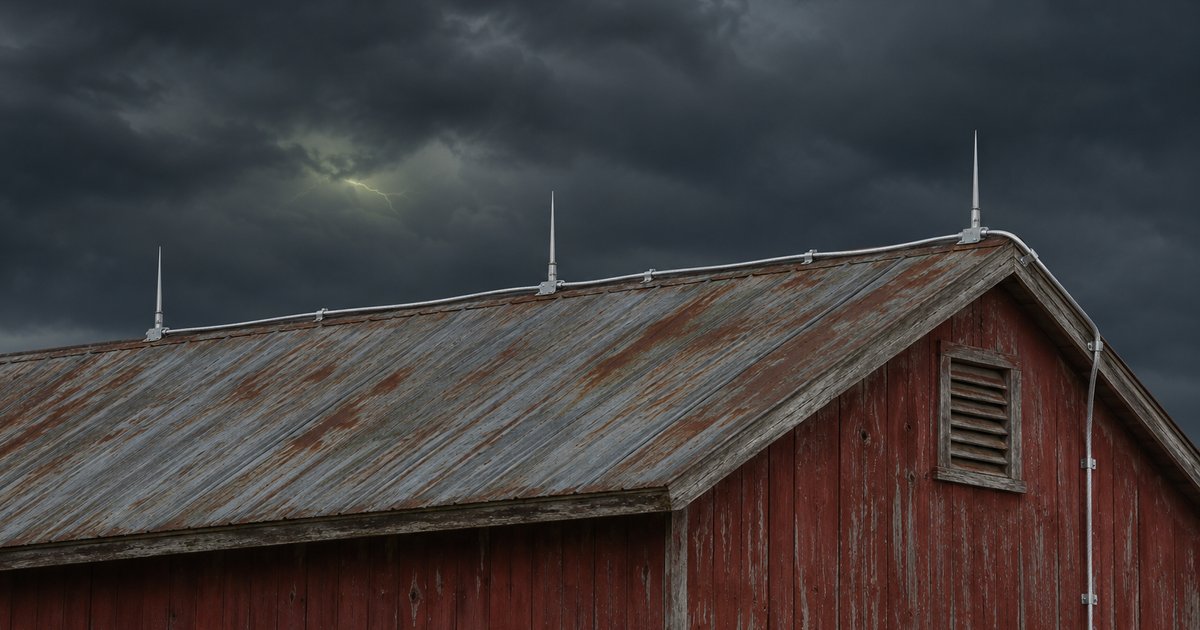
Yes, for one specific job. According to the National Weather Service (NWS), a lightning protection system, meaning rods on the roof joined by conductors to a ground connection, is designed to protect a building from a direct strike, mainly from the fire a strike can start. It does not prevent lightning from striking, rods alone do not cover the wires and pipes that bring lightning inside, and no source reviewed for this article calls any rod fully reliable.
A lightning protection system carries a strike to the ground
The National Weather Service (NWS) says lightning rods and the system around them are designed to protect a house or building from a direct strike and, in particular, from a fire that lightning starts. The same NWS page says these systems do not prevent lightning from striking a structure. They intercept a strike, give it a conductive path in the form of a copper or aluminum cable, and release its energy into a grounding network.
The rod is one of three parts. In his 1986 book All About Lightning, Martin Uman lists the rods on the roof, the wires that join them and run down the building, and the grounding arrangement, and writes that the system may fail if any part is inadequate. The NWS adds that the parts must be properly connected, or bonded, to cut the chance of sparks and side flashes.
Fire is the damage these systems target. A U.S. Fire Administration report from 2001, revised in 2002 and based on 1996 to 1998 data, estimated 17,400 lightning fires a year, 41% of them in structures. Roofs, sidewalls, framing and electrical wires were the areas most often ignited, and deaths and injuries from lightning-caused fires occurred mostly in structures. No newer national figure was reviewed for this article.
A rod works in the last yards and does not prevent lightning
Uman describes how a rod acts: it launches a spark that travels toward the descending lightning and meets it when the spark is generally 10 to 100 yards long. He writes that the rod can divert a stroke only in the final part of its path to earth, and that before the spark starts, the stroke is essentially unaffected by objects below it. Because any high object can launch such a spark, he says the rod should be the tallest object near the building, so that a chimney or a nearby tree does not win.
Whether a rod “attracts” lightning depends on the word. The Lightning Protection Institute (LPI), an association of manufacturers and contractors in the industry, answers no: rods intercept a strike. A 1995 report from the National Institute of Standards and Technology (NIST) defined a lightning rod as a vertical rod used to “attract (or intercept)” a strike by enhancing the local electric field. NOAA’s National Severe Storms Laboratory (NSSL) explains why height matters: the tallest object is the most likely to send up the streamers that connect with the downward leader. Read together, the sources describe a rod as helping choose where a nearby stroke lands, not as pulling strokes in from far away.
Rods alone leave the wires and pipes uncovered
The NWS lists three main ways lightning enters a structure: a direct strike, wires or pipes that run outside the building, and the ground. A rod addresses the first. The NWS rods page says a complete system is needed to help prevent surges and fires from lightning that enters through wires and pipes, and that a complete system also includes surge protection for incoming power, data and communication lines and for vulnerable appliances. It adds that gas piping may need protection too.
The NWS indoor-safety page adds a caution: typical surge protectors will not protect equipment from a lightning strike. Neither NWS page explains how the surge devices in a full system differ from ordinary ones, so this article does not either.
The standards treat the system as a unit. UL 96A, the UL installation standard (14th edition, published September 29, 2023), applies to systems that are complete and cover all parts of a structure, and says partial systems are not covered. LPI warns that a grounded weather vane or antenna is not adequate protection because a single path to ground cannot carry the current of a lightning discharge.
No source reviewed calls a rod fully reliable
Uman writes that no lightning rod, however tall, offers absolute protection, and that lightning has struck the Empire State Building 50 feet below its top. He also writes that rod systems are effective if used properly. NIST’s 1995 survey of the research literature reached a similar place: it saw no reason to believe any air terminal is 100% efficient at attracting lightning, and it found that reliable quantitative data on the performance of conventional rods were insufficient.
The one number found for how much a system reduces fires comes from an old and different design. Uman reports a Polish study, cited to a 1959 paper, of a cheap wire suspended above thatched farmhouse roofs. Over five years, the protected buildings had about 10% of the lightning-caused fires of unprotected ones. That says nothing direct about a modern U.S. house with rods, so this article does not treat it as one.
The shape of the tip is still debated. Uman wrote in 1986 that there was no evidence a pointed rod beats one topped with a ball. Researchers publishing in the Journal of Applied Meteorology in 2000 noted that the United States had no standards for the shape of these devices, and reported field tests in which several blunt, rounded rods were struck while nearby sharper rods were not. They concluded that moderately blunt rods are better strike receptors than sharper or very blunt ones. A second paper from the same group, in Geophysical Research Letters, reported that after seven years of tests none of the sharp rods had been struck while 12 blunt rods had taken strikes. These tests show which rod receives a strike, not how much damage a building avoids, and one research group ran them. Whether the current NFPA 780 requires a particular tip shape is not covered here, because the standard’s text was not reviewed.
Products sold as improvements have a thinner record. Early streamer emission terminals are rods fitted with a device meant to start the upward spark sooner. The 1995 NIST survey found that nearly all performance data on them came from manufacturers, and that it was nearly impossible to make quantitatively meaningful comparisons with ordinary rods. Whether later work changed that is outside the sources reviewed for this article.
Tesla’s 1918 patent argued against pointed rods
Nikola Tesla’s U.S. patent 1,266,175, “Lightning-Protector,” filed May 6, 1916 and published May 14, 1918, names the pointed terminal as the flaw in the Franklin rod and says he avoids points. Tesla wrote that such a rod attracts lightning, so that it is struck oftener than the building would be without it, while rendering harmless most, but not all, of the discharges it receives. His alternative was a terminal with a large surface and no sharp edges, such as an ellipsoidal metal shell slipped over a rod or a cupola-shaped roof, joined to a grounded conductor of small self-induction. He described the result as acting as a “quasi-repellant.”
Later field tests touch the same question without confirming his design. In the Moore group’s tests, blunt rods with tip diameters of 12.7 to 25.4 millimeters took strikes over seven years while nearby sharp Franklin rods took none, and laboratory work found that positive ions form and move more readily over sharp tips than over blunter ones. That fits Tesla’s premise that points emit charge, but not a repellant effect: the blunt rods were the ones struck. The patent also describes shells and a roof, not the small rod tips tested. Neither abstract mentions Tesla. His patent states that the design would be far more dependable than earlier protectors, but a patent records an inventor’s reasoning, not a test result, and no source reviewed for this article reports his terminals being tested or proven.
Common rod claims, checked against the sources
| Claim | What the sources say | Source |
|---|---|---|
| A rod keeps lightning from striking | No. Systems intercept a strike; they do not prevent it. | NWS; Uman, 1986 |
| A rod gives a direct strike a path to ground | Yes. That is the design purpose, aimed mainly at fire. | NWS; Uman, 1986 |
| A rod alone covers wires and pipes | No. A complete system with surge protection is needed for that path. | NWS |
| A properly installed rod is fully reliable | No source says so. Uman and NIST both say no rod is absolute or 100% efficient. | Uman, 1986; NIST, 1995 |
| A pointed tip works best | Unsettled. Uman found no evidence for it in 1986; field tests reported in 2000 favored moderately blunt tips. | Uman, 1986; Moore et al., 2000 |
NFPA 780 and UL 96A set the installation standards
NFPA 780 is the National Fire Protection Association’s Standard for the Installation of Lightning Protection Systems. The NWS says any system should follow the standards of LPI, NFPA and Underwriters Laboratories. LPI says a system meeting NFPA 780, UL 96 and UL 96A includes strike termination devices, down conductors, bonding and surge protection.
LPI also says pricing generally runs under 1% of the value of the structure but varies with size, location, construction, roof type and grounding conditions. It calls lightning protection “not a do-it-yourself project” and says insurance discount policies vary by company. LPI’s members make and install these systems, so treat its price and benefit statements as the industry’s view. None of the sources reviewed says every house must have a system, and none counts how many U.S. homes do.
A rod protects the building, not the people outside
The NWS describes lightning protection as protection for a house or building, so it does not change what to do while you are outdoors. Inside, the NWS indoor tips still stand: stay off corded phones, and avoid plumbing by not washing hands, showering or washing dishes. For where to go when a storm is close, see where to shelter from lightning, and for other beliefs about where lightning goes, ten lightning myths.
Knowing that a storm is close is a separate job. Lightning Tracker, an iPhone app, shows recent detected strikes on a live map, with the distance and direction to the nearest one and how many minutes ago it was detected.
Not a substitute for official weather warnings.
If you hear thunder, seek shelter even if the app shows no nearby strike.
Sources
- National Weather Service, Lightning Rods
- National Weather Service, Lightning Indoors
- Martin A. Uman, All About Lightning (Dover, 1986), chapter 2, How Does a Lightning Rod Work?, as reproduced by the University of South Florida Contemporary Art Museum
- National Institute of Standards and Technology, Early Streamer Emission Lightning Protection Systems: Literature Survey and Technical Evaluation (NISTIR 5621), January 31, 1995
- C. B. Moore, W. Rison, J. Mathis and G. Aulich, Lightning Rod Improvement Studies, Journal of Applied Meteorology, May 2000
- C. B. Moore, G. D. Aulich and W. Rison, Measurements of lightning rod responses to nearby strikes, Geophysical Research Letters, May 15, 2000
- Nikola Tesla, Lightning-Protector, U.S. Patent 1,266,175, filed May 6, 1916, published May 14, 1918, as scanned and machine-read by Google Patents
- U.S. Fire Administration, Lightning Fires, Topical Fire Research Series, August 2001 (revised March 2002)
- NOAA National Severe Storms Laboratory, Severe Weather 101: Lightning FAQ
- UL Standards & Engagement, UL 96A, Installation Requirements for Lightning Protection Systems, 14th edition, September 29, 2023
- National Fire Protection Association, NFPA 780, Standard for the Installation of Lightning Protection Systems, product page, read November 2026
- Lightning Protection Institute, Frequently Asked Questions, industry association, undated
- Lightning Protection Institute, About, undated