 Lightning Tracker
App Store
Home and everyday
Phones, chargers and surge protectors in a thunderstorm
November 11, 2026 · 7 min read
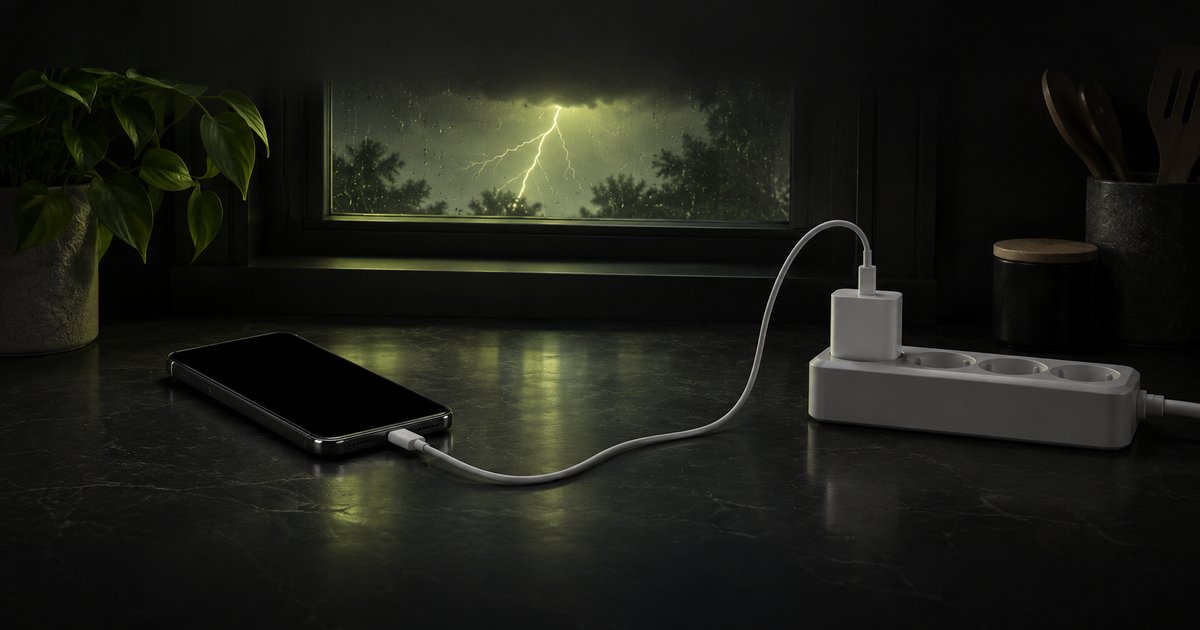
A cell phone or cordless handset running on its own battery is fine to use indoors during a thunderstorm, according to the National Weather Service and the CDC. The agencies tell you to leave alone the corded phone and anything connected to an outlet, and the CDC names a phone on a charger specifically. Surge protectors are a separate question: they can help equipment, but the National Weather Service says typical ones will not protect it from a lightning strike.
Why a phone on its battery is not the hazard
The National Weather Service (NWS) lightning-indoors page says to stay off corded phones and that you can use cellular or cordless phones. The CDC's lightning guidance, dated June 16, 2026, draws the same line, and adds that the 911 call for a lightning victim can be made from a cell phone or cordless phone during a storm. The full list of indoor habits is in where to shelter from lightning.
Metal in a phone does not change where lightning lands. The NWS lightning myths page names metal on the body, with cell phones in its example, as a belief that is wrong, and says height, pointed shape and isolation are what decide where a bolt strikes. The CDC splits the point in two: metal does not attract lightning, but it is a good conductor, and a person touching metal when struck is more likely to be burned. Ten lightning myths covers the rest of the list.
The caveat is where you stand, not what you hold. A 2006 letter in the BMJ from a London hospital described a 15-year-old girl struck in a large park while using her mobile phone. She survived a cardiac arrest and a year later had lasting physical, cognitive and emotional problems. A Cambridge astrophysics PhD student replied in the same journal that the three newspaper reports the authors cited are not compelling evidence that a phone raises the odds of a strike or the severity of the injury, and that a phone's casing is usually all plastic. Two letters are not a study. In the cases the first letter cites, the person was outdoors in a storm, which the agencies' advice to go inside already covers. If someone nearby is struck, the first minutes start with a phone call.
What counts as plugged in
The CDC's lightning FAQ, dated July 10, 2026, attaches one condition to phone use: mobile and cordless phones are fine if they are not connected to an outlet through a charger. A phone on a charger is therefore treated like any other plugged-in appliance. The NWS explains the mechanism: lightning can enter a building by a direct strike, along wires or pipes that reach outside, or through the ground, and once inside it can travel through the electrical, phone and plumbing systems. Anyone touching something connected to those systems is at risk, including anything that plugs into an outlet and corded phones. That route is called conduction, and five ways lightning strikes people explains it.
| Item | What the agencies say | Source |
|---|---|---|
| Cell phone on its battery | Fine to use | NWS, CDC |
| Cordless phone handset | Fine to use | NWS, CDC |
| Corded phone | Stay off it | NWS, CDC |
| Phone connected to a charger | Outside the "fine" rule: the CDC allows phones only when they are not connected to an outlet through a charger | CDC FAQ |
| Computer, laptop, game system or appliance plugged in | Do not use or touch | NWS, CDC |
| TV remote control | Fine to use | NWS |
| Wireless charging pad, power bank, earbuds | Not mentioned on the NWS or CDC pages read. A pad plugs into an outlet, so the plugged-in rule is the closest guidance | Interpretation |
Is it okay to cook during a thunderstorm? The CDC says not to use anything connected to an electrical outlet during a storm and names stoves specifically, so an electric stove falls under that advice. For a gas stove, the CDC rule also applies if the stove is connected to an outlet; neither agency gives a separate rule for a gas stove with no electrical connection. The issue in their guidance is the connection to the electrical system, not whether the burner uses gas or electricity.
Researchers in Brazil looked at what this means in practice. A paper in the 2024 IEEE Electrical Safety Workshop, by authors at the Institute of Energy and Environment of the University of São Paulo, gathered 2022 Brazilian news reports of people using a plugged-in smartphone when lightning struck near their home or hit the power grid, and says at least five people died. Most of the strikes were in rural areas, and witnesses described a loud, close strike. News reports are not an official count, and the authors' simulation covers one scenario with no surge protection ahead of the charger, so the paper shows a mechanism, not a U.S. rate. It concludes that using a smartphone that is charging from the socket during a lightning storm is hazardous, which matches the CDC's condition.
The sources disagree about unplugging
Should you unplug appliances during a thunderstorm? The NWS says no: touching equipment to unplug it during the storm carries a risk of being struck. Its Melbourne office says to unplug electrical equipment before the storm arrives if you plan to do so. The NWS also says lightning can cause damaging surges some distance from a strike and that typical surge protectors will not protect equipment from a lightning strike.
The NWS and the São Paulo authors give opposite advice about unplugging during a storm. The São Paulo paper recommends removing the phone charger from the socket as soon as you notice a storm starting, along with installing surge protection. A 2001 booklet from the National Institute of Standards and Technology (NIST) adds a third angle: power companies sometimes suggest disconnecting appliances when a severe storm approaches, which does not help when no one is home, and pulling the power cord of an appliance that is still wired to a phone line or cable TV might not be a good idea, because the appliance loses the grounding its power cord provides.
This article cannot settle that, and no single rule follows from all three. None of the sources recommends holding a plugged-in phone during a storm, so one reading that fits all of them is to decide before the first thunder: charge the phone while the sky is clear, then carry it on battery once a storm is close. That reading is an interpretation, not guidance from any agency.
Surge protectors guard equipment against some surges, not against a direct strike
Surge protectors address property, not people. The NWS lightning-indoors page lists surge advice under protecting your property: lightning creates electric surges that can damage electronic equipment some distance from the strike, and typical surge protectors will not protect equipment from a lightning strike. The CDC lists whole-house surge protectors among its indoor tips, with the stated aim of protecting appliances. Property damage is common: the Insurance Information Institute (Triple-I) counts 61,986 lightning-caused homeowners insurance claims in 2025, worth about $1.65 billion. The figure covers all lightning damage and does not separate out electronics.
NIST's booklet Surges Happen! explains why a plug-in device can fall short. A surge can reach an appliance through any of its connections to the outside: power, telephone, cable or antenna. A direct strike affects the object struck and its surroundings, while indirect effects reach further, along power lines, telephone systems and cable TV. An appliance wired to both power and a communications line can be damaged by the voltage difference between the two, and NIST says that can happen even when a surge protector sits on each. For motor-driven and heating appliances, it adds that those with electronic controls can be more susceptible to damage than those with mechanical controls.
| Device | What the sources say it does | Where it stops |
|---|---|---|
| Plain power strip | UL describes it as an extension cord with a lot of outlets | It has no element inside to clamp a surge; UL says that is what a surge protector adds |
| Plug-in surge protector, power only | NIST calls it sufficient for a TV with a rabbit-ears antenna, which has only a power cord | The NWS says typical surge protectors will not protect equipment from a lightning strike |
| Combined power and phone or cable protector | NIST describes one unit that passes both connections through it, for appliances with two links | NIST says to read which telephone connection is in and which is out |
| Whole-house protector at the service panel | NIST says it diverts large surges on the power line before they enter the house; the CDC recommends whole-house protectors | NIST answers "No for two-link appliances" when asked if it is enough for the whole house |
NIST also says to look for the mark of a testing laboratory such as UL, ETL or CSA, and that the indicator lights on protectors are not standardized, so the instructions matter. The booklet is from 2001 and names no brands, so it is a guide to how surges travel, not to what to buy.
Where a lightning alert fits
Lightning Tracker is an iPhone app that alerts you when a strike is detected inside a radius you set for each place, 10 miles (16 km) by default, and warns when strikes are coming closer. That can be the cue for the choices above, such as charging a phone early or switching to battery before the storm is overhead; how to choose an alert radius covers the trade-off. Detection networks miss some strikes, especially weak ones, and data can arrive late, so the app marks delays and gaps rather than treating them as quiet, and how lightning is detected explains why. The app does not replace official warnings or local procedures. If you hear thunder, treat it as the cue whatever the app shows.
Not a substitute for official weather warnings.
If you hear thunder, seek shelter even if the app shows no nearby strike.
Sources
- National Weather Service, Lightning Indoors
- National Weather Service, Melbourne office, Lightning Rules
- National Weather Service, Five Ways Lightning Strikes People
- National Weather Service, Lightning Myths
- Centers for Disease Control and Prevention, Frequently Asked Questions About Lightning
- Centers for Disease Control and Prevention, Safety Guidelines: Lightning
- BMJ, Esprit, Kothari and Dhillon, Injury from lightning strike while using mobile phone (June 24, 2006)
- BMJ, Faragher, Injury from lightning strike while using mobile phone: statistics and physics do not suggest a link (July 8, 2006)
- IEEE Electrical Safety Workshop 2024, de Souza, Shigihara and Sueta, A study of lightning fatalities inside buildings using smartphones, paper ESW2024-19 (PDF)
- National Institute of Standards and Technology, Surges Happen! How to Protect the Appliances in Your Home, Special Publication 960-6 (May 2001, PDF)
- UL Solutions, Guide to Power Strips and Surge Protectors
- Insurance Information Institute (Triple-I), Facts + Statistics: Lightning