 Lightning Tracker
App Store
Using the app
How to choose an alert radius
November 11, 2026 · 3 min read
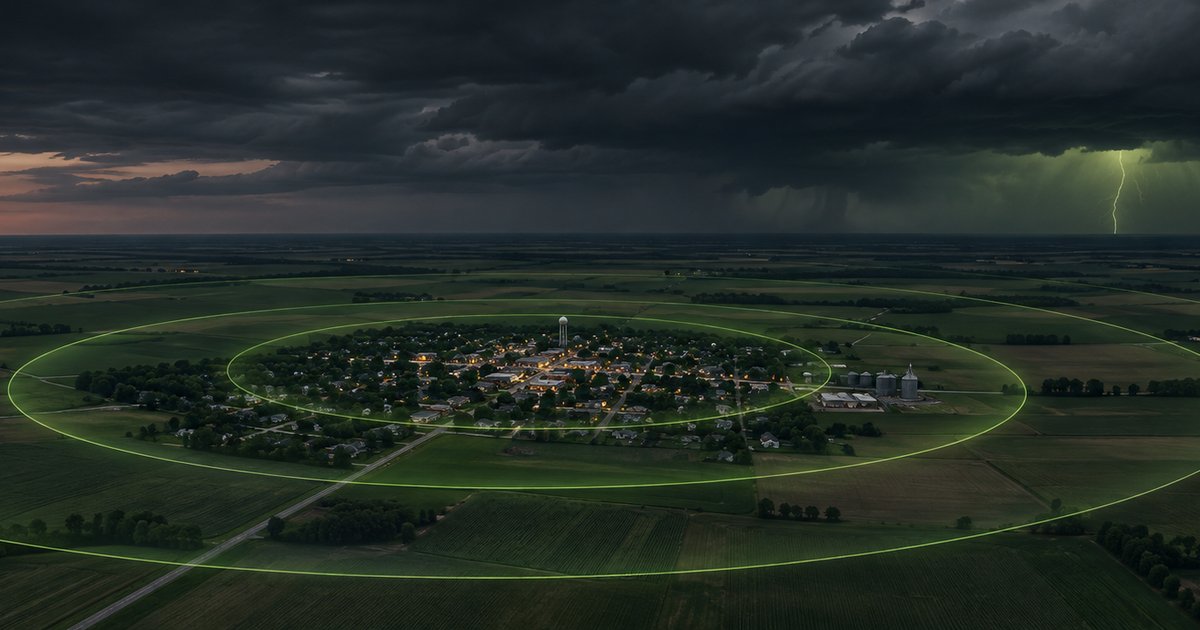
An alert radius is a decision made in advance: when lightning is detected this close, we move. Set it too small and the alert arrives with the storm already near. Set it too large and alerts fire for storms that never come close — until people start tuning them out.
What the distances say
A few numbers from the National Weather Service frame the choice:
- Thunder can usually be heard only about 10 miles from a flash.
- Lightning can strike more than three miles from the center of a storm, and “bolts from the blue” can strike 10 to 15 miles from it.
- Successive flashes can be far apart: the NWS cites data showing half are about 9 km (5.6 miles) apart, and guidance to stay at least 10–13 km (6–8 miles) from a previous flash.
That is the reasoning behind Lightning Tracker's default radius of 10 miles (16 km): roughly the range at which you would hear thunder, and beyond the typical gap between successive flashes. You can set any whole number from 1 to 50, in miles or kilometers.
How far from a storm can lightning strike?
Farther than the rain. The National Weather Service says lightning often strikes more than three miles from the center of a thunderstorm, and that “bolts from the blue”—strikes outside the rain or thunderstorm cloud—can strike 10 to 15 miles from it. Positive flashes, about 10 percent of all flashes according to the NWS, can come 5 to 10 miles or more ahead of the main part of a storm and its rain, and the NWS notes that many people are caught by surprise by them. A radius drawn around the rain you see on radar is therefore too small. Ten lightning myths covers why blue sky overhead proves little, and flash to bang shows how to judge the distance of a storm you can hear.
Then add the time your place needs
The distances describe where lightning can reach. Your radius also has to cover the time it takes your people to reach shelter once the alert comes in. The National Weather Service’s Melbourne office says event organizers choose how close lightning can get before warning alarms go off, based on storm motion and how long people need to reach shelter. Ask:
- How long does it take to clear the field, get a crew off a roof, or bring a boat back to the dock?
- Where is the nearest substantial building or hard-topped vehicle, and does everyone fit?
- Who makes the call, and how will everyone hear it?
Storms move at very different speeds and change direction, so no radius converts neatly into minutes. As plain arithmetic, a storm moving at 20 mph covers 10 miles in 30 minutes; at 40 mph, in 15. If getting everyone inside takes a quarter of an hour, a small radius leaves little margin. Treat the radius as your trigger to move, not as a forecast of when a storm arrives.
Starting points, not rules
- A ballfield with the clubhouse next door. Everyone can be inside in a couple of minutes, so the 10-mile default is a reasonable start.
- A roofing or construction crew. Climbing down, securing materials and reaching vehicles takes longer. Consider a larger radius.
- A boat or a harbor. Getting back to the dock across open water can take a long time. A larger radius buys it.
- A trail or a golf course. Distance to shelter changes as you move. Size the radius for the point farthest from cover.
If your league, employer or club has a lightning policy, follow it. Its radius and procedures come before any app default.
How the radius works in Lightning Tracker
- Each saved place has its own radius, in your units, shared by the alerts, the ring on the map and the return wait.
- You are alerted when lightning is detected inside the radius, and again as strikes get materially closer. An optional mode alerts on every strike inside it.
- The return wait starts after the last strike inside the radius — see why the wait is 30 minutes.
- Snooze and quiet hours are there when you need them, and alerts are kept in the alert log.
Whatever the radius, hearing thunder means it is time to go in.
Not a substitute for official weather warnings.
If you hear thunder, seek shelter even if the app shows no nearby strike.
Sources
- National Weather Service, Lightning Myths
- National Weather Service, Understanding Lightning: Thunder
- National Weather Service, Lightning Safety Overview
- National Weather Service, Understanding Lightning: Positive Flashes
- National Weather Service Melbourne, Lightning Safety