 Lightning Tracker
App Store
Using the app
Lightning radius calculator: account for time to shelter
November 19, 2026 · 5 min read
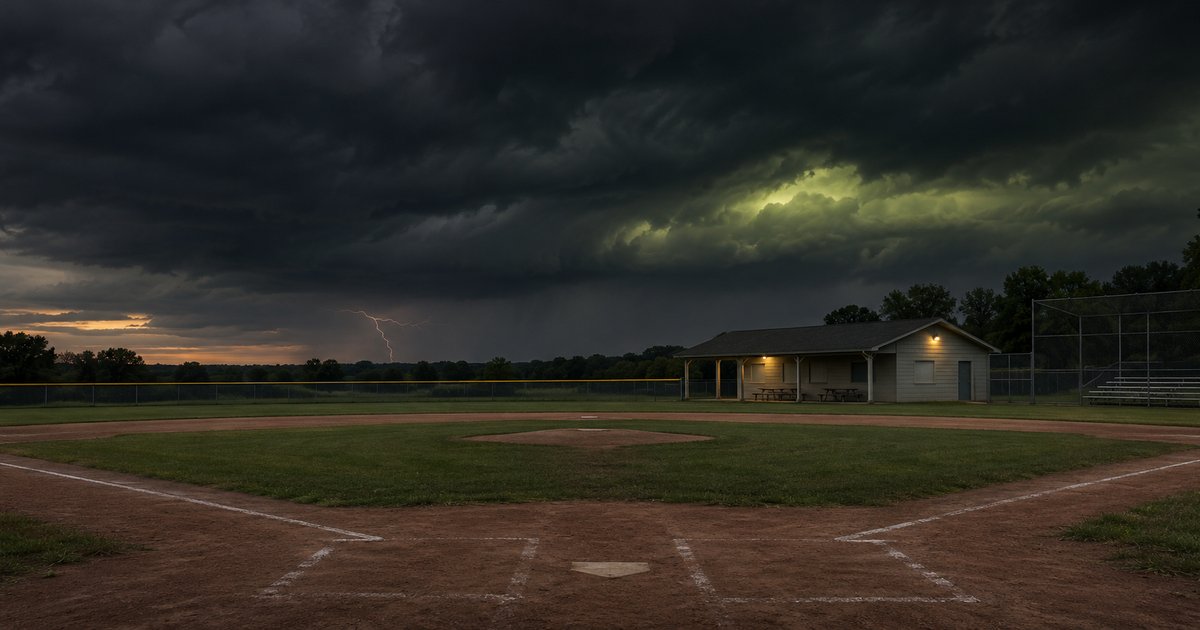
To get a lightning radius to plan with, start from 10 miles and add the distance a storm covers while your group gets inside (storm speed in mph × minutes ÷ 60); the worksheet below does the arithmetic. If your league, employer or venue has its own radius, use that one. The result is a planning radius, not a promise that an alert arrives in time.
Radius in miles = 10 + storm speed in mph × your minutes to shelter ÷ 60.
A larger radius gives more time and more alerts for storms that never come close; a smaller one gives fewer alerts and less time. If you hear thunder, go indoors whatever the radius.
The 10 miles in the formula is an allowance for lightning’s reach
The National Weather Service (NWS) says a significant lightning threat extends outward from the base of a thunderstorm cloud about 6 to 10 miles. The same page says thunder can usually be heard from about 10 miles away. The worksheet takes 10 miles as a fixed allowance. It is not an edge: the NWS also says “bolts from the blue” can strike 10-15 miles from the thunderstorm.
Minutes to shelter: the slowest person, the farthest point and the call
The NWS office in Melbourne, Florida, says a lightning action plan rests on two questions answered before storms threaten: how far the group is from an enclosed building or vehicle, and how long the trip takes. Our reading is to count three things. First, the slowest person, at the pace that person will really keep, going to a building that counts as shelter. Second, the farthest point of the site: a field, a lake and a trail each have their own, so each needs its own shelter and walk time. Third, the call itself. The NWS says the lightning monitor should not be the coach, umpire or referee, who will be busy, so the minutes between a detected strike and the monitor’s call belong in the count.
How much extra time to add for alerting everyone and delays
The National Weather Service Central Region’s Event Ready decision tool, which the NWS labels experimental, adds up three amounts: the time to notify everyone and start the plan, the time to get everyone sheltered, and a 25% safety factor on the sum of those two, for changes in storm speed and unexpected delays. It measures a storm’s distance from an 8-mile lightning safety radius, so its distances are not this worksheet’s. To borrow its margin, enter the total as your minutes. Our arithmetic: 5 minutes to notify plus a 15-minute walk is 20, a quarter of that is 5, and 25 minutes at 29 mph gives 10 + 29 × 25 ÷ 60 = 22.08, so 23 miles (37 km).
Choosing a storm speed: the sources give a spread, not one number
How fast thunderstorms move depends on which storms are counted, and no single value is published. A 2024 paper in Weather and Forecasting summarized an analysis of NWS severe thunderstorm and tornado warnings from October 2007 to May 2016: the national mean speed was about 25 knots (29 mph). Those are storms the NWS judged severe or tornadic. The same paper reports that the most common speed forecast in Storm Prediction Center watches from 2008 to 2020 was 35 knots (about 40 mph), and that for that speed a reasonable fastest value was 52 mph and the slowest 28 mph.
For a particular day, a severe thunderstorm or tornado warning ends with a storm speed in knots that forecasters estimate and typically update in each follow-up statement, according to that paper. The NWS Event Ready radar guide says to loop recent radar images and compare the first and last frames for a first guess of how far storms moved. With neither, try the figures above in the worksheet: 29, 40 and 52 mph. The choice among them is a judgment, and none is a typical speed for all storms.
Worked examples, with the arithmetic
These cases use the worksheet’s formula, 10 + speed × minutes ÷ 60, rounded up to a whole mile. The minutes are invented for illustration, the speeds come from the figures above, and the arithmetic is ours.
| Case | Minutes | Speed | Arithmetic | Radius |
|---|---|---|---|---|
| Field beside a clubhouse | 5 | 29 mph | 10 + 29 × 5 ÷ 60 = 12.4 | 13 miles (21 km) |
| Field with a longer walk | 15 | 29 mph | 10 + 29 × 15 ÷ 60 = 17.25 | 18 miles (29 km) |
| Same walk, fast storm | 15 | 52 mph | 10 + 52 × 15 ÷ 60 = 23 | 23 miles (37 km) |
| Far trail, fast storm | 60 | 52 mph | 10 + 52 × 60 ÷ 60 = 62 | 62 miles (100 km) |
Rows two and three show what speed does: the same 15 minutes need a radius 5 miles larger at 52 mph. The last row, 62 miles, passes the app’s maximum of 50, in miles or kilometers, so the worksheet says to move on the forecast or an official warning before strikes come close.
Why no radius converts neatly into minutes
The NWS glossary says the cells of a multicell storm move roughly with the mean wind, but the motion of the storm as a whole usually deviates significantly from it, because new cells develop along the gust front. The worksheet assumes one steady speed and a heading straight for your place; a storm that turns, speeds up or passes to one side can make the result too small or too large. It also assumes the alert arrives at once, yet detection networks miss some strikes and data can arrive late, so the real minutes can be fewer. Adding the delay you have seen in your own alerts to the minutes is a reasonable adjustment.
The tradeoff, and whose radius comes first
A larger radius starts the move sooner and sends more alerts for storms that never come close; a smaller one sends fewer alerts and leaves less time. The worksheet does not settle that, and no one threshold fits every group. Where a league, employer or venue has a written policy, its radius comes first. The NWS recommends that organizers have a lightning safety plan and follow it without exception, and the October 2024 guidelines of the National Federation of State High School Associations for lightning delays in youth and school sports say play shall be suspended when lightning is within a 10-mile radius of the event. Starting points by kind of place, such as a ballfield, a work crew or a harbor, are in how to choose an alert radius.
Entering the radius in Lightning Tracker
Lightning Tracker is an iPhone app that lets you set a radius for each place, from 1 to 50 in miles or kilometers, with 10 miles (16 km) as the default. It alerts when a strike is detected inside the radius and again as strikes get noticeably closer. Detection networks miss some strikes, data can arrive late, and iOS decides when a closed app checks for data. The app does not replace official warnings or local procedures. It is on the App Store.
Not a substitute for official weather warnings.
If you hear thunder, seek shelter even if the app shows no nearby strike.
Sources
- National Weather Service, Lightning Safety and Outdoor Sports Activities
- National Weather Service Melbourne, FL, Lightning Safety
- National Weather Service, Lightning Myths
- National Weather Service, Overview: Lightning Safety
- National Weather Service, Glossary: Cell
- Ash et al., Quantifying and Visualizing Severe Thunderstorm Motion Uncertainty for Improved Decision Support, Weather and Forecasting, December 2024
- National Weather Service Central Region, Event Ready: Evacuation/Sheltering Decision Tool
- National Weather Service, Event Ready, Appendix C: Basics of Weather Radar (PDF, undated)
- National Federation of State High School Associations, Guidelines on Handling Practices and Contests During Lightning or Thunder Disturbances (PDF, October 2024)