 Lightning Tracker
App Store
Places and activities
A lightning plan for summer camps
November 17, 2026 · 11 min read
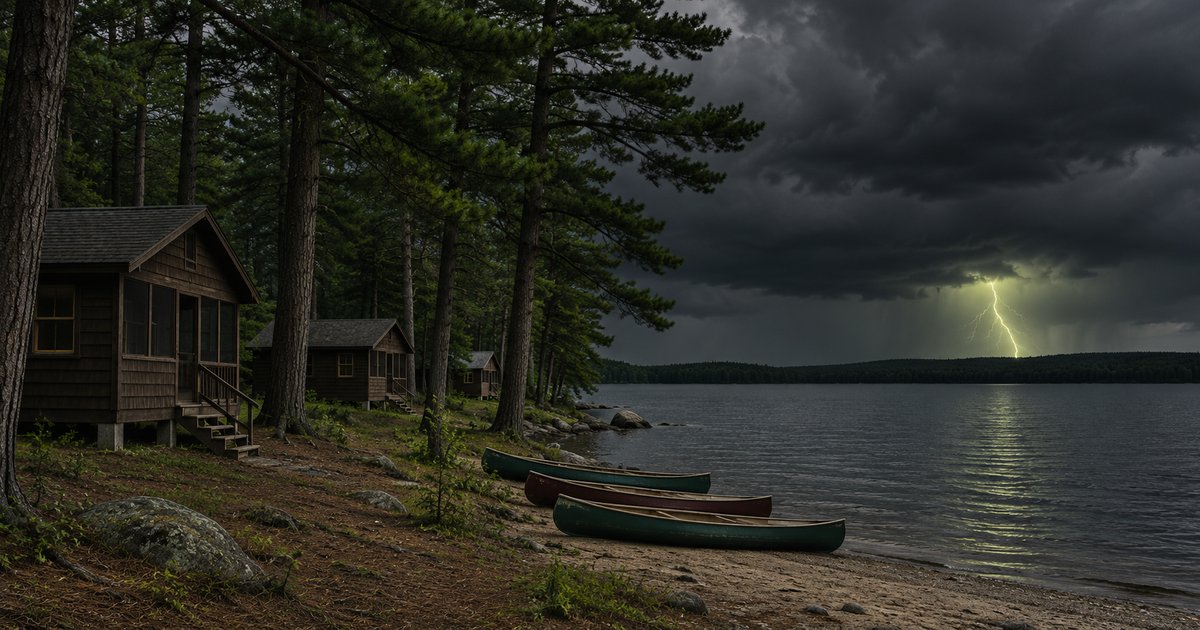
A summer camp lightning plan is a written procedure that names one person to watch the weather, stops every activity at the first thunder or lightning, gives each activity area a qualifying shelter and a known walk time, and keeps everyone inside until 30 minutes after the last thunder. The National Weather Service asks organizers of outdoor activities to have such a plan and follow it without exception. As of November 2026, the sources reviewed for this article set no single national lightning standard for camps, so trigger distances and state licensing rules are for each camp to confirm.
Why a camp is not a ball field
The National Weather Service guidance on lightning and outdoor sports offers a starting point for a camp policy. It asks organizers to have a lightning safety plan and follow it without exception, and to settle five questions in writing: when activities stop, where people go, when activities resume, who monitors the weather and makes the call, and what happens if someone is struck. It also asks organizers to check the forecast before an event and to consider canceling, postponing or moving indoors when thunderstorms are expected.
A camp has to answer those five questions for many places at once. On a single afternoon the same property can hold a field game, a swim at the lake, a hike and a cabin group in free time, each a different walk from a building that counts as shelter. That spread means a camp plan needs an answer for each activity area.
Responsibility does not move to the children. The National Weather Service’s lightning myths page says adults are responsible for the safety of children, and that many lightning casualties happen because people do not seek shelter soon enough. The National Lightning Safety Council’s analysis of U.S. lightning deaths from 2006 through 2024 found that in many camping deaths the victims were only steps from a vehicle that could have protected them; Who gets struck by lightning? has the wider picture.
Who watches the sky, and who can stop the activity
The National Weather Service says a lightning safety plan should name someone to monitor the weather for lightning, and that this monitor should not be the coach, umpire or referee, because those people are busy and cannot watch conditions adequately. The monitor has to know the plan and be empowered to make sure it is followed.
The Cybersecurity and Infrastructure Security Agency (CISA) guide for sports and special events, published in May 2026, splits the job in two. A Weather Safety Official watches conditions and gives the decision-maker as much lead time as possible; an Authorized Decision-Maker decides when and how the plan starts, including delays, cancellations and shelter or evacuation orders. At small events the guide allows one person to hold both roles. The guide was written for venues and events, not camps, so it is a model to borrow from rather than a camp rule.
For a camp, the same reasoning points away from the person leading an activity, such as the counselor teaching archery or the lifeguard on the dock, and toward someone who is free to watch the weather and tell every area to move. The National Federation of State High School Associations (NFHS), writing in April 2018 about school sports, says the person who decides to suspend activity should have “unchallengeable authority to suspend the activity.” In camp terms, a counselor told to move a group should not have to wait for a second opinion, and nobody should be able to talk the group back outside early.
Give every activity area a shelter and a walk time
CISA’s guide tells organizers to identify places of shelter before an event and to understand how long it will take to get people to them. The National Weather Service defines what qualifies: buildings with electricity and plumbing, or metal-topped vehicles with the windows closed. Picnic shelters, dugouts and small buildings without plumbing or electricity do not qualify. The sources reviewed for this article do not address rustic cabins, open-sided lodges or boathouses by name; the NWS sports page invites organizers to contact their nearest National Weather Service office for local lightning safety information, which is the place to ask.
| Area | What the sources say | Decide before the season |
|---|---|---|
| Fields, courts and ranges | The National Weather Service says dugouts, rain shelters and sheds do not protect people, and that substantial buildings with wiring and plumbing give the greatest protection. | Which building each group runs to, and how long the slowest group needs to get there. |
| Waterfront | The National Weather Service lists getting out and away from ponds, lakes and other bodies of water among its tips for people caught outside. For boats, it says to stay off the water when thunderstorms are forecast. | How long it takes to clear the water and reach shelter, and one signal that means “out now.” |
| Trails and day hikes | The National Weather Service says mountain thunderstorms typically develop in the early afternoon, so the advice is to hike early in the day and be down the mountain by noon. An NWS-hosted backcountry sheet by John Gookin says to set turnaround times and to begin turning back at the first thunder. | A turnaround time set before the group leaves, and the building or vehicle each route returns to. |
| Overnight sites | The National Weather Service says a tent offers no protection from lightning. | A qualifying building or hard-topped vehicle for every sleeper, and who moves the group. |
| Cabins and lodges | Buildings with electricity and plumbing count as shelter; small buildings without plumbing or electricity do not. | Which buildings on the property qualify, and which do not. |
| Camp vehicles | The National Weather Service says the outer metal shell of a hard-topped vehicle protects people inside when the windows are closed. | Where vehicles are during each activity, and whether the whole group fits. |
The backcountry sheet also draws a line that matters for camp hikes. It calls an outdoor setting within a 30-minute walk of modern buildings or vehicles “frontcountry” and says that is where most lightning injuries occur, because that is where people spend more time outdoors. A day hike from camp often sits inside that definition. For where to go once a group is inside, Where to shelter from lightning covers the details.
If a group is caught with no qualifying shelter within reach, the National Weather Service says the tips for that situation only slightly lessen the threat. One of them is to spread out so that current does not travel between members of a group. It is a last resort, not a plan.
Pick a trigger distance, and know why the sources differ
A trigger distance is the distance at which the plan starts moving people, and the sources reviewed for this article give different numbers for it. The comparison below lists each source, its date and what it applies to.
| Source | Date | Distance it gives |
|---|---|---|
| National Weather Service, outdoor sports guidance | Undated page | A significant threat extends about 6 to 10 miles from the base of a thunderstorm cloud; thunder can usually be heard to about 10 miles. |
| NFHS, school sports | April 2018 | Everyone in a designated shelter area when thunder is heard or lightning is reported within 6 miles. Since revised. |
| NFHS, school sports | October 2024 | Play suspended when thunder is heard or lightning is seen, and when detection data show lightning within a 10-mile radius. |
| American Camp Association page (National Weather Service text) | Posted 2015; first published winter 2006 | The whole group already in shelter when the storm reaches 5 miles; groups should start leaving sooner. |
| CISA guide, citing NOAA | May 2026 | Staged triggers at 15, 12 and 8 miles, with 8 miles as the minimum; venues may change them. |
The numbers do not agree, and none of the sources sets a distance for camps. The CISA guide attributes the staged triggers to NOAA, the National Oceanic and Atmospheric Administration, and explains the 8-mile floor: it says most lightning occurs within 8 miles of a thunderstorm, that 20 percent of strikes land beyond that, and that bolts from the blue are possible. It also says the distances can change with the venue and with the time an evacuation needs. For an organized storm system it says a lead time of 30 minutes or more should be considered for an evacuation.
The practical reading is that the walk, not the map, sets the distance. A camp whose slowest group needs 20 minutes to reach a qualifying building needs a trigger that buys at least that, plus margin. How to choose an alert radius shows the arithmetic. Where a camp has no detection at all, the fallback is the ear: the National Weather Service says thunder can usually be heard to about 10 miles, so hearing it means the storm is likely within that range. CISA calls the 30/30 counting rule a last resort, because it can lead to delayed responses and misheard thunder; Flash to bang explains what counting seconds can and cannot tell you.
Practice the move: headcount, signal and drills
Moving a whole camp is a logistics problem as much as a weather one. The National Weather Service says a large group needs extra time to get everyone to shelter, and recommends professional lightning detection equipment that alerts the group when lightning nears the site. CISA’s plan checklist adds a communication plan for rapidly alerting people, with pre-scripted instructions, and training for the staff who carry the plan out.
One state agency shows what that looks like for camps. The Maryland Department of Health’s youth camp emergency safety plan guidance, dated December 2025, asks each camp to describe how it monitors severe weather, how it provides shelter for campers and staff, how it takes attendance quickly at the start of, during and after an emergency, and what drills it runs early in each session. It also requires staff and volunteers to be trained on the plan no more than 30 days before camp. That guidance covers severe weather in general rather than lightning alone, and it is one state’s document; requirements differ from state to state, so a camp should ask its own licensing agency what applies.
For a camp lightning drill, give each counselor a roster for the group in that counselor’s care, a named shelter destination, and a way to report the group’s count to the camp’s decision-maker. The Maryland Department of Health’s December 2025 youth-camp guidance asks Maryland camps to describe attendance checks at the beginning, during and after an emergency, how to find a missing camper, and drills early in each session. A practice move should therefore include a count at the activity area, another at shelter, and a missing-camper report through the plan’s communication channel; these are a practical way to carry out that state guidance, not a nationwide camp rule.
Before opening for summer 2027, a director can use that Maryland document as a planning check: put the emergency plan where staff can reach it, train staff and volunteers, document their training, assign shelters and evacuation routes, and schedule the first drill. The National Weather Service’s outdoor-activity guidance adds a forecast check before the activity and a named weather monitor with authority to enforce the lightning plan. Confirm the 2027 licensing requirements with the camp’s own state agency before treating the Maryland training schedule as binding elsewhere.
Resuming the day
The National Weather Service says experts agree people should wait at least 30 minutes after the last thunder before resuming outdoor activities, because electrical charges can linger in clouds after a storm seems to have passed. Each new rumble restarts the count, as Why wait 30 minutes after the last strike? explains. CISA adds an alternative for venues that consult a professional meteorologist using real-time lightning data: resuming is possible once criteria are met that include lightning having moved beyond 8 miles and the storm’s motion taking it away. A camp without a meteorologist or a detection service has the 30-minute wait to rely on.
Phone apps are not a shortcut. The NFHS guidance of April 2018 says apps may lack accuracy about where a strike landed, may show it several minutes late, and should not replace the 30-minute guideline. A camp that writes a rainy-day schedule in advance, with indoor programs ready for a long wait, can ease the pressure to cut the wait short.
If a camper or staff member is struck
The National Weather Service says most people struck by lightning survive but need immediate medical attention: call 911, remember that victims do not carry an electrical charge, and know that CPR or an automated external defibrillator (AED) may be needed. If possible, move the person inside, away from the threat of another strike. A camp plan should say where the nearest AED is and who calls, so nobody works that out during a storm; If someone is struck by lightning has the first-minute steps.
Where Lightning Tracker fits in a camp plan
Lightning Tracker is an iPhone app that shows recently detected strikes on a live map, with the distance and direction to the nearest one and how many minutes ago it landed. The camp’s weather monitor can use it as one input. It alerts when a strike is detected inside a radius you set for each place, 10 miles (16 km) by default, so the waterfront and the far trailhead can be saved as separate places with radii that match their walk times. Its return wait starts after the last detected strike inside the radius and restarts with each new one; when it ends, the app reports what it observed and asks you to judge conditions yourself rather than announcing that the storm is over.
The limits matter in a camp setting. Detection networks miss some strikes, especially weak ones, and data can arrive late; the app labels a delay or a gap instead of treating it as quiet. iOS decides when the app may check for data in the background, so a closed app may show the latest strikes only when it is opened. Alerts are local notifications, and iOS settings such as Focus, Background App Refresh and Low Power Mode affect delivery; Five iPhone settings that decide when a storm alert arrives lists them. The app does not replace official warnings or a camp’s own procedures.
Not a substitute for official weather warnings.
If you hear thunder, seek shelter even if the app shows no nearby strike.
Sources
- NFHS Sports Medicine Advisory Committee, Guidelines on Handling Practices and Contests During Lightning or Thunder Disturbances (October 2024)
- National Weather Service, Lightning Safety and Outdoor Sports Activities
- National Weather Service, Lightning Safety: Outdoor Activities, Camping and Boating
- National Weather Service, Lightning Indoors
- National Weather Service, Lightning and Cars
- National Weather Service, Lightning Tips
- National Weather Service, Lightning Myths
- National Weather Service, J. Gookin, Lightning Risk Management for Backcountry Campers and Hikers (PDF, version of March 2012)
- Cybersecurity and Infrastructure Security Agency, Lightning Safety Guide for Sports and Special Events (PDF, May 2026)
- National Federation of State High School Associations, Guidelines for Developing Lightning Safety Policies (April 9, 2018)
- American Camp Association, Lightning Safety Outdoors (CampLine; National Weather Service text first published winter 2006)
- Maryland Department of Health, Youth Camps: Emergency Safety Plan Guidance (PDF, December 2025)
- National Lightning Safety Council, J. Jensenius, A Detailed Analysis of Lightning Deaths in the United States from 2006 through 2024 (PDF, January 2025)