 Lightning Tracker
App Store
Places and activities
Lightning at pools and water parks: when to clear the water and when to reopen
November 16, 2026 · 9 min read
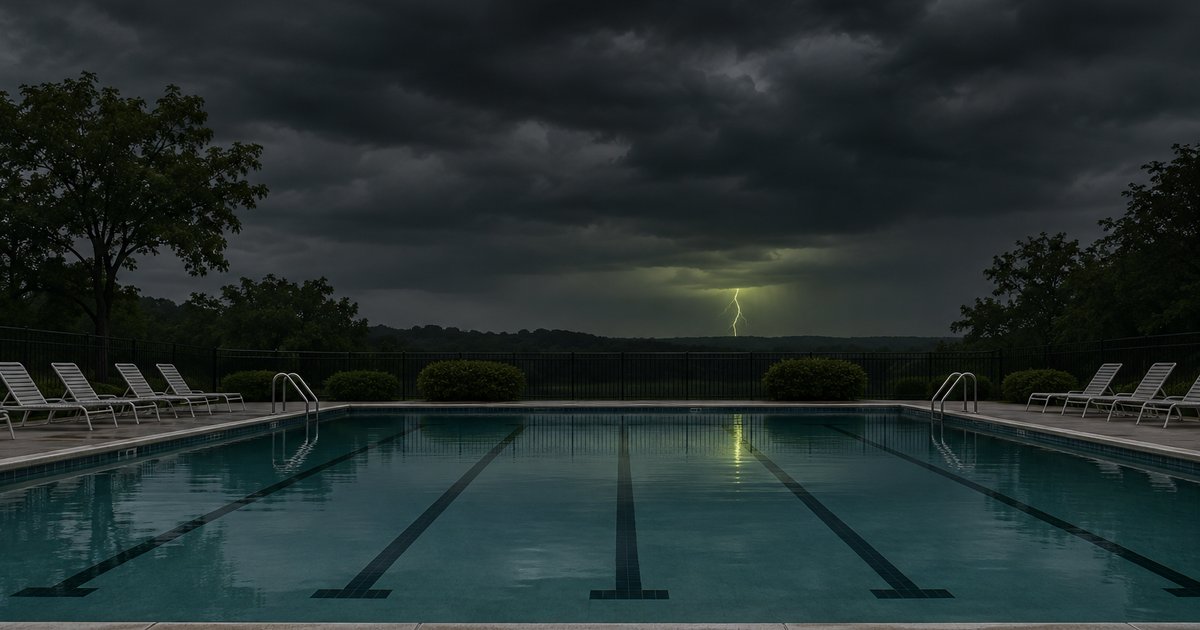
Everyone leaves the water at the first thunder, and nobody goes back in until 30 minutes after the last thunder or lightning: that is the National Weather Service (NWS) rule, and it covers outdoor pools and water parks alike. What differs from one operator to the next is the trigger, which can be any thunder, a distance such as 10 miles, or a flash-to-bang count. Indoor pools are the contested case: the Red Cross's own advisory council found in 2010 that no research settled whether they must close, and the sources we read since then still disagree.
Outdoor pools: out of the water at the first thunder
The NWS forecast office in Melbourne, Florida, tells people to get out of the water and spells out that this includes pools, lakes, rivers, oceans and water rides. The same page gives the core rule, "When thunder roars, go indoors," and says to stay in for 30 minutes after the last clap. It also warns that lightning often strikes outside the rain area, as much as 10 miles away, so a dry sky over the deck says little about the storm.
Operators mostly follow. In a survey of aquatics facilities reported in Aquatics International in September 2019, 98 percent of the outdoor pools closed during thunderstorms, though the timing, the length of the closure and the instructions given to swimmers varied.
Staff and guests need somewhere to go. The NWS names a substantial building with electricity or plumbing, or an enclosed metal-topped vehicle with the windows up. The Melbourne office adds that carports, open garages, covered patios and pavilions are not adequate shelter. Our reading is that a shaded pool deck, a cabana or a picnic pavilion falls into that group; where to shelter from lightning explains why a roof is not enough.
Swimming appears in the death statistics, but pools do not appear separately. In the National Lightning Safety Council (NLSC) analysis of U.S. lightning deaths from 2006 through 2024, about 8 percent of the water-related victims had been swimming. The text we read does not say how many of those were in pools rather than lakes or the sea, so it gives no pool-specific count.
Why the closing trigger differs from pool to pool
Aquatics International columnist Shawn DeRosa reviewed the positions of national groups in 2019. He found agreement that people should not swim outdoors during a thunderstorm, but no standard message about when exactly to close the pool. The table sets out what the sources we read say, as of November 2026.
| Source | Applies to | Close when | Reopen |
|---|---|---|---|
| NWS, Melbourne, Florida office | Everyone outdoors; not written for pools | Thunder is heard | 30 minutes after the last clap of thunder |
| National Lightning Safety Institute (NLSI), pool procedures | Indoor and outdoor pools | Flash-to-bang count of 30 seconds, about 6 miles; in a follow-up statement its president said at the first signs of thunder or lightning | 30 minutes after the last thunder |
| American Red Cross advisory council, May 2010 | Indoor and outdoor pools | Flash-to-bang count of 30 seconds or less | 30 minutes after the last lightning or thunder |
| YMCA of Greater San Antonio | Outdoor pools | Lightning within 10 miles | 30 minutes after the last lightning or thunder |
| YMCA of Greater San Antonio | Indoor pools | A strike within 3 miles | 30 minutes after the last lightning within 3 miles |
| City of Portsmouth, New Hampshire, indoor pool, July 2023 | Indoor pool | Lightning within 10 miles | 30 minutes after the last thunder or lightning |
| Washington, D.C. Parks and Recreation, reported August 2015 | Indoor pools | A confirmed strike within 5 miles | Not given in the article we read |
| Fairfax County Park Authority, The Water Mine | Water park | Audible thunder and visible lightning | Its FAQ gives 30 minutes after the last thunder or lightning as an example |
No national mile cutoff in the NWS outdoor sports guidance governs every pool. The NWS asks an activity organizer to write a plan that says when to stop, where people go, when to resume and who makes the call; it lists seeing lightning, hearing thunder and threatening skies as possible stop signals. The 3-, 5- and 10-mile distances in the table are policies of the named facilities or operators, not a single NWS rule.
The spread comes from what each trigger measures. A thunder rule needs no counting: the NWS says thunder can usually be heard about 10 miles away when there is no background noise, and a significant lightning threat extends 6 to 10 miles from the base of a storm cloud. A flash-to-bang count of 30 seconds, at five seconds per mile, puts the storm about 6 miles away, which is inside the range the NWS describes. A distance trigger such as the YMCA's 3 miles for indoor pools is tighter still. The sources do not explain why each organization chose its number. Whatever the reason, the policy posted at your pool is the one its staff will enforce, and flash to bang shows how the count works and what it can tell you.
Distance only matters next to the time it takes to get everyone out. The NWS tells organizers of outdoor activities to account for the time it takes for everyone to reach shelter, and how to choose an alert radius applies the same idea to a radius.
Indoor pools: what is known and what is argued
The American Red Cross Advisory Council on First Aid, Aquatics, Safety, and Prevention published a scientific review of this question in May 2010. It found no studies behind several agency policies beyond logic and risk management, and said that the lack of research makes the question difficult to impossible to resolve. Its literature search turned up 4 references on lightning and swimming pools and none on lightning and indoor swimming pools.
The council still recommended the conservative option: remove bathers from all aquatic facilities, indoors or out, during thunderstorms until research says otherwise. It tied that to the 30-30 rule, which means taking cover when the flash-to-bang gap is 30 seconds or less and staying under cover until 30 minutes after the last lightning or thunder, while avoiding plumbing and electrical circuits. The review sets out the case for closing indoor pools as the fact that a pool is a large body of water connected to plumbing and electrical equipment, and it notes that the general advice to avoid water indoors rests mainly on anecdotal reports of injuries to people in bathtubs or touching plumbing. We did not find a newer Red Cross statement on pools in the sources we read, so this is the council's position as of 2010.
The Indiana Department of Health gives a concrete example of the conservative position: its swimming-pool FAQ advises against using indoor pools during a thunderstorm because a strike to the complex could travel through water, plumbing and wiring. It notes that it knows of no recorded deaths from swimming indoors during a lightning storm. That is Indiana’s published guidance, while the facility policies in the table show that operators choose different closing distances.
The other side argues from absence. The review itself notes that opponents of closing indoor pools point out that no deaths have been reported in indoor swimming pools. In 2015 Aquatics International reported the argument of Tom Griffiths, founder and president of the Aquatic Safety Research Group, that there are no known lightning hits in indoor pools. In July 2025 Undark reported that, as far as Griffiths could tell, nobody had died or been hospitalized from lightning while swimming in an indoor pool. A lack of reports is not a measurement, and the Red Cross review describes the evidence behind the recommendations as logical conjecture and expert opinion, so neither side has data.
Both sides name the same hazard around the edges of the pool. The NWS says lightning that gets into a building can travel through the electrical, phone, plumbing and radio and television systems, and tells people indoors to avoid plumbing: no hand-washing, showers or dishes. Aquatics International reported Griffiths's argument in 2015 that people who leave an indoor pool tend to do riskier things, and noted that showering, washing hands in a sink and using a landline have all been documented as scenarios in which someone was injured by lightning. The Red Cross review likewise asks patrons to wait in an area free from water, plumbing or electrical circuits. The NWS general indoor guidance we read does not mention swimming pools by name. Our reading is that clearing a pool and then sending swimmers to the locker-room showers works against the point of clearing it.
Water parks: crowds, queues and a longer walk
A water park puts the same decision on a larger scale. The NWS lists water rides among the places to leave, and the Fairfax County Park Authority's Water Mine says guests are cleared from the facility in storms with audible thunder and visible lightning, and that it stays closed until conditions allow reopening.
The workers are exposed too. The OSHA and NOAA fact sheet on lightning safety for outdoor work lists pool and beach lifeguarding among the activities at higher risk, and asks employers to allow time to evacuate customers and members of the public as well as time for workers to reach shelter. The NLSC's list of work-related deaths from 2006 through 2024 includes lifeguarding among its "other" occupations. A lightning plan for outdoor work covers what OSHA expects such a plan to say.
Reopening: the 30 minutes restart with every rumble
The NWS says that electrical charges can linger in clouds after a storm has seemingly passed, so experts agree on waiting at least 30 minutes after the last thunder before resuming outdoor activities. Every policy in the table that gives a return time uses 30 minutes from the last thunder or lightning. Why the wait restarts with every strike explains why a pool that reopens at 30 minutes sharp after the first rumble is not following the rule.
Who watches the sky matters as much as the number. The NWS says a lightning safety plan should name a monitor, and for sports it adds that this person should not be the coach, umpire or referee, because they are busy. The NLSI's pool procedures likewise ask for a responsible person as the weather lookout. Our reading is that the same logic applies to lifeguards, whose job is to watch swimmers, so the lookout is best someone with no swimmer to watch.
What swimmers and parents can do
- Leave at the first signal. A whistle, an announcement or your own first thunder is enough; the NWS wait is 30 minutes after the last thunder.
- Skip the shaded spots. A pavilion or covered patio is not adequate shelter, according to the NWS. Go to a building or a hard-topped car.
- Hold off on the shower. The NWS advice to avoid plumbing includes sinks, baths and faucets. A rinse-off shower in the locker room waits.
- Don't judge by the sky. Lightning can strike up to 10 miles from the rain, so blue sky over the pool is not an all-clear.
- Mind the noise. The NWS says traffic, wind and precipitation can limit hearing thunder to less than 10 miles. Our reading is that splashing, slides and music do the same on a pool deck, so staff signals and a detection source help.
Using a lightning map at the pool
Lightning Tracker is an iPhone app that shows recently detected strikes on a live map, with the distance and direction to the nearest one and how many minutes ago it was detected. A pool you manage, or one where your children swim, can be saved as a place. The app alerts you when a strike is detected inside the radius you set for that place, with a default of 10 miles (16 km). After the last detected strike inside the radius it starts a 30-minute return wait, which restarts with each new strike. When the wait ends it reports what it observed and asks you to judge conditions yourself rather than announcing that the storm is over. Parents can teach the thunder rule before a swim day; teaching kids about lightning gives the wording and the adult’s role.
The alert is one more warning sign, not the pool's rule. The operator's policy decides when the water is cleared, and the app does not replace official warnings or local procedures. Detection networks miss some strikes, especially weak ones, and data can arrive late; the app marks late or missing data instead of treating it as quiet.
Not a substitute for official weather warnings.
If you hear thunder, seek shelter even if the app shows no nearby strike.
Sources
- National Weather Service, Melbourne, FL, Lightning Rules
- National Weather Service, Lightning Safety and Outdoor Sports Activities
- National Weather Service, Lightning Tips
- National Weather Service, Lightning Safety Indoors
- Indiana Department of Health, Swimming Pools: Frequently Asked Questions
- American Red Cross Advisory Council on First Aid, Aquatics, Safety, and Prevention, ACFASP Scientific Report: Lightning Safety for Indoor Swimming Pools (International Journal of Aquatic Research and Education, May 2010, PDF)
- National Lightning Safety Institute, Section 4.7, Indoor/Outdoor Swimming Pool Safety (PDF copy on a city website)
- Aquatics International, S. DeRosa, A Bolt and a Clap: Part 2 of the Survey on Lightning and Aquatics Facilities (September 4, 2019), trade press
- Aquatics International, E. Ansley, 5 Reasons Lightning Shouldn't Close Your Indoor Pool (August 4, 2015), trade press
- Undark, S. Talpos, Do Indoor Pools Really Need to Close for Lightning? (July 15, 2025), magazine
- YMCA of Greater San Antonio, Lightning and pool policy (undated page)
- City of Portsmouth, New Hampshire, Indoor Pool Thunderstorm Policy (July 12, 2023, PDF)
- Fairfax County Park Authority, The Water Mine Procedures and FAQs
- OSHA and NOAA, Fact Sheet: Lightning Safety When Working Outdoors (PDF)
- National Lightning Safety Council, J. Jensenius, A Detailed Analysis of Lightning Deaths in the United States from 2006 through 2024 (PDF, January 2025)