 Lightning Tracker
App Store
Places and activities
Gold Coast storms: season, lightning and beach closures
November 18, 2026 · 7 min read
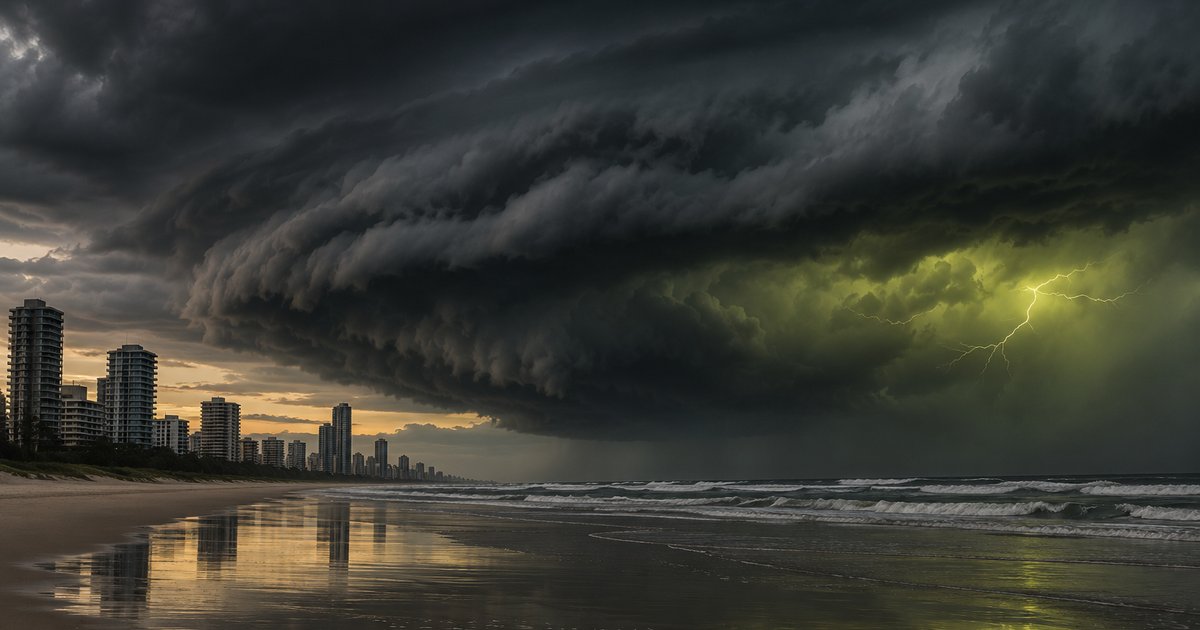
Gold Coast storms are most common in spring and summer, according to the City of Gold Coast, and the Bureau of Meteorology (BOM) said on October 14, 2026, that October to December brings the highest severe-thunderstorm risk on Australia’s east coast, including southern Queensland. The City sends people to BOM’s Queensland warnings and its own Disaster and Emergency Dashboard. On a patrolled beach, Surf Life Saving Queensland’s lightning procedure closes the beach when the flash-to-bang count is 30 seconds and reopens it 30 minutes after the last sighting of lightning.
When is Gold Coast storm season?
The City of Gold Coast says the Gold Coast can have severe weather at any time of year, although storms are most common in spring and summer. The sources date the season differently, and they describe different hazards: BOM’s national figure is for severe thunderstorms, its Queensland dates cover storms, cyclones and floods, and the City’s wet season covers severe weather and flash floods.
| Period | What the source says | Source |
|---|---|---|
| Spring and summer | Storms are most common on the Gold Coast | City of Gold Coast |
| October to March | The Gold Coast’s wet season, when severe weather and flash floods are a particular danger | City of Gold Coast |
| September to March | When most severe thunderstorms in Australia happen | BOM |
| October to April | Queensland’s severe weather season, with a heightened risk of storms, cyclones and floods | BOM, October 14, 2026 |
| October to December | The highest risk of severe thunderstorms on Australia’s east coast, including southern Queensland | BOM, October 14, 2026 |
BOM’s thunder-day map, built from observations over 1990–1999, shows a secondary maximum in southeast Queensland. For the time of day, BOM lists a sea breeze moving inland and the heating of the day among the ways air is lifted into a thunderstorm, and says single-cell storms are most likely on summer afternoons and usually last no more than an hour. On November 24, 2025, local station Hot Tomato reported a BOM severe thunderstorm warning for the Gold Coast after storms were detected near Border Ranges National Park, Murwillumbah and Mudgeeraba around 1:30 pm. Hailstones as big as 9 cm fell at Coombabah and Mount Tamborine, and the storms hit just before school pickup. One day is not a pattern.
Where do Gold Coast storm warnings come from?
BOM issues Severe Weather and Severe Thunderstorm warnings when dangerous weather is occurring or expected, and the City says lead times range from one hour to 36 hours depending on the weather system. The City may also issue warnings in the Australian Warning System’s three levels: Advice (yellow), Watch and Act (orange) and Emergency Warning (red). It adds that people may not always receive an official warning, and lists heavy clouds, darkening skies, increasing winds, thunder, lightning and heavy rain as signs to look out for.
The City’s Disaster and Emergency Dashboard gives information and warnings before, during and after an event; the City says it includes road closures, power outages and weather warnings, and that people can subscribe there to alerts about severe weather events. Residents can also sign up to Gold Coast Alerts for local updates by phone and email. Where an emergency warning is issued, Emergency Alert may send text messages to mobile phones or voice messages to landlines in areas at risk.
| Open | What the publisher says it offers |
|---|---|
| BOM Queensland Warnings | Current weather warnings, which the City tells people to view |
| City Disaster and Emergency Dashboard | Local information and warnings, road closures, power outages and severe weather alert subscriptions |
| City alerts | Water and sewerage outages, local road closures, beach closures and recreational water quality alerts |
| BOM Thunderstorm Tracker pilot | Radar-based thunderstorm positions in Southeast Queensland and their expected positions 10, 20 and 30 minutes ahead; not a warning |
| BOM rain radar | Rain radar for Queensland sites, including Brisbane (Mt Stapylton), which BOM places just east of Beenleigh |
| Energex Lightning Tracker | Cloud-to-ground and cloud-to-cloud events, fading from white (current) to red (30 minutes) to blue (60 minutes) |
Which tracker shows lightning near the Gold Coast?
Energex’s Lightning Tracker is the lightning-detection product in that list. Energex says its network runs from the New South Wales border north to Gympie, which takes in the Gold Coast and Brisbane. The tracker shows crosses for cloud-to-ground events and squares for cloud-to-cloud events. Weatherzone supplies the data, and Energex warns that the information may be slightly delayed. Energex describes the tracker as showing storm activity during severe weather and its potential effect on restoring power, and says lightning can delay restoration because its crews cannot work on elevated platforms during lightning activity. In emergencies it points people to BOM’s warnings page. Energex is one of several lightning trackers in Australia.
BOM’s Thunderstorm Tracker is a different kind of product. It is an automated pilot that looks for areas of intense rainfall in the last two to three radar scans and draws ovals around them, and BOM says it is not a warning. BOM’s radar images display the reflectivity of water droplets and ice crystals, while Energex’s display marks lightning events, so a rain radar and a lightning map answer different questions.
A warning is not a lightning count either. BOM issues a severe thunderstorm warning when it expects hail of 2 cm or more, wind gusts of 90 km/h or more, tornadoes or very heavy rainfall conducive to flash flooding, and says most thunderstorms do not reach that intensity. Its tracker page adds that all thunderstorms generally produce lightning, so lightning can occur in a storm that never meets BOM’s warning thresholds.
What happens on a patrolled beach when lightning is near?
The City of Gold Coast says 28 beaches are patrolled year-round by professional lifeguards and 14 more during peak seasons and school holidays, and it tells swimmers to listen to and obey lifeguards’ instructions. Surf Life Saving Queensland (SLSQ) publishes the steps its patrols follow for lightning at the beach in Lightning Procedure LSP 001, version 3, effective July 17, 2024. The procedure applies to SLSQ members, clubs, lifeguards and staff, so the table gives SLSQ’s steps, not a City of Gold Coast rule.
| Step | What SLSQ’s procedure says |
|---|---|
| Close the beach | When the flash-to-bang count is 30 seconds, which the procedure equates with lightning 10 km away and a significant risk that a strike could reach the patrol area |
| Clear the water and sand | All persons should be advised to leave the water and clear the beach immediately |
| Flags and patrol | The Patrol Captain removes the patrol flags and closes the beach; the patrol retires to the clubhouse and keeps a lookout from there |
| Shelter | A hard-top vehicle or building; avoid small structures, patrol shelters, fabric tents and isolated or small groups of trees |
| Reopen | When 30 minutes have passed since the last sighting of lightning; SLSQ says a typical storm travels at about 40 km/h, so the wait puts it about 20 km away |
| Carnivals and events | Delay the event until the danger has passed, or cancel or postpone it |
How do you find out whether a Gold Coast beach is closed?
The City tells swimmers to swim at a patrolled beach between the red and yellow flags, and says no flags means no swim. Its closed-beach sign reads “Beach closed. Dangerous conditions.” and adds never to swim when the beach is closed. The sign names dangerous conditions in general, not lightning in particular. To see whether a beach is closed, the City points to its City alerts page and its Facebook page, and its Broadbeach page notes that a patrol may be closed because of dangerous swimming conditions, unsafe beach conditions or beach maintenance works. The City’s eight swimming enclosures are not patrolled by lifeguards, and its waterways page says not to enter waterways during storms, heavy rain or floods.
Are Gold Coast pools closed for lightning?
City of Gold Coast aquatic centres publish a rule for outdoor pools in their conditions of entry: at the first sight of thunder or lightning, outdoor pools are vacated, and they stay closed until at least 30 minutes after the last sign of thunder or lightning.
Who do you call after a Gold Coast storm?
The City says to call Triple Zero (000) in a life-threatening emergency and the State Emergency Service (SES) on 132 500 for non-life-threatening emergency assistance. The City itself is on 1300 465 326. For fallen power lines or electric shocks, Energex lists 000 or 13 19 62, and 13 62 62 for a power outage. After severe weather, the City says to watch for fallen power lines, damaged trees and debris, and to avoid damaged buildings and flooded areas.
Lightning Tracker is an iPhone app that works on the Gold Coast and elsewhere. It shows recent detected lightning with the distance and direction to the nearest strike and how many minutes ago it was, and it does not replace official warnings or local procedures.
Not a substitute for official weather warnings.
If you hear thunder, seek shelter even if the app shows no nearby strike.
Sources
- City of Gold Coast, Get ready – Severe weather
- City of Gold Coast, During a disaster
- City of Gold Coast, City alerts
- City of Gold Coast, Beach safety
- City of Gold Coast, Waterways safety
- City of Gold Coast, Stormwater and floodwater safety
- City of Gold Coast, Broadbeach
- City of Gold Coast, Aquatic centres – Conditions of entry
- Bureau of Meteorology, Now is the time to Get Ready Queensland
- Bureau of Meteorology, Thunderstorms
- Bureau of Meteorology, Average annual thunder-day and lightning flash density
- Bureau of Meteorology, Thunderstorm Tracker – Southeast Queensland Pilot
- Bureau of Meteorology, About Thunderstorm Tracker
- Bureau of Meteorology, Queensland radar information
- Energex, Lightning tracker
- Energex, About our network
- Surf Life Saving Queensland, Lightning Procedure
- Hot Tomato, STORM WARNING: Severe thunderstorms lash the Gold Coast