 Lightning Tracker
App Store
Places and activities
Brisbane thunderstorms and lightning: season, trackers and official checks
November 14, 2026 · 4 min read
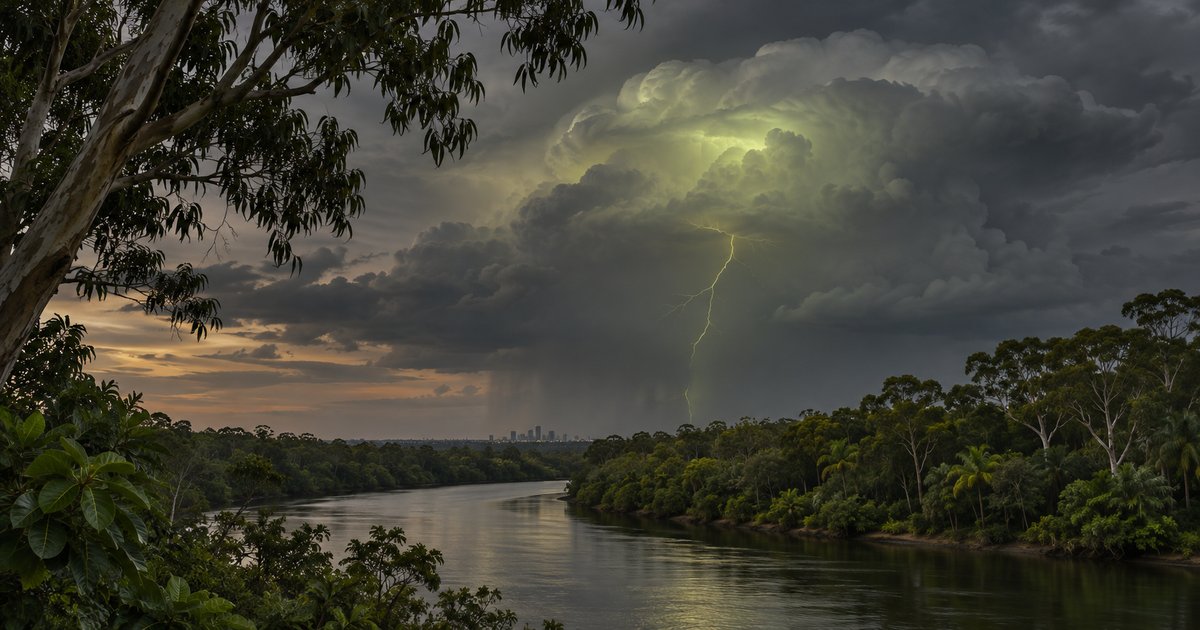
Brisbane’s storm season typically runs from October to March, according to Brisbane City Council. For a changing storm, check Bureau of Meteorology (BOM) warnings first, then use Brisbane radar or Energex’s lightning tracker for different observations. A tracker marker is not an official warning, and a storm can produce lightning without meeting the Bureau’s severe criteria.
When Brisbane storms are more likely
Brisbane City Council describes October to March as the city’s typical storm season, when heavy rain, strong wind and hail warrant preparation. In a 14 October 2026 briefing, BOM said October to December brings the highest severe-thunderstorm risk to Australia’s east coast, including southern Queensland. That is a seasonal pattern, not a prediction for a particular day or suburb. Queensland SES says severe storms can affect the state at any time of year, so a calendar alone cannot settle an outdoor plan.
A fine, sunny Brisbane day can turn stormy quickly, Council says. Before a trip to a pool, park or sports ground, use the forecast and warning for that location and identify a route indoors. If thunder is heard, Queensland SES says to move indoors, bring children and pets with you, and stay away from windows, external doors and skylights during the storm.
Which Brisbane storm page answers which question?
BOM, Energex and Council publish different products. As of November 2026, the official warning directory is BOM’s Queensland Warnings Summary. The BOM radar directory offers both Brisbane (Mt Stapylton) and Brisbane (Marburg) links. Radar shows rain-related returns, while a lightning tracker shows detected electrical discharges; rain radar and strike maps answer different questions.
| Open | Use it for | Do not read it as |
|---|---|---|
| BOM Queensland warnings | Official warning text and affected areas | A record of every lightning flash |
| BOM Brisbane radar | Recent precipitation near Brisbane | A lightning detection map |
| Energex Lightning Tracker | Recently displayed cloud-to-ground and cloud-to-cloud events | A complete or delay-free strike record |
| Brisbane Severe Weather Alert | Subscribed alerts for nominated Brisbane addresses | A GPS alert for every thunderstorm |
BOM also has a Southeast Queensland Thunderstorm Tracker pilot. BOM says this automated product uses recent radar scans to draw ovals around potential thunderstorm activity and projects positions 10, 20 and 30 minutes ahead. Its own description says, “It is not a warning.” Some ovals may be heavy showers or developing storms that have not yet produced lightning. Read the separate warning text when BOM issues one.
How to read Energex’s lightning tracker
Energex serves South East Queensland, from the New South Wales border north to Gympie and west to the base of the Great Dividing Range, according to its network page. Brisbane falls within that service region. Its tracker, checked in November 2026, uses crosses for cloud-to-ground events and squares for cloud-to-cloud events. Its legend fades markers from white for current, to red at 30 minutes old, to blue at 60 minutes old. Energex says the display is intended to show storm activity and potential effects on electricity restoration: lightning activity can keep crews off elevated work platforms. It also includes weather warning and hotspot layers, so a colored marker must be read against the correct legend.
Energex identifies Weatherzone as the provider of its displayed data and warns that the information may be slightly delayed. An empty or old-looking display cannot prove that lightning has stopped around a person. Check strike age and detection gaps when interpreting any map. Energex directs people to BOM warnings in emergencies. Its tracker is useful for recent observations, while BOM’s warning tells you about an officially assessed severe-storm threat.
What Brisbane Severe Weather Alert does and misses
Brisbane City Council’s free Severe Weather Alert service lets residents nominate unlimited Brisbane addresses, including a workplace or school, for severe thunderstorm and other weather alerts. Delivery can be by SMS, email or voice message. Council says the account must be verified before alerts can arrive. Its system uses the registered address rather than GPS, so a person moving across the city should check the Bureau’s warning area directly.
Council says its storm alerts are targeted to registered addresses inside a BOM warning area and issued only when a storm meets severe criteria. The Council lists large hail of at least 2 cm, damaging gusts of at least 90 km/h, heavy rain that may cause flash flooding, or tornadoes. Lightning itself is not one of those criteria. The Council also says mobile-network conditions can delay an SMS. A thunderstorm can therefore demand action even when no Council message has reached a phone.
What to do at a pool or after storm damage
Swimming Queensland’s Lightning Protection Policy, effective 25 March 2019, tells pool operators: “Do not depend on a severe thunderstorm warning to clear the pool.” Its next sentence explains why: non-severe thunderstorms can still pose a lightning threat. The policy calls for an evacuation plan adapted to each pool, including how long it takes people to reach a building or hard-top vehicle. For pool users, follow staff directions promptly; the deeper pool lightning rules depend on the facility’s plan.
Queensland SES advises moving indoors during a storm and staying clear of windows, external doors and skylights. Afterward, it warns people to avoid fallen power lines and floodwater. For non-life-threatening storm or flood assistance, SES lists 132 500; for a life-threatening emergency, call 000. Energex separately lists 000 or 13 19 62 for fallen power lines or electrical shocks, and 13 62 62 for an outage. Follow the instructions on an official warning and avoid approaching damaged electrical equipment.
Lightning Tracker is an iPhone app that works in Australia and shows recent detected strikes, including the distance to the nearest detection. It does not replace BOM warnings or local procedures.
Not a substitute for official weather warnings.
If you hear thunder, seek shelter even if the app shows no nearby strike.
Sources
- Brisbane City Council, Brisbane Severe Weather Alert
- Bureau of Meteorology, Now is the time to Get Ready Queensland
- Bureau of Meteorology, Queensland Warnings Summary
- Bureau of Meteorology, Rain radar and weather maps
- Bureau of Meteorology, About Thunderstorm Tracker
- Energex, Lightning tracker
- Energex, About our network
- Queensland State Emergency Service, Storm
- Swimming Queensland, SQ Lightning Protection Policy