 Lightning Tracker
App Store
Lightning safety
Lightning in Australia: storms, warnings and what to do
November 14, 2026 · 5 min read
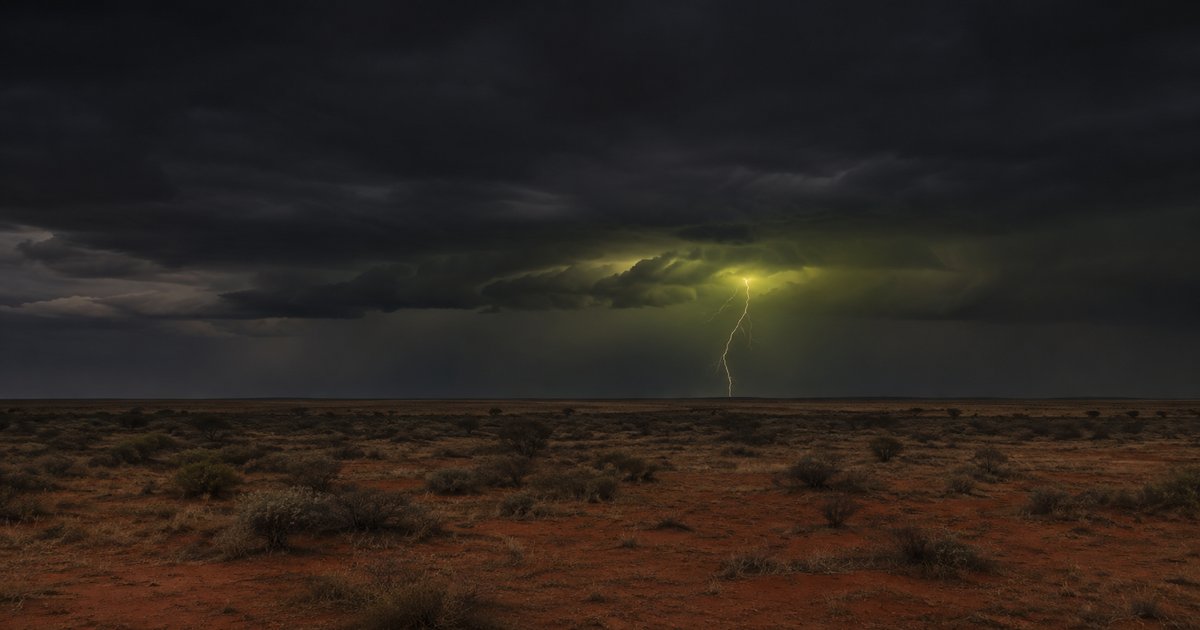
In Australia, move into a solid building or enclosed hard-top vehicle when thunder begins, even if no severe thunderstorm warning is posted. The Bureau of Meteorology warns only for storms meeting severe wind, hail, tornado or flash-flood criteria; every thunderstorm can produce lightning. Check the Bureau’s warning for your area, then follow state or territory emergency-service instructions.
Where and when lightning is common
The Bureau of Meteorology (BOM) says most Australian thunderstorms occur from September through March, although severe storms can occur in any month. Northern Australia's dry season has fewer severe thunderstorms; southern winter storms can develop with cold fronts. The Bureau's historical climate maps show the highest overall lightning activity in the northwestern part of the continent, with activity generally decreasing toward the south. Their thunder-day observations cover 1990–1999, while satellite-derived flash-density data cover 1995–2012. These are climate averages, not a measure of today's conditions at a campsite or sports field.
The Bureau's thunder-day map also identifies a secondary maximum in southeast Queensland and central and eastern New South Wales, extending into northeastern Victorian highlands. Its map counts days when thunder was observed at weather stations, while its flash-density maps estimate cloud and ground flashes from satellite data. Those different measures explain why a number of thunder days should not be read as a number of ground strikes. An Australian summer outing may face both lightning and a sudden downpour; a winter front in the south can also bring a storm.
What a Bureau warning tells you
BOM states plainly that all thunderstorms produce lightning, but Australia issues thunderstorm warnings only for storms classified as severe or very dangerous. Severe classification depends on at least one of four hazards: hail at least 2 cm (0.8 in) across, wind gusts at least 90 km/h (56 mph), a tornado, or heavy rain that may cause flash flooding. Lightning is not a threshold in that list. Hearing thunder without a posted Severe Thunderstorm Warning is therefore still a reason to leave an exposed place.
The Bureau’s warnings and alerts page is the official starting point for the state or territory you are in. A regional Severe Thunderstorm Warning covers a broad area of a state or mainland territory where severe storms are happening or may happen in the next three hours. A detailed warning is issued for capital cities and surrounding areas when individual severe storms are within range of city radars. It gives more specific locations and projected movement for up to 60 minutes. Neither format promises that every point in the shaded area will be struck, nor does an unshaded spot rule out lightning.
Open the warning text and check the named hazards, affected districts and places, issue time, next update time, observations and recommended actions. BOM warns that severe thunderstorms can form and change quickly, making exact locations hard to predict even shortly before impact. NSW SES separately uses the Australian Warning System levels Advice, Watch and Act, and Emergency Warning for severe weather. Those SES action levels are different from BOM's storm classification; follow the instructions in whichever warning applies to your area.
Move at thunder, including at work and on water
The Bureau says to move to shelter immediately if caught outdoors during a thunderstorm. Choose a solid building or enclosed hard-top vehicle; avoid tents, open shelters and trees. If swimming or surfing, leave the water immediately. If boating, head ashore for shelter as soon as possible. At an Australian beach, the trip off the sand takes time, so plan the route to a building or enclosed vehicle before the weather turns.
Inside, BOM advises staying clear of windows, doors and skylights, avoiding landline phones and not touching metal poles, fences or similar structures outside. Its storm guidance also warns against driving, walking, riding or swimming through floodwater. A hard-top vehicle can serve as lightning shelter, but choose a stopping place away from floodwater, trees and power lines, as NSW SES advises. A small open shelter, tent or tree is not a substitute for a solid building or enclosed vehicle.
Australia’s national work health and safety agency says workplaces should manage hazardous weather by working indoors where possible, postponing outside work and providing access to shelter. NT WorkSafe's 2022 alert asks outdoor employers to set a method for warning workers, a stop-work trigger when workers see lightning or hear thunder, a route and time to reach shelter, and a procedure for resuming work. These are concrete parts of an outdoor work lightning plan, especially where a crew is far from a substantial building.
What the Australian injury figures count
The Australian Institute of Health and Welfare (AIHW) reported 8 lightning deaths and 58 hospital admissions after lightning strikes in Australia across the two financial years 2014–15 and 2015–16. The death count comes from the National Mortality Database; the admissions are hospitalised cases coded as victims of lightning. AIHW published the report in November 2018. The figures are for that period and those recorded outcomes, not an annual prediction or a count of everyone affected by lightning.
AIHW says two of the eight lightning deaths in that period occurred while the person worked for income. Its locations for the deaths included recreational or cultural areas, countryside, and farms or other primary-production places, with two in each category. Those small counts cannot rank an individual outing or job by risk. They do show why the shelter decision matters for both recreation and work, rather than only for a storm described as “severe.”
Official Australian links and emergency help
For a changing weather situation, use the Bureau's warnings directory and read the warning for your location. State and territory emergency services may add instructions about local storm impacts; NSW SES storm guidance is one example. The national work health and safety agency’s hazardous-weather guidance is for workplace planning. These official pages describe warnings and action, while a detected-strike map answers a different question about observations.
In a life-threatening emergency, call Triple Zero (000). Healthdirect says 000 is the national number for urgent ambulance, police or fire help. NSW SES gives 132 500 for storm or flood emergency assistance in New South Wales, reserving 000 for life-threatening situations. Follow the local emergency service's instructions if a warning directs you elsewhere.
As of November 2026, Lightning Tracker works in Australia and is available in the App Store. Its English-language iPhone app shows recently detected strikes and the distance to the nearest detection; use BOM and local emergency-service warnings for official instructions.
Not a substitute for official weather warnings.
If you hear thunder, seek shelter even if the app shows no nearby strike.
Sources
- Bureau of Meteorology, Severe weather and coastal hazard warning services
- Bureau of Meteorology, Thunderstorms
- Bureau of Meteorology, Average annual thunder-day and lightning flash density
- Bureau of Meteorology, Warnings and alerts
- Australian Institute of Health and Welfare, Electrical injuries, deaths and hospitalisations 2014–15 and 2015–16
- NSW State Emergency Service, During a storm
- SWA, Working in hazardous weather
- NT WorkSafe, Risk of lightning strikes to outdoor workers
- healthdirect Australia, Calling triple zero (000)