 Lightning Tracker
App Store
Home and everyday
Driving in a thunderstorm: cars, convertibles and motorcycles
November 12, 2026 · 7 min read
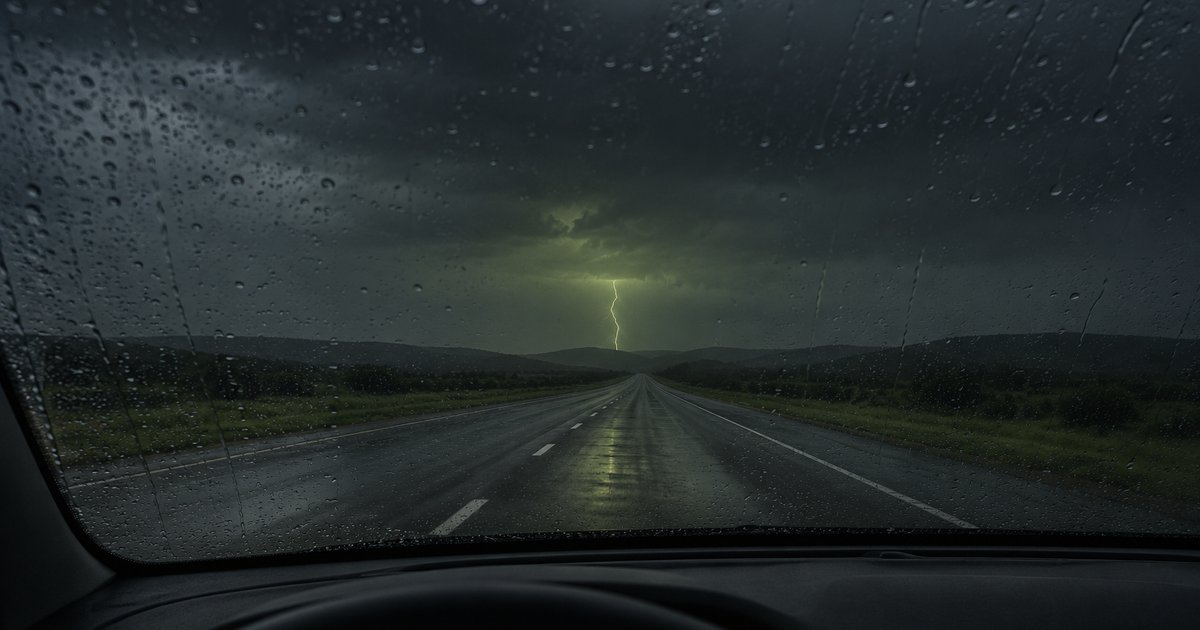
A hard-topped metal car with the windows closed protects the people inside from lightning, according to the National Weather Service, and the protection comes from the metal shell, not the rubber tires. A convertible gives no protection even with the top up, and motorcycles, bicycles and other open vehicles are not shelter either. The car itself can still be damaged, and the official lightning pages checked for this article do not say whether a driver should keep going or stop.
A hard-topped car works because of its metal shell
The National Weather Service (NWS) says the outer metal shell of a hard-topped metal vehicle protects the people inside, provided the windows are closed. Tires are not part of the answer: the NWS asks whether the rubber tires protect someone who is outside and leaning on the car, and replies with a flat no. The National Lightning Safety Council (NLSC) says the same, noting that a car's protection “has nothing to do with the rubber tires.” NOAA's JetStream guide adds that rubber soles and rubber tires are not insulators from lightning. Ten lightning myths covers the tire belief alongside the rest.
The standard also holds for larger vehicles. NOAA's JetStream guide, last updated June 22, 2026, calls an enclosed metal automobile, van or school bus a decent alternative when no large building is available. A building still comes first; Where to shelter from lightning explains why.
What a lightning strike does to the car
Yes, lightning can hit a car, and it can damage the car. The NWS says that anything outside when thunderstorms are in the area is at risk of being struck, cars included, and the NLSC calls the idea that rubber tires protect a vehicle a myth. Neither page says that a moving car is any less exposed than a parked one.
The NWS describes a typical strike as landing on the antenna or along the roofline, passing through the outer metal shell and then through the tires to the ground. It lists damage to the antenna, the electrical system, the rear windshield and the tires as common. The heat can partly melt an antenna, part of the discharge can reach the electronics and leave the car unable to run, lightning can follow the thin defrosting wires in a rear window and shatter the glass, and a fire is possible. The shell protects the people inside, not the vehicle.
NOAA's guide tells occupants to roll the windows up and to avoid contact with any conducting path that leads outside the vehicle, naming radios, CB sets and the ignition as examples. That matches how the NWS describes conduction: lightning can travel long distances along wires and other metal surfaces, which is one of the five ways lightning strikes people. The NOAA page says nothing about the steering wheel or about turning off the engine, so those extras are not something this agency states.
Convertibles and open-cab vehicles give no protection
NOAA's JetStream guide states that convertible vehicles offer no protection from lightning, even if the top is up. Its list of vehicles that do not count also includes those with open cabs, such as golf carts, tractors and construction equipment. For crews that work in them, A lightning plan for outdoor work shows what to write down before the season starts.
The pages cited here do not discuss removable hard tops or other fabric-roofed vehicles. That leaves them as an open question, and the benchmark in the NWS, NLSC and NOAA pages stays the same: a hard-topped metal vehicle with the windows closed.
Motorcycles, bicycles and ATVs are not shelter
The NLSC says motorcycles, bikes, golf carts, all-terrain vehicles and lawnmowers should be avoided when thunderstorms are in the area. The NWS office in Jackson, Mississippi tells people to get off and away from motorcycles, scooters, golf carts and bicycles, and not to take shelter in open-top vehicles.
The NLSC's analysis of U.S. lightning deaths from 2006 through 2024 shows why this matters. Of 492 deaths, 20, or 4 percent, happened to people riding a bicycle, motorcycle or ATV. The author writes that some of these victims were a long way from shelter when the storm arrived, and that although most people know tires do not protect a rider, some likely still believe it. The NWS adds that no one should shelter under an isolated tree. The study's general conclusion applies to riders: where no shelter is within easy reach and thunderstorms are forecast, the only alternative is to cancel or postpone the activity beforehand. Who gets struck by lightning? has the rest of the study.
Vehicle by vehicle: what the sources say
Across the NWS, NLSC and NOAA pages, only one kind of vehicle counts as shelter, and the rest fall on the other side of the line.
| Vehicle | Protection from lightning | Source |
|---|---|---|
| Hard-topped car, van or school bus, windows closed | Protects the people inside; the vehicle itself may be damaged | NWS, NOAA JetStream |
| Convertible, top up | None | NOAA JetStream |
| Golf cart, tractor or construction equipment with an open cab | None | NOAA JetStream |
| Motorcycle, scooter, bicycle or ATV | Not shelter; get off and away from it | NLSC, NWS Jackson |
Keep driving or pull over? The lightning pages do not say
The NWS Lightning and Cars page, the NLSC cars page and NOAA's lightning guide explain where protection comes from, but none of them tells a driver whether to keep moving or to stop. Other federal pages come close. For severe thunderstorms, the NWS says being in a vehicle beats being outside, but advises driving to the closest secure shelter if there is enough time. The Federal Emergency Management Agency's Ready.gov tells people under a thunderstorm warning to move from outdoors into a building or a car with a roof. For high winds, the NWS says that a driver who is not near a sturdy building should take shelter in the car, drive to a nearby sturdy building if that is possible, and otherwise move the car where falling trees or power lines are less likely to hit it.
Lightning is not the only hazard on the road. The NWS says flooding causes more deaths each year than any other thunderstorm hazard, and that 12 inches of rushing water is enough to carry away most cars. Its rule is Turn Around, Don't Drown: never drive into a flooded road or around a barrier.
Hearing a warning is also harder behind the wheel. The NWS notes that traffic, wind and precipitation can cut the distance at which thunder is audible to less than the usual 10 miles. A closed car with rain on the roof is likely to be just as noisy, though no source cited here tests that. Flash to bang explains what the count means when you can hear it.
Waiting inside, and the short walk to the car
A fact sheet from the Occupational Safety and Health Administration (OSHA) and NOAA tells employers to guide workers to hard-topped metal vehicles with the windows rolled up when no building is reachable, and to keep them there for at least 30 minutes after the last thunder. Why wait 30 minutes explains why the clock restarts.
The NLSC study shows the car only helps if people reach it in time. It counts 16 deaths, 3 percent, among people walking to, from or waiting for a vehicle, and says that in many camping deaths the victims were only steps from a vehicle that could have protected them. It also describes one case of a person killed in a car by a tree that lightning toppled, a reminder that a roof does not remove every danger.
If lightning does hit a car with people inside
The NWS says anyone struck by lightning may need immediate medical attention, including a call to 911, CPR and an AED. The pages cited here give no steps specific to vehicles. If someone is struck by lightning covers what the first minutes look like.
What the sources leave unknown
Three questions stay open after reading the NWS, NLSC and NOAA pages.
- The odds. People ask how often moving cars are struck. The NWS, NLSC and NOAA pages cited here give no figure, so this article gives none.
- Other body materials. The pages describe a metal shell. They do not discuss vehicles with non-metal bodies or electric drivetrains, so no claim is made about them.
- Stopping versus driving on. As above, the lightning pages are silent, and the severe-weather and wind advice is written for other hazards.
Where Lightning Tracker fits
The decision that matters most for a drive comes before the engine starts. Lightning Tracker, an iPhone app, shows recently detected strikes on a live map, with the distance and direction to the nearest one and how many minutes ago it was detected. It alerts you when a strike is detected inside a radius you set for each place; the default is 10 miles (16 km). Detection networks miss some strikes, especially weak ones, and data can arrive late, so a quiet map does not prove there is no lightning nearby. The NLSC study notes that lightning notification services can help where noise or terrain hides the warning signs. The app does not replace official warnings or local procedures.
Not a substitute for official weather warnings.
If you hear thunder, seek shelter even if the app shows no nearby strike.
Sources
- National Weather Service, Lightning and Cars
- NOAA, JetStream: Lightning Safety (last updated June 22, 2026)
- National Lightning Safety Council, Lightning and Cars
- National Lightning Safety Council, J. Jensenius, A Detailed Analysis of Lightning Deaths in the United States from 2006 through 2024 (PDF, January 2025)
- National Weather Service Jackson, Mississippi, Severe Weather Preparedness Week Day 5: Lightning
- National Weather Service, Lightning Tips
- National Weather Service, Lightning Science: Five Ways Lightning Strikes People
- National Weather Service, Lightning Safety and Outdoor Sports Activities
- National Weather Service, What to Do During Severe Weather
- National Weather Service, Wind: What to Do During
- National Weather Service, Turn Around Don't Drown
- Ready.gov, Thunderstorms & Lightning
- OSHA and NOAA, Lightning Safety When Working Outdoors (PDF, May 2016)