 Lightning Tracker
App Store
Places and activities
Camping in a thunderstorm: tents and campsites
November 10, 2026 · 7 min read
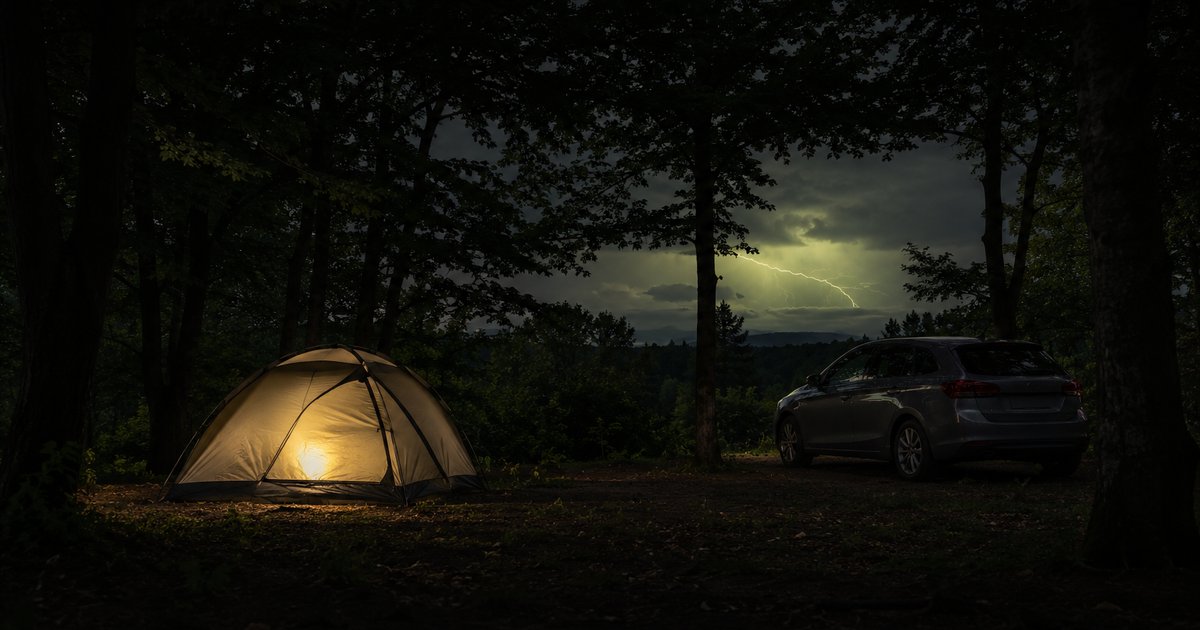
A tent does not protect you from lightning. The National Weather Service and the National Park Service both say so, and both name a substantial building or a hard-topped vehicle as the place to be when thunder starts. For a camper, the usable answer is to decide before dark which vehicle or building you will walk to, pitch on ground that exposes you least, and treat the first thunder as the signal to go.
A tent keeps off rain, not lightning
The National Weather Service says a tent offers no protection from lightning. Its outdoor guidance works through a camping case: someone cooking dinner hears distant thunder, with a tent and a large open-sided picnic shelter close by and a vehicle a quarter mile away at the trailhead. The answer is to go to the vehicle, because neither the tent nor the picnic shelter protects, and to wait 30 minutes after the last rumble of thunder before going back to the campsite. The National Park Service page for visitors, last updated in June 2018, agrees that tents do not protect you from lightning, and it lists pavilions and picnic shelters among the structures that do not count either.
Tent poles: where the sources disagree
The National Weather Service and Rocky Mountain National Park disagree about whether tent poles attract lightning. The Weather Service says height, pointy shape and isolation dominate where lightning strikes, and that the presence of metal makes no difference to where it lands. It adds that metal does conduct the current, which is why it tells people to stay away from metal fences and similar objects. The Rocky Mountain page, last updated in July 2024, says a tent has metal poles and could attract lightning.
As of November 2026 the two pages are not reconciled, and this article does not pick a winner. For a camper the disagreement changes little: both pages rank a building or vehicle above any tent.
Match the shelter to the kind of camping
Campers fall into four setups, and the nearest qualifying shelter differs for each. The table uses the shelter definitions of the National Weather Service and the National Park Service, plus the 30-minute-walk line that a backcountry sheet hosted by the Weather Service draws between frontcountry and backcountry. Owners of a motorhome or travel trailer can check which shells count as shelter in RVs and campers in a thunderstorm.
| Setup | Where to go at the first thunder | What the sources add |
|---|---|---|
| Campground, vehicle at the site | The vehicle, if it has a hard metal top. Close the windows. | The Weather Service lists an enclosed, metal-topped vehicle with windows up as shelter. The Park Service adds that you should avoid touching metal surfaces inside or outside it. The protection comes from the metal shell, not from the tires. |
| Campground with a building on the grounds | A substantial building with electricity or plumbing. | The Weather Service counts such buildings, and its ball-field example sends people to vehicles or the restrooms. It rules out dugouts, rain shelters and sheds; the Park Service adds pavilions, picnic shelters and porches. Whether a specific camp building qualifies is a question for a ranger. |
| Walk-in site, vehicle at the trailhead | The vehicle, as in the Weather Service's quarter-mile example. | The Park Service tells visitors to know how long the walk to shelter takes before the storm, not during it. |
| Backcountry, 30 minutes or more from a vehicle | No qualifying shelter is close enough for a quick retreat. | The Weather Service-hosted sheet defines backcountry as at least a 30-minute walk from the nearest vehicle or modern building. The options there are timing and terrain, covered below. |
Decide at the forecast, not at the tent door
The National Lightning Safety Council says that when no qualifying shelter is readily available and thunderstorms are forecast, the only alternative is to cancel or postpone the trip. That statement is in the council's analysis of 2006 through 2024 deaths, published in January 2025. The Weather Service gives the matching advice for outdoor areas: if the chance of thunderstorms is high, stay inside.
Timing is the other lever. The Weather Service says mountain thunderstorms typically develop in the early afternoon, so hikers should be down the mountain by noon. The Park Service suggests having a Plan B when thunderstorms are forecast, asking a ranger whether the park has designated shelters, and checking in with rangers for alerts, since not every park has cell service. Some parks run lightning detection and notification systems.
Pitching where the ground exposes you less
The National Weather Service advises campers in an open area to set up in a valley, ravine or other low area. Its wider tips for people outdoors add four more rules:
- Avoid open fields, hilltops and ridge tops.
- Stay away from tall, isolated trees and other tall objects; in a forest, stay near a lower stand of trees.
- Keep away from water, wet items such as ropes, and metal objects such as fences. Water and metal do not attract lightning, but current travels easily through them. Wet guy lines and clotheslines fit that description, though the Weather Service does not name them.
- Spread out in a group so the current does not travel between people.
The Weather Service-hosted backcountry sheet, credited to John Gookin (version dated March 2012), is more specific about tents. It says a tent on a ridge, in a broad open area or near a tall tree should be left before the storm arrives, with the camper moving to safer terrain. In gently rolling hills it finds lower flat ground no better than higher flat ground, because strikes there are random, and suggests a dry ravine or other significant depression. Rocky Mountain National Park scores places near streams, wet gullies and boggy ground at 1 on a 0 to 10 scale, where 10 is a building or vehicle.
When thunder starts at camp
Thunder is the signal for campers to move, and the National Weather Service says it can usually be heard about 10 miles away when there is no background noise. The same agency puts the significant lightning threat at about 6 to 10 miles from the base of a thunderstorm cloud. Wind, rain and traffic can mask the sound, and counting seconds between flash and thunder gives only an estimate, so treat the first rumble as the cue rather than waiting for a closer one.
The National Lightning Safety Council counted 23 camping deaths among the 492 U.S. lightning deaths from 2006 through 2024. It reports that in many camping cases the victims were only steps from a vehicle that could have protected them, and that in some, mountains or trees hid the sky so the victims did not realize a storm was near. In a few remote cases there may have been little the victim could do. The full breakdown is in Who gets struck by lightning?
The practical sequence follows from the sources: stop cooking or packing, walk to the building or vehicle you picked in advance, and stay until 30 minutes have passed since the last thunder. Why the 30-minute clock restarts explains the wait, and Where to shelter from lightning covers what to avoid once you are inside.
If no building or vehicle is within reach
The National Weather Service says its outdoor tips only slightly lessen the threat and that you are not protected outside. They do not make a tent or open site a shelter. The sources agree on one point: do not lie flat, because that increases exposure to ground current.
They differ on crouching. The Weather Service's myths page says crouching does not make you any better off outdoors. The Weather Service-hosted backcountry sheet and Rocky Mountain National Park both describe a lightning position for waiting out a storm when you cannot move: feet together, crouched or seated, on a foam pad or pack if you have one. The sheet says a camper in a tent on safer terrain who hears thunder should at least be in that position, and suggests spacing a group about 20 feet (7 m) apart. Rocky Mountain's page adds that campers in a high or exposed area should leave the tent for a grove of trees. No source reviewed here measures how much any of these steps reduces risk.
Where Lightning Tracker fits at a campsite
Lightning Tracker is an iPhone app that shows recently detected lightning strikes on a live map, with the distance and direction to the nearest one and how many minutes ago it struck. It alerts you when a strike is detected inside a radius you set for each place; the default is 10 miles (16 km). For a campsite, the radius should buy the walk to your vehicle or building with time to spare, and How to choose an alert radius shows how to match the two.
Detection networks miss some strikes, especially weak ones, and data can arrive late; the app marks a delay or gap instead of treating it as quiet. iOS decides when the app may check for data in the background, so a closed app may see the latest strikes only when you open it. Thunder therefore stays your trigger. Once you are in shelter, the app starts a 30-minute wait after the last strike detected inside your radius and restarts it with every new one. When it ends, the app reports what it observed and asks you to judge conditions yourself. It does not replace official weather warnings.
Not a substitute for official weather warnings.
If you hear thunder, seek shelter even if the app shows no nearby strike.
Sources
- National Weather Service, Lightning safety outdoors: scenarios for campers, beach-goers and others
- National Weather Service, Lightning Tips
- National Weather Service, Lightning Safety and Outdoor Sports Activities
- National Weather Service, Lightning Myths
- National Weather Service, Lightning and Cars
- National Weather Service (hosted sheet by John Gookin, March 2012), Lightning Risk Management for Backcountry Campers and Hikers (PDF)
- National Park Service, Lightning Safety
- National Park Service, Rocky Mountain National Park, Lightning Safety - Rocky Mountain
- National Lightning Safety Council, J. Jensenius, A Detailed Analysis of Lightning Deaths in the United States from 2006 through 2024 (PDF, January 2025)