 Lightning Tracker
App Store
Places and activities
RVs and campers in a thunderstorm
November 10, 2026 · 7 min read
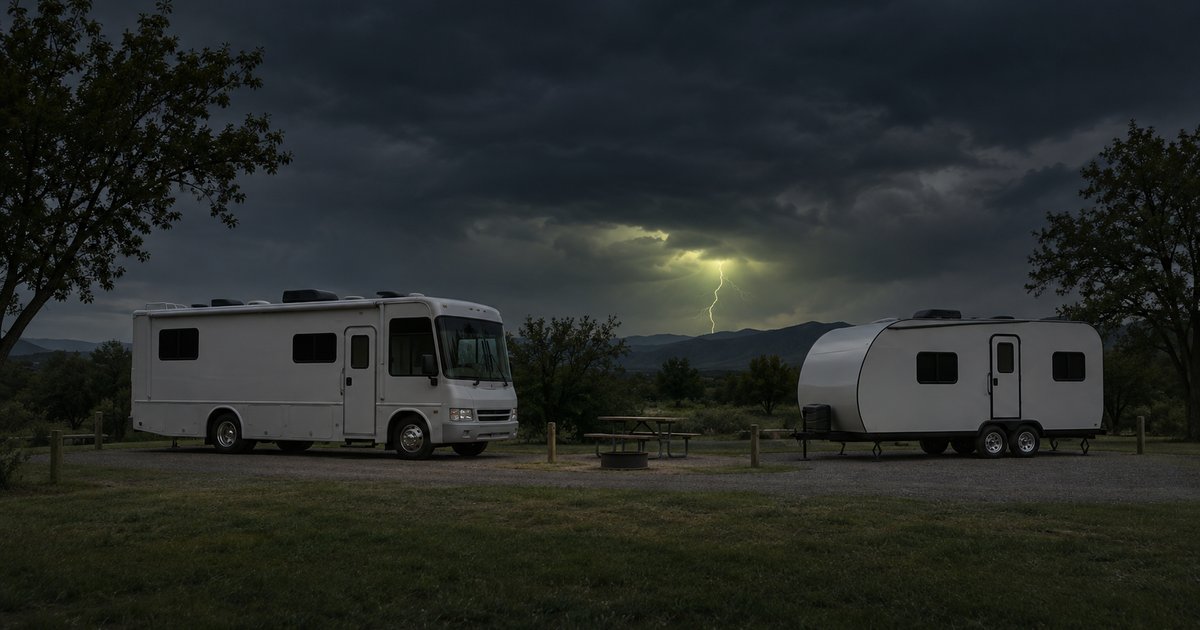
An RV protects you from lightning only if its body works like the metal shell of a car, and the official guidance on which RVs do is thinner than most RV blogs suggest. The U.S. National Weather Service (NWS) names a substantial building or a hard-topped metal vehicle with the windows closed, and the NWS pages checked for this article never mention RVs, trailers or campers by name. The one government page found that does is from Environment and Climate Change Canada: RVs of steel or aluminum are acceptable, while fiberglass RVs and fabric-sided pop-up campers are not. Nothing checked covers the common in-between case, a fiberglass shell on a metal frame.
The NWS rule does not mention RVs
The National Weather Service tells anyone who hears thunder to move to a substantial building with electricity or plumbing, or to an enclosed, metal-topped vehicle with the windows up. Its Lightning and Cars page says the protection comes from the outer metal shell of a hard-topped metal vehicle with the windows closed. The words RV, trailer and camper appear on neither page, so whether a given rig counts depends on whether its body is that kind of shell. Where to shelter from lightning covers the building-or-vehicle rule in full.
Metal by itself is not the test. The NWS says the presence of metal makes no difference to where lightning strikes, although metal conducts it once lightning arrives, a point Ten lightning myths treats at more length. NOAA's JetStream guide, last updated June 22, 2026, lists metal sheds and carports among buildings that do not protect people, because they have exposed openings. A metal surface with gaps in it is not the same thing as a closed metal shell.
What Canada's weather service says about RVs
Environment and Climate Change Canada, in camping guidance whose page carries a date-modified stamp of May 7, 2020, is the one government source found that sorts RVs by material. It explains that lightning travels around the outside surface of a metal-framed vehicle, which it calls the Faraday cage effect, and that this shields the passengers. It then puts RVs on either side of the line: a steel or aluminum RV is acceptable, in its words, while the page lists fiberglass RVs as unsafe because “A lightning strike will go right through the vehicle.” It lists pop-up campers with fabric-like sides as unsafe too.
The Canadian page is guidance for Canadian campers, and it shows no test or measurement behind the material rule. The NWS pages checked here do not repeat it. It is the best official sorting available, which is not the same as a certification of any particular rig.
The same page adds a condition for metal vehicles: occupants stay protected as long as they do not touch the outer metal shell, for example through internal parts such as the steering wheel, radio knob or door handle. NOAA's JetStream guide gives a similar instruction for any vehicle: avoid contact with conducting paths that lead to the outside, such as radios, CB sets and the ignition.
Rig by rig: what the sources say
Sorting common camping rigs against the NWS and Canadian wording leaves four rows with a stated answer and two with none.
| Rig | What the sources say | Source |
|---|---|---|
| Hard-topped metal tow vehicle, windows closed | Counts as shelter when no building is available | NWS |
| Travel trailer or motorhome made of steel or aluminum | Acceptable; the NWS does not mention RVs by name | Environment Canada |
| RV made out of fiberglass | Unsafe; a strike goes right through the vehicle | Environment Canada |
| Pop-up camper with fabric-like sides | Unsafe | Environment Canada |
| Fiberglass shell on a metal frame | Not addressed | None found |
| Slide-in truck camper or camper van | Not addressed by name | None found |
Why a fiberglass trailer is not one category
Builders describe their rigs in ways that do not map onto the Canadian categories. Oliver Travel Trailers describes its campers as molded double-hull fiberglass on an aircraft-grade aluminum frame, while Airstream describes its travel trailers as riveted aluminum. Both are travel trailers, yet the first is called a fiberglass trailer in everyday talk and the second a metal one. The Canadian page speaks of RVs “made out of” fiberglass, steel or aluminum, and does not say how to read a fiberglass shell over a metal frame. Neither builder page cited here mentions lightning. What a particular body is made of is something only its manufacturer can confirm.
The tow vehicle is the fallback the sources do name
Environment and Climate Change Canada tells RV campers who hear thunder to go to a building with plumbing and wiring or to an all-metal automobile without a convertible top. For a pickup or SUV with a hard roof, the NWS conditions apply: windows closed, hard top. That makes the tow vehicle the shelter with the clearest sourcing for a fiberglass or fabric-sided rig, though neither agency says so in those words.
A campground building counts only if it matches the NWS description. The NWS says picnic shelters, dugouts and small buildings without plumbing or electricity do not protect people. Once inside, the NWS says to stay at least 30 minutes after the last sound of thunder; Why wait 30 minutes after the last strike? explains why the clock restarts.
Getting there in time matters as much as the choice. The National Lightning Safety Council (NLSC) counted 23 camping deaths in the United States from 2006 through 2024, and its analysis says that in many of them the victims were only steps away from a vehicle that could have provided safety. Who gets struck by lightning? has the rest of the study. The NLSC’s list of camping deaths gives a location for each victim, such as in a tent, under a tree, in an open area or at a campground. No entry names an RV or camper, so the list cannot show how RVs fare.
Shore power, jacks and strikes that miss the rig
A strike does not have to hit an RV to reach it. Environment and Climate Change Canada says RVs can be affected by lightning when they are connected to shore power or when their jacks are deployed on the ground. That matches the NWS description of conduction, in which lightning can travel long distances in wires or other metal surfaces; Five ways lightning strikes people explains it. The NWS also says lightning generates electric surges that can damage electronic equipment some distance from the actual strike, and that typical surge protectors will not protect equipment from a lightning strike.
On unplugging, the sources pull in different directions. The NWS indoor page says not to unplug equipment during a thunderstorm because there is a risk of being struck, and that advice is written for houses. None of the pages checked says how to handle an RV pedestal cable or leveling jacks. The only timing the sources support is an early one: anything that needs a trip outside belongs before thunder is heard, since the NWS instruction once thunder is heard is to move to shelter.
Environment and Climate Change Canada also tells campers not to set up a trailer or RV under an isolated or the tallest tree, close to a metal fence, or on a hilltop.
Wind is a separate problem for a towed rig
NWS wind guidance warns that one strong gust can be enough to flip a trailer towed behind a vehicle onto its side. The pages checked give no wind speed at which an RV tips over, so this article gives none.
What the sources leave unknown
- The in-between rigs. No source checked says whether a fiberglass shell on an aluminum or steel frame, a truck camper or a camper van counts as a metal shell.
- The odds. No figure was found for how often RVs are struck, or whether metal-bodied and fiberglass rigs fare differently in practice.
- Disconnecting in advance. No agency page checked says whether unplugging shore power or raising jacks before a storm reduces damage.
- A test of the rule. The Canadian material rule cites no test, and none was found for this article.
Where Lightning Tracker fits
The choice of shelter has to be made before the storm arrives. Lightning Tracker, an iPhone app, shows recently detected strikes on a live map, with the distance and direction to the nearest one and how many minutes ago it was detected. It alerts you when a strike is detected inside a radius you set for each place; the default is 10 miles (16 km), and How to choose an alert radius shows how to match it to the time a walk to the tow vehicle takes. Detection networks miss some strikes, especially weak ones, and data can arrive late, so the app marks a delay or a gap instead of treating it as quiet. It does not replace official warnings or local procedures.
Not a substitute for official weather warnings.
If you hear thunder, seek shelter even if the app shows no nearby strike.
Sources
- National Weather Service, Lightning Tips
- National Weather Service, Lightning and Cars
- National Weather Service, Lightning Myths
- National Weather Service, Lightning Science: Five Ways Lightning Strikes People
- National Weather Service, Lightning Indoors
- National Weather Service, Wind: What to Do During
- NOAA, JetStream: Lightning Safety (last updated June 22, 2026)
- Environment and Climate Change Canada, Lightning safety when camping (date modified 2020-05-07)
- National Lightning Safety Council, J. Jensenius, A Detailed Analysis of Lightning Deaths in the United States from 2006 through 2024 (PDF, January 2025)
- National Lightning Safety Council, Camping Lightning Fatalities (PDF)
- Oliver Travel Trailers, Travel trailers
- Airstream, Travel trailers