 Lightning Tracker
App Store
Home and everyday
What happens when lightning hits a tree
November 10, 2026 · 10 min read
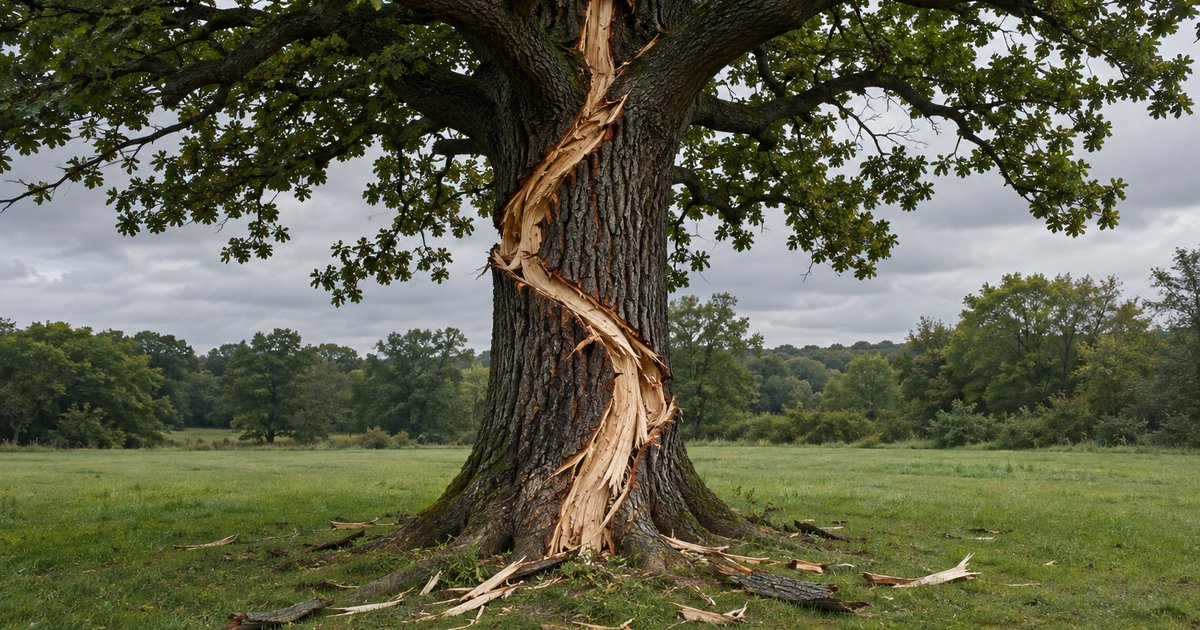
When lightning hits a tree, the current turns water in the wood to steam, which can blow off bark, split the trunk or kill the roots, and whether the tree survives often cannot be told for weeks or months. The same strike makes the tree a poor shelter: part of the current can jump to a person standing a foot or two away, and more spreads through the ground.
Trees are struck mainly because they are tall, and the water inside them helps
The National Weather Service (NWS) says height, a pointed shape and isolation are the dominant factors that decide where a lightning bolt lands, and that tall, isolated natural objects with little or no metal in them, such as trees and mountains, are struck many times a year. The National Severe Storms Laboratory (NSSL) explains the height part: the object about to be struck sends up an upward discharge called a streamer to meet the descending lightning channel, and the tallest object is the one most likely to produce one.
Wood on its own conducts electricity poorly. Nebraska Extension (May 2024) says the water and sap inside a tree raise its conductivity, as does rain on the bark, and it names solitary trees in the open, trees on hilltops and the tallest tree in an area as the ones prone to strikes. No national count of struck trees turned up in the sources for this article. Alabama Extension (June 2023) gives one regional estimate: 6 percent of lightning strikes in that state hit trees, roughly 60,000 trees a year. That is an estimate for one state, not a measured count.
Species is a less settled question than height. A 1983 review in Arboriculture & Urban Forestry lists oak, elm, maple, poplar, ash, spruce, fir, pine and tuliptree as commonly struck, and beech, birch and horsechestnut as rarely struck. It suggests smooth-barked trees such as beech are hit less because their bark gets thoroughly wet in a storm. That wetness explanation cites a 1912 study, and none of the newer extension pages read for this article ranks species by risk, so the list is best read as an old observation, not a measured rate.
Lightning turns the water in a tree to steam
NSSL describes what happens when lightning runs down a tree trunk: it turns water to steam, and the rapidly expanding steam can blast pieces of bark and branches off the tree, with the wood along the path often killed. The air in the lightning channel itself heats to above 50,000 °F in a few millionths of a second, according to NSSL.
The path decides the damage. Nebraska Extension says a bolt can travel down one branch or through the whole tree from top to roots, and can pass shallowly over wet bark, down through the phloem or through the deeper wood that carries water. Alabama Extension describes the phloem as the sap-conducting layer just under the bark. The University of Maryland Extension (updated March 2023) ties the wide range of damage to the strike’s intensity, the moisture on and in the tree, and the tree’s type and structure.
Visible damage runs from a narrow strip of bark blown off the trunk to a completely debarked tree, with deep vertical cracks and severely split branches or trunks in between, according to Nebraska Extension. Some damage cannot be seen. The University of Maryland Extension says internal wood or roots may burn without obvious outside symptoms, and the 1983 review reports that in many cases only minimal damage shows on the trunk while the roots have suffered considerable damage.
Extension guides sort struck trees by how much of the tree is gone
Alabama Extension (June 2023) and Nebraska Extension (May 2024) both use one-third thresholds to decide whether a struck tree is worth keeping. Their advice to the tree’s owner, side by side:
| What the tree shows | Alabama Extension | Nebraska Extension |
|---|---|---|
| Trunk split partly or fully apart | Remove the tree | Remove the tree |
| Crack in the main trunk one-third of its diameter deep or more | Remove if near high-value targets | Remove if near high-value targets such as a home or busy street |
| Bark gone from under one-third of the trunk’s circumference | Monitor for several weeks; preventive insect treatment | Monitor for internal damage; prevent drought stress |
| Bark gone from one-third or more of the circumference | Remove if the species is decay-prone or high-value targets are within the dripline | Remove, unless it is a very high-value species |
| More than one-third of the canopy lost | Consider removing right away if the scars are significant | Consider removing |
The two guides agree on most rows and differ on bark loss: Alabama ties removal to decay-prone species or targets under the canopy, Nebraska to the value of the species. Neither replaces an inspection. The University of California’s statewide IPM program (UC IPM) advises having an arborist certified by the International Society of Arboriculture, or registered with the American Society of Consulting Arborists, inspect a struck tree for limb, trunk and root damage right after the strike.
Whether a struck tree survives often cannot be told for weeks or months
Alabama Extension states that no fixed guidelines exist for judging a struck tree’s chance of survival. Nebraska Extension describes why: some trees explode, some show few signs of damage and die later from root injury, and some survive what looks like terrible damage and keep growing. Unless a trunk or branch is severely cracked or split, or broken limbs hang in the canopy, Nebraska recommends a wait-and-see approach.
How long to wait differs by source. Alabama Extension says several weeks before removing or even pruning, Nebraska Extension says a few months, the University of Maryland Extension says a full growing season if possible, and the 1983 review says about a year before costly treatment. The guides do not reconcile these figures, so they are best read as a range.
Waiting has a cost. Alabama Extension says a strike strips the bark that protects the wood, can damage the vessels that carry water and sap, and leaves the tree stressed, which attracts insects, so many struck trees suffer secondary pests that can weaken or kill them. UC IPM likewise lists bark beetles, wood-boring insects and decay pathogens. Alabama Extension adds that there is some controversy over how well preventive insecticide works, because the full extent of the damage cannot be known.
A study of an old-growth lowland forest in Panama, published in New Phytologist in March 2020, shows how far one strike can reach. Using a lightning location system and field surveys, the authors found that on average each strike directly killed 3.5 trees more than 10 cm (about 4 inches) in diameter and damaged 11.4 more. They estimated that lightning accounts for 40.5 percent of the short-term mortality of large trees, those over 60 cm (about 24 inches) across, at that site. A tropical forest is not a backyard, so the numbers do not transfer, but they show that a strike’s effects are not limited to the one trunk that was hit.
A struck tree can injure people beside it, even if they never touch it
The NWS says that being underneath a tree is the second leading cause of lightning casualties. Its page on the five ways lightning strikes people describes one route as a side flash: lightning hits a taller object near a person and part of the current jumps to the person, usually when they are within a foot or two of it, and most side flash victims had taken shelter under a tree from rain or hail. The same page says that when lightning hits a tree, much of the energy travels outward along the ground, and that this ground current causes the most lightning deaths and injuries of all the types. Five ways lightning strikes people covers all five. Hunters whose stand is fixed to a tree can use tree stands and lightning for the decision about when to climb down.
NSSL adds that the current can also leave the tree by other routes. It may hit a tree and then branch off to hit something else, and in built-up areas it may strike a tree or pole and travel to nearby houses through wiring and plumbing.
The most detailed collection of tree cases found for this article is a 2013 American Meteorological Society conference paper by Ronald Holle. It gathered 444 tree-related lightning events, 328 of them in the United States, from news reports, publications and NOAA’s Storm Data; they caused 362 deaths and 1,101 injuries. Because the cases come from media reports, the paper says they cannot be turned into a rate. It also cites a figure from 1990s U.S. data: 15 percent of lightning deaths and 6 percent of injuries happened under or near a tree. Its main findings:
- Where people were. The most common reported position was under a tree (200 events), then near a tree (110).
- How they were hurt. Where the reports identified the mechanism, ground current came first (30 events), then side flash (23), blunt trauma such as falling branches or exploding tree parts (22) and direct contact with the tree (7). In the other 362 events the mechanism could not be identified.
- How far away. The three fatalities with a known distance were between 1 and 7 meters (about 3 to 23 feet) from the tree. Most injuries were 1.5 to 10 meters (about 5 to 33 feet) away, and one driver was hurt 100 meters (about 330 feet) away when chunks of wood thrown from a tree went through a car window.
- Falling wood. One death was a 91-year-old woman walking beneath a tree in Pennsylvania when lightning severed a large branch that fell on her. The National Lightning Safety Council’s analysis of deaths from 2006 to 2025 (March 2026) also lists being struck by a tree that lightning toppled, while driving or riding in a car, among everyday-routine circumstances.
The NWS lists “never shelter under an isolated tree” among its last-resort tips for people caught outdoors with no building or vehicle nearby. Holle’s summary notes that people were hurt under or near a single tree and also in forests or woods, so any arrangement of trees can create a path from the strike to a person. None of the sources used here identifies a tree, or a stand of trees, as shelter; where to shelter from lightning explains what does protect, and the myth that a tree keeps you dry is one of ten the NWS corrects. If someone near a struck tree is hurt, the NWS says calling 911, starting CPR and using an AED may be critically important; what to do in the first minutes has the steps.
A damaged tree can stay hazardous after the storm has passed
UC IPM warns that a struck tree may be hazardous and fail, dropping limbs or falling over, which is why it advises the arborist inspection right away. Alabama Extension says that in a tree with a split trunk, or with more than a third of the canopy blasted away, the risk of failure increases over time as decay weakens the wood. NSSL says the current from a strike dissipates fairly quickly, so the ground or the object that was struck does not stay electrically dangerous afterward; the lasting hazard is the damaged wood, and the storm itself. The NWS advises staying in a building or hard-topped vehicle for at least 30 minutes after the last thunder, and why the clock restarts explains the rule.
For a valuable tree in a lightning-prone place, UC IPM says grounded lightning rods can be installed at the top of tall specimen trees and points to standards from the National Fire Protection Association and the Tree Care Industry Association. The 1983 review warns homeowners not to install such systems themselves and to consult a commercial arborist. Readers also ask whether home insurance pays for removing a struck tree; none of the sources used here covers insurance, so this article does not answer that.
Leaving the trees early is the practical lesson, and an alert radius buys the time
Lightning Tracker is an iPhone app that alerts you when a lightning strike is detected inside a radius you set for each place; the default radius is 10 miles (16 km). Detection networks miss some strikes, especially weak ones, and data can arrive late, so the app marks a delay or a gap instead of treating it as quiet. An alert is a prompt to walk to a building or a hard-topped vehicle, not to the nearest tree line. How to choose an alert radius shows how to fit the distance to the time your group needs, and how lightning is detected explains why a map can miss a strike.
Not a substitute for official weather warnings.
If you hear thunder, seek shelter even if the app shows no nearby strike.
Sources
- National Weather Service, Lightning Myths
- National Weather Service, Lightning Science: Five Ways Lightning Strikes People
- National Weather Service, Lightning Tips
- NOAA National Severe Storms Laboratory, Severe Weather 101: Lightning FAQ
- Alabama Cooperative Extension System, Caring for Lightning-Struck Trees (June 22, 2023)
- Nebraska Extension in Lancaster County, Lightning Strikes – Will My Tree Survive? (May 22, 2024)
- University of Maryland Extension, Lightning Damage (updated March 1, 2023)
- University of California Statewide IPM Program, Lightning
- DeRosa, Lightning and Trees, Arboriculture & Urban Forestry, February 1983
- Holle, Lightning-Caused Deaths and Injuries in the Vicinity of Trees (PDF), American Meteorological Society 93rd Annual Meeting, 2013
- Yanoviak et al., Lightning is a major cause of large tree mortality in a lowland neotropical forest, New Phytologist, March 2020 (abstract in the Princeton University research portal; DOI 10.1111/nph.16260)
- National Lightning Safety Council, J. Jensenius, A Detailed Analysis of Lightning Deaths in the United States from 2006 through 2025 (PDF, March 2026)