 Lightning Tracker
App Store
Storm basics
Fulgurites: how lightning turns sand into glass
November 18, 2026 · 7 min read
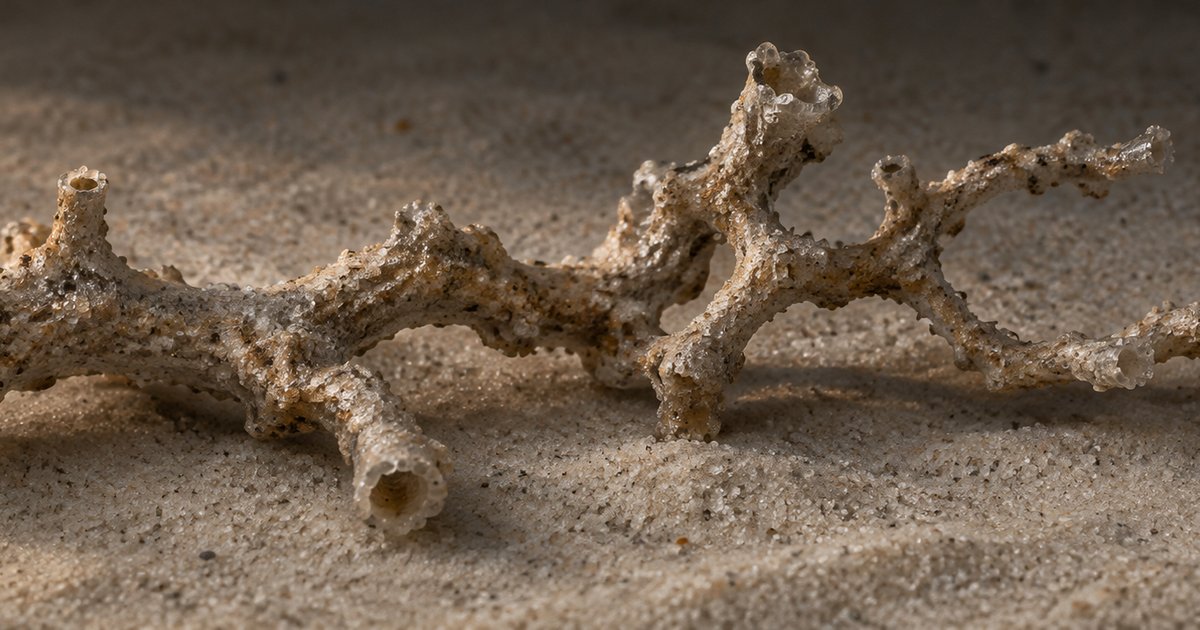
A fulgurite is natural glass formed when a lightning strike fuses sand, soil or rock; the best-known kind is a hollow, branching tube. Lightning can turn sand into glass, but sources say not every ground strike does, and they describe several kinds, from sand tubes to crusts on mountain rock.
A fulgurite is glass that lightning melts out of the ground
The Utah Geological Survey, in a January 2005 issue of its Survey Notes, describes fulgurites as natural tubes or crusts of glass formed when a lightning strike fuses silica (quartz) sand or rock, with a shape that mimics the path of the bolt as it disperses into the ground. The Oxford University Museum of Natural History says the name comes from fulgur, the Latin word for lightning, and that damp sand conducts electricity, so the grains fuse into a glass of nearly pure silicon dioxide.
The Utah survey states that a temperature of 3,272 °F (1,800 °C) is required to melt sand instantaneously. The National Park Service puts lightning at 50,000 °F (about 27,800 °C), and says the bolt vaporizes the sand along its path and melts the sand around it into dark glass.
Whether every ground strike leaves glass is where the sources part. The Utah survey says all lightning strikes that hit the ground are capable of forming fulgurites. Martin Uman, a University of Florida lightning researcher, was asked in a 1998 Weatherwise article whether every strike makes one and answered “Probably not,” adding that lightning sometimes blows sand up without making a fulgurite. NOAA’s National Severe Storms Laboratory (NSSL) says fulgurites have been found all over the world but are relatively rare. Read together, the sources say fulgurites are found worldwide and that not every strike leaves one.
The NSSL adds three details about what a ground strike leaves. The shape in the ground is the shape of the path the current followed, the color depends on the minerals in the sand that was struck, and grasses along the path are often damaged. In a tree, the same laboratory says, lightning traveling down the trunk turns water to steam, and the expanding steam can blast bark and branches off.
Researchers sort fulgurites into four main types by what was struck
A 2012 paper by Matthew Pasek, Kristin Block and Virginia Pasek in Contributions to Mineralogy and Petrology defines fulgurites as natural glasses formed by cloud-to-ground lightning and classifies them by what the strike melted. The authors name four main types and one minor type.
| Type | What was struck | What the walls are like |
|---|---|---|
| I | Sand | Thin glass walls |
| II | Clay | Thick, melt-rich walls |
| III | Caliche | Thick, glass-poor walls |
| IV | Rock | Glass, with walls of surrounding unmelted rock |
| Minor type | Droplet fulgurites | Shaped unlike the other types, but compositionally related to type II or IV |
The Utah survey uses a simpler split, sand and rock, and says sand fulgurites are the most common. They are generally found in beach or desert regions with clean, dry sand, resemble roots or branching tubes with a rough surface of partially melted grains, and have a glassy interior from rapid cooling. Many average 1 or 2 inches (2.5 to 5 cm) across and can be up to 30 inches (76 cm) long. Rock fulgurites are coatings or crusts of glass on rock, found as veins or branching channels on a surface or lining cracks, and mostly on or within several feet of mountain summits. The survey reports rock fulgurites on peaks including Mount Timpanogos in Utah’s Wasatch Range, where, it says, a steel shelter that attracts lightning produced some of them.
Fulgurites turn up in dunes, deserts, beaches and on high summits
The National Park Service reports blackish glass tubes at Great Sand Dunes National Park and Preserve, and reads the Roman philosopher Cicero’s phrase “condere fulmina,” meaning to dig up thunderbolts, as a sign that early Romans knew of fulgurites in sandy parts of Italy. The Utah survey lists rock fulgurites on mountains from the French Alps (Mont Blanc) to the Sierra Nevada, the Cascade Range, the Rocky Mountains and the Wasatch Range, so the high ground hikers climb is among the places they form.
Some finds are old and famous. The Oxford museum describes three fulgurites found in 1812 near Drigg, in Cumbria, England, thought to be forks of one bolt, running several meters underground, and says Charles Darwin knew of them and thought fulgurites he found in South America looked very similar. The same page says the German scientist Dr. Fiedler first described the fulgurites of Senner Heath, Westphalia, in 1817, and that finds in the Sahara show the desert was once less arid than it is today.
The longest find the sources report came from a research site. A 1998 Weatherwise article describes a fulgurite that University of Florida researchers dug up in 1996 at Camp Blanding in northern Florida. It forked into three branches, the first over 14 feet (4.3 m) long, the second more than 16 feet (4.9 m) and the third about 8 feet (2.4 m), and the article says the Guinness Book of World Records recognized it for its length. That is the record as of that 1998 article.
Thunderstorms are not the only cause. A 2023 paper in Scientific Reports says fulgurites form by cloud-to-ground strikes from thunderstorms or volcanic eruptions, and also in accidents involving electric transmission lines.
What the sources say about identifying a fulgurite
The sources describe what a fulgurite looks like, and none of them gives a field test. For a sand fulgurite, the Utah survey gives a rough outside covered with partly melted grains and a glassy inside, and the University of Wisconsin–Madison’s Weather Guys column gives the same picture of a hollow tube with a sandy outside and a smooth inside. Color follows the minerals in the ground, according to the NSSL, so color alone does not identify one. Size varies too: Uman told Weatherwise that some are like soda straws and others one to two inches across.
The 2012 paper describes fulgurites by structure and chemistry. Most contain at least two components, a silicon dioxide glass called lechatelierite and a groundmass of more varied composition. Two fulgurites from York County, Pennsylvania, showed iron reduced to iron metal, along with an assortment of Fe–Ti and Si–P compounds.
Not every fulgurite comes from a storm. In a 2018 paper in Mineralogy and Petrology, Pasek and Virginia Pasek list features of fulgurites formed with downed power lines: melted conductors, quartz changed to cristobalite, a higher share of glass and smaller internal voids. The authors say understanding fulgurites may be critical in determining the cause of a fire or other shock-related event, so a glass tube found in the ground does not always come from a storm.
Scientists date fulgurites and study them in the lab and in the field
Researchers use fulgurites as dated records of past climate. A 2007 paper in Geology by Rafael Navarro-González and colleagues analyzed gases trapped in the glass bubbles of a fulgurite from the Libyan Desert. Thermoluminescence dating, a method that measures the light minerals give off when heated, placed its formation about 15,000 years ago, and the gases indicated organic carbon in the ground similar to that of today’s semiarid Sahel. A 2007 Science News Explores article describes the method this way: the older the material, the more defects natural radiation has made in it and the more it glows when heated.
A 1993 paper in The Holocene by Barbara Sponholz and colleagues used a second approach for fulgurites in the southern Central Sahara in Niger. The authors dated them relative to the landscape, such as ancient lakes and soils, and concluded that fulgurites are indicators of thunderstorms. They read a mid-Holocene shift from northerly to southerly rains in the pattern.
Researchers have also gone looking for fresh ones. The 1998 Weatherwise article says the University of Florida team stages more than 30 triggered lightning strikes a year at Camp Blanding to study power lines, and marks natural spring and summer strikes there for excavation in the winter months. Uman told the magazine that length depends on the local water table, and that fulgurites are so fragile that an untrained digger would destroy one; the team used excavation techniques developed in paleontology.
Laboratories can also make them. A 2023 Scientific Reports paper generated fulgurites from volcanic ash with a direct-current source in a high-voltage laboratory and reports that they closely resemble natural fulgurites in state and texture. The same paper notes that the oldest fulgurite found to date has been speculated to be Permian in age, a speculation based on the fossil-bearing rocks above its host, not a measured date. The 2012 paper used morphology to estimate that fulgurite-forming strikes carry between 1 and 30 megajoules per meter (about 3.3 feet) of fulgurite, with heating rates around 1,000 kelvins per second and lightning channels about 0.04 inch (1 millimeter) wide.
The National Park Service asks visitors to leave fulgurites where they lie
The Park Service page on Great Sand Dunes, last updated March 5, 2024, asks visitors who find a fulgurite in the dunes to study and enjoy it but leave it in the sand, and notes that natural resources in national parks are protected by law. The same page says a fulgurite shows that lightning can and does strike the exposed dunefield, and tells anyone exploring when a storm approaches to come down off the dunes.
A fulgurite records a strike that already happened, while Lightning Tracker, an iPhone app, shows recently detected strikes on a live map, with the distance and direction to the nearest one and how many minutes ago it was detected.
Not a substitute for official weather warnings.
If you hear thunder, seek shelter even if the app shows no nearby strike.
Sources
- Utah Geological Survey, Glad You Asked: What are fulgurites and where can they be found?, Survey Notes, January 2005
- National Park Service, Fulgurites: The Power of Lightning, Great Sand Dunes National Park & Preserve, updated March 5, 2024
- NOAA National Severe Storms Laboratory, Severe Weather 101: Lightning FAQ
- Oxford University Museum of Natural History, Fulgurites, display of May 27 to July 22, 2013
- Pasek, Block and Pasek, Fulgurite morphology: a classification scheme and clues to formation, Contributions to Mineralogy and Petrology 164, September 2012 (abstract, University of South Florida Digital Commons)
- Pasek and Pasek, The forensics of fulgurite formation, Mineralogy and Petrology 112, April 2018 (abstract, University of South Florida Digital Commons)
- Çalışkanoğlu et al., Experimental generation of fulgurite under realistic lightning discharge conditions, Scientific Reports, 2023
- Navarro-González et al., Paleoecology reconstruction from trapped gases in a fulgurite from the late Pleistocene of the Libyan Desert, Geology 35, 2007 (abstract, U.S. Geological Survey publication record)
- Sponholz, Baumhauer and Felix-Henningsen, Fulgurites in the southern central Sahara, Republic of Niger and their palaeoenvironmental significance, The Holocene 3, 1993 (abstract, University of Würzburg repository)
- Wright, Florida’s Fantastic Fulgurite Find, Weatherwise 51(4), July/August 1998 (reprint, University of South Florida Contemporary Art Museum)
- University of Wisconsin–Madison, The Weather Guys: What is fulgurite?, August 26, 2019
- Science News Explores, Petrified lightning, February 16, 2007