 Lightning Tracker
App Store
Storm basics
How hot is lightning?
November 10, 2026 · 5 min read
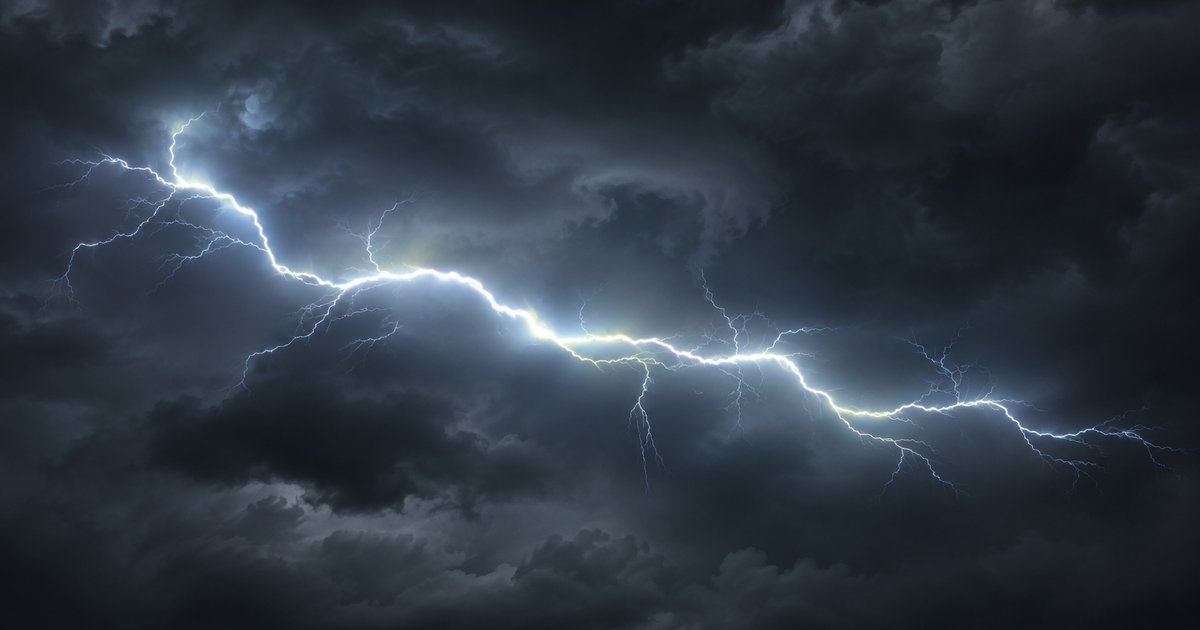
The air along a lightning channel can reach about 50,000 °F (roughly 27,800 °C), according to the National Weather Service, which is about five times hotter than the Sun's surface. That is a round, approximate figure rather than a thermometer reading: another NOAA source gives a range of 18,000 to 60,000 °F, and two recent field studies report average peak temperatures of about 31,000 and 62,000 °F.
Lightning has no temperature of its own, but the air around it does
The National Weather Service explains that lightning is technically the movement of electric charge, and moving charge by itself has no temperature. What heats up is whatever the charge passes through, because the material resists the flow. A good conductor warms less than a poor one, and air is a very poor conductor, so the air along a lightning path becomes extremely hot. The NWS says lightning can heat that air to 50,000 °F.
The same NWS page notes what happens when the path runs through a tree: the heat turns any water in its way to vapor, which can make the tree explode or blow a strip of bark off.
The 50,000 °F figure is a round number, not a single measurement
The NOAA National Severe Storms Laboratory (NSSL) gives two statements on one FAQ page. One says the energy of lightning heats the surrounding air to anywhere from 18,000 to 60,000 °F. Another says the air in the channel climbs above 50,000 °F in a few millionths of a second. So two NOAA sources do not quote an identical number, and the NSSL itself gives a span rather than a single value.
Nobody can hold a thermometer inside a bolt, so researchers infer temperature from the light it gives off. In a 2025 paper, a research team used sensors tuned to bright infrared lines of oxygen atoms and compared the brightness at three of them. In a 2026 paper, authors from the same group reported the same kind of average for a different set of strokes. Their averages for the peak temperature of the main, bright surge of a strike, called the return stroke, differ widely.
| Source | Reported figure | Roughly in °F |
|---|---|---|
| National Weather Service | Air can reach 50,000 °F | 50,000 |
| NSSL FAQ | Air heated to 18,000–60,000 °F | 18,000–60,000 |
| Field study, Feb. 2025 (44 strokes) | Average peak 17,600 K | 31,000 |
| Field study, Jan. 2026 (23 strokes) | Average peak 34,800 K | 62,000 |
The kelvin figures are converted here, not copied. The spread means no single number describes every bolt. The studies also disagree on a detail: the 2025 paper found no apparent link between peak temperature and peak current, while the 2026 paper found a weak one. Its authors add that the peer-reviewed literature on the temperature of lightning's sub-processes is scant, so the honest summary is that the order of magnitude is well supported and the exact value for any one bolt is not.
Duration matters as much as degrees. The 2026 study followed one stroke that held about 20,000 K (roughly 35,500 °F) for at least 10 milliseconds while cooling slowly, and the NSSL describes the air reaching its peak within millionths of a second.
How lightning compares with the Sun's surface, lava and an oven
NASA lists the Sun's visible surface, the photosphere, at about 10,000 °F (5,500 °C), which matches the NWS statement that lightning is five times hotter. NASA's fact sheet gives an effective surface temperature of 5772 K; the two field averages above work out to roughly three and six times that value in kelvin. The comparison holds only for the surface, because NASA puts the Sun's core above 27 million °F.
| What | Temperature | Source |
|---|---|---|
| Sun's core | Above 27 million °F (15 million °C) | NASA |
| Air in a lightning channel | About 50,000 °F (roughly 27,800 °C) | NWS |
| Sun's surface | About 10,000 °F (5,500 °C) | NASA |
| Basaltic lava at eruption | Up to 2,280 °F (1,250 °C) | USGS |
| Pizza ovens | 700–1,000 °F (370–540 °C) | USGS |
| Regular oven | 500 °F (260 °C) | USGS |
These are peaks, not durations or amounts of heat. A lightning channel is hotter than lava in degrees, but the sources above describe the lightning peak lasting from millionths of a second to at least 10 milliseconds, and none of them compares the energy involved, so degrees alone do not say which does more damage.
Thunder is the sound of that sudden heating
Thunder begins as a pressure jump in the heated air. The NSSL explains that the return stroke heats the channel so fast that the air has no time to expand, leaving it at very high pressure. That air then pushes outward into the surrounding air, and the disturbance is a shock wave for roughly the first 10 yards (about 9 meters) before it settles into an ordinary sound wave, which is thunder. The NWS adds that thunder can normally be heard about 10 miles from a strike.
The rumble, the count from flash to bang and the reason hearing thunder means you are within range are covered in Flash to bang: how far away was that lightning?, so this article stops at the temperature behind the sound.
What the heat does to trees and ground
Trees show the effect most clearly. The NSSL notes that lightning traveling down a trunk turns water to steam, and the rapidly expanding steam can blast pieces of bark away, matching the NWS description above. When lightning strikes the ground, the NSSL says it tends to fuse dirt and clay into a glassy, tube-shaped rock called a fulgurite, which is relatively rare. The NSSL page gives no temperature for this, so none is stated.
A struck tree is also why trees are poor cover; Where to shelter from lightning and Five ways lightning strikes people explain how people are hurt near one.
The temperature does not change what to do
The NWS states that if you hear thunder, even a distant rumble, you are already in danger of becoming a lightning victim. The temperature of the bolt does not change that advice. Lightning Tracker, an iPhone app, shows recent detected strikes on a live map with the distance and direction to the nearest one and how many minutes ago it happened.
Not a substitute for official weather warnings.
If you hear thunder, seek shelter even if the app shows no nearby strike.
Sources
- National Weather Service, How Hot Is Lightning?
- National Weather Service, Understanding Lightning Science
- NOAA National Severe Storms Laboratory, Severe Weather 101: Lightning FAQ
- NASA, Sun Facts
- NASA Goddard Space Flight Center, Sun Fact Sheet (updated May 9, 2024)
- U.S. Geological Survey, California Volcano Observatory, How hot is hot when it comes to volcanoes? (October 1, 2024)
- Wemhoner et al., Journal of Geophysical Research: Atmospheres, February 2025, Near-Infrared Atomic Oxygen Photometry of Lightning (NSF Public Access Repository record)
- Wemhoner et al., Scientific Reports, January 9, 2026, Atomic oxygen photometric temperature of lightning and its sub-processes with SOPAPILLA (abstract also in the NSF Public Access Repository)