 Lightning Tracker
App Store
Storm basics
Why lightning looks purple, red or white
November 19, 2026 · 7 min read
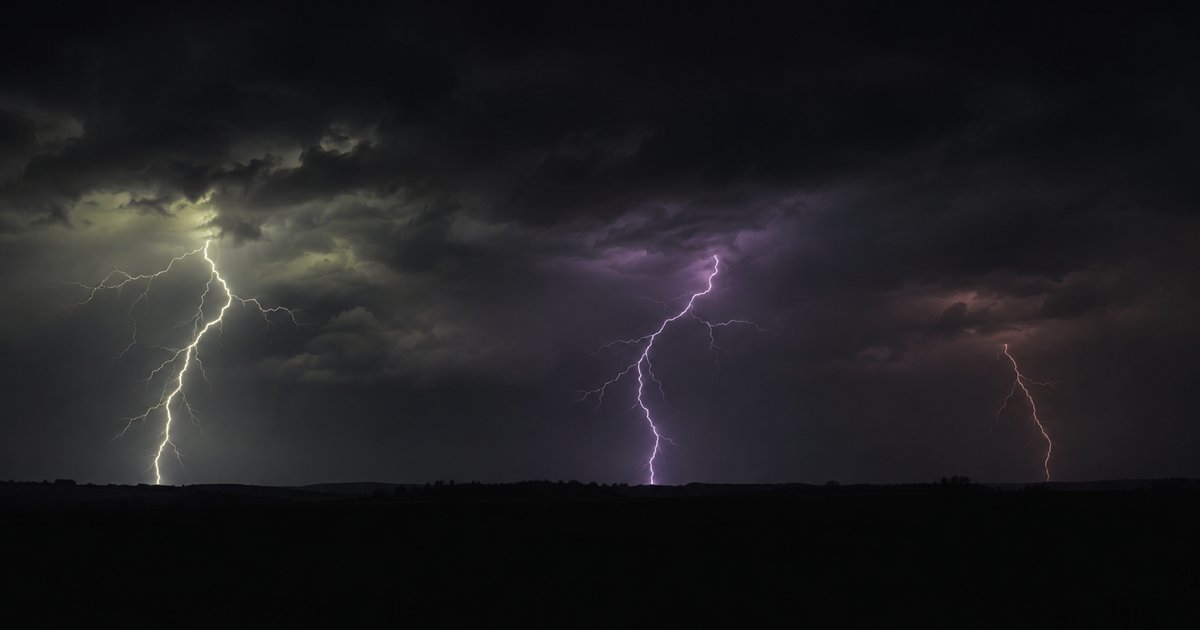
Purple is one of the many colors the same bolt can show: the University of Wisconsin–Madison says lightning emits light at every visible wavelength, with most of the energy at blue wavelengths. The NOAA National Severe Storms Laboratory says the same bolt can look many different colors depending on what its light travels through, such as haze, dust, moisture and raindrops. The sources reviewed here give no single documented cause for purple, and the NOAA and university pages do not rank colors by rarity, heat or danger. The National Weather Service treats thunder, not color, as the signal to go indoors.
White is the usual look, and your eyes help make it so
The University of Wisconsin–Madison’s Weather Guys column explained in September 2017 that a lightning channel is a very hot plasma that emits light at every visible wavelength, with most of the energy at blue wavelengths. Because the intensity of all the colors tends to saturate the eye, the column says, people perceive white. It also points out that color describes what we sense and interpret, not the light itself. The NOAA National Severe Storms Laboratory (NSSL) lightning FAQ, as of November 2026, treats white or blue as the usual appearance and answers the question of why lightning is ever colored instead.
What the light is made of
A spectrometer splits light into its wavelengths. Measured that way, the studies below describe lightning light as narrow bright lines sitting on a continuous glow. A 2014 conference paper by T. Daniel Walker and Hugh Christian of the University of Alabama in Huntsville recounts that Leon Salanave’s 1961 overview of early spectra already named the hydrogen lines among the significant ones, with neutral and singly ionized nitrogen and oxygen as the most predominant features. The authors report newly found lines of doubly ionized nitrogen, which had not been observed in earlier work.
A 2015 Sandia National Laboratories poster adds detail from summer thunderstorms near Albuquerque. In the faint leader, the dim channel that forms before the bright return stroke, one hydrogen line at 656.3 nanometers dominated the emission. That wavelength falls in the red part of the spectrum. Once the return stroke began, emission below 700 nanometers shifted mainly to a continuous glow, with nitrogen lines at 500 and 568 nanometers staying fairly persistent.
These are instrument measurements of the light, not records of what a person saw. None of the measurements reviewed here tests perceived color, so they explain why lightning carries both blue and red light, not why one observer sees purple.
How distance and weather tint a bolt
NSSL says haze, dust, moisture, raindrops and other particles in the atmosphere affect lightning’s color by absorbing or diffracting part of its white light. The idea is familiar from sunsets. NASA’s Space Place, in a page updated in August 2022, explains that blue light is scattered more than other colors because it travels as shorter waves, so when sunlight crosses more air, reds and yellows are left to reach the eye. NSSL applies the same logic to flashes too far away for thunder to be heard, which it says may look reddish, like sunsets.
The same reasoning predicts that a bolt seen through a long or hazy path leans warmer than the same bolt seen close up. An educator at the Museum of Science in Boston said in a September 2021 podcast that the closer you are to lightning, the less air its light crosses and the whiter it often looks. Treat that as a secondary, informal source, though it agrees with the NSSL logic.
Colors people report, and how firm the support is
| Color seen | What the sources say | How firm it is |
|---|---|---|
| White | Brightness across all wavelengths saturates the eye (UW–Madison, 2017). | Firm: university and NSSL agree on the usual look. |
| Blue | NSSL calls white or blue the usual appearance; the plasma’s output peaks at blue wavelengths. | Firm. |
| Pink or green | NSSL says they are often described in snowstorms, where lightning is somewhat rare. | Stated by NSSL, with only the general particle explanation. |
| Purple | No NSSL or National Weather Service page explains it; explainers give different causes. | Weak: none cites measurements. |
| Reddish | NSSL says distant lightning may look reddish, like a sunset. | Firm. |
| Red, orange or yellow near volcanoes | The Museum of Science podcast (2021) links them to heated ash and volcanic gases. | Weak: one secondary source. |
| Red sprites, blue jets | NSSL says sprites are mostly red and blue jets are named for their color; both occur above storms. | Firm, but rarely seen by eye. |
Sprites and jets are not what shows up in a bolt near you. NSSL says sprites are rarely seen with the human eye and are usually imaged with highly sensitive cameras, and it says blue jets have been witnessed by pilots.
Purple has no single documented cause
NSSL does not mention purple. Museum of Science staff said in the 2021 podcast that there is no clear-cut answer, and tied the purple of their indoor sparks to humidity and to how much air the light crosses. An undated explainer from a television station in the Quad Cities says that excited nitrogen and oxygen at the surface give off violets, blues and reds, which it says blend to purple. It cites no measurements and leans on a paint-mixing comparison, so it is a hypothesis, not a finding.
Putting the pieces together, purple plausibly comes from the strong blue light lightning emits mixing with red, either from the hydrogen line or from a long path that removes blue. That is an inference from the sources above, not a finding of any of them.
Is purple rare? ABC News does not call it rare. Its story (posted 19 October 2024, updated 7 January 2025) quotes Bureau of Meteorology senior forecaster Jessica Lingard saying purple was the most common colour of lightning, with no count behind it. She says light from lightning refracts into a spectrum, like a rainbow, and that the hotter the lightning, the more likely blues and purples show rather than reds or pinks. A photographer the story quotes, Jordan Cantelo, usually sees white by eye and purple more often on camera. This differs from the inference above, which points to a hydrogen line or a long path that removes blue. Neither account rests on a measurement of perceived color, so this article reports both and picks neither. That is this article’s reading.
A photo is weaker evidence than it looks
The Museum of Science podcast said that a photograph can come out more yellow or brown depending on camera settings, and that the same bolt may look different to each person because people perceive color differently. That matches the UW–Madison point that color belongs to perception. A lightning photo or video that looks purple may show the camera’s processing as much as the sky.
The “rarest color” question has no sourced answer
NSSL, as of November 2026, ranks no color by rarity. The one rarity it states is that lightning in snowstorms is somewhat rare, and pink and green are the colors people describe there. Some popular pages fill the gap with rankings. A WorldAtlas explainer published July 15, 2020 calls white the most common color and also the hottest, then says blue lightning is considered the most dangerous because it can travel fast.
NSSL’s color answer ties appearance to what the light travels through and says nothing about temperature, speed or danger. Because the look also depends on the viewer’s distance and camera, a fixed ranking of bolt colors by rarity would be hard to support from the sources reviewed. If anything is rare to see, it is sprites, which NSSL says are rarely seen with the human eye.
Is purple lightning dangerous?
None of the agency and university pages reviewed here says that purple, or any other color, marks a more dangerous strike, and the National Weather Service ties its advice to the sky and to thunder, not to color: get inside if the sky looks threatening or you hear thunder. None of the color explanations changes the National Weather Service guidance: if you hear thunder, you are likely within striking distance of the storm, so go indoors, and wait 30 minutes after the last lightning or thunder before going back out. A white bolt, a purple sky and a pink flash call for the same response. Flash to bang shows how to turn the delay into a distance, where to shelter says where to go, and why the wait restarts explains the clock. For other beliefs checked against the Weather Service, see ten lightning myths.
For tracking rather than guessing from color, Lightning Tracker, an iPhone app, shows detected strikes on a live map, with the distance and direction to the nearest one and how many minutes ago it was detected.
Not a substitute for official weather warnings.
If you hear thunder, seek shelter even if the app shows no nearby strike.
Sources
- NOAA National Severe Storms Laboratory, Severe Weather 101: Lightning FAQ
- NOAA National Severe Storms Laboratory, Severe Weather 101: Lightning Types
- University of Wisconsin–Madison Space Science and Engineering Center, The Weather Guys, Why is lightning white?, September 5, 2017
- T. D. Walker and H. J. Christian, University of Alabama in Huntsville, Novel Observations in Lightning Spectroscopy, 15th International Conference on Atmospheric Electricity, June 2014
- Sandia National Laboratories, Multi-mode Observations of Cloud-to-Ground Lightning Strokes, poster SAND2016-0152C
- NASA Space Place, Why Is the Sky Blue?, updated August 29, 2022
- National Weather Service, Lightning Safety Overview
- Museum of Science, Boston, Why Is Our Lightning Purple?, Pulsar podcast, September 20, 2021, secondary source
- WHBF, Ever wonder why lightning usually appears purple?, undated, secondary source
- WorldAtlas, What Color Is Lightning?, July 15, 2020, secondary source
- ABC News, Why purple is the most common colour of lightning seen during a thunderstorm, posted October 19, 2024, updated January 7, 2025, secondary source