 Lightning Tracker
App Store
Storm basics
Thundersnow: lightning inside a snowstorm
November 9, 2026 · 5 min read
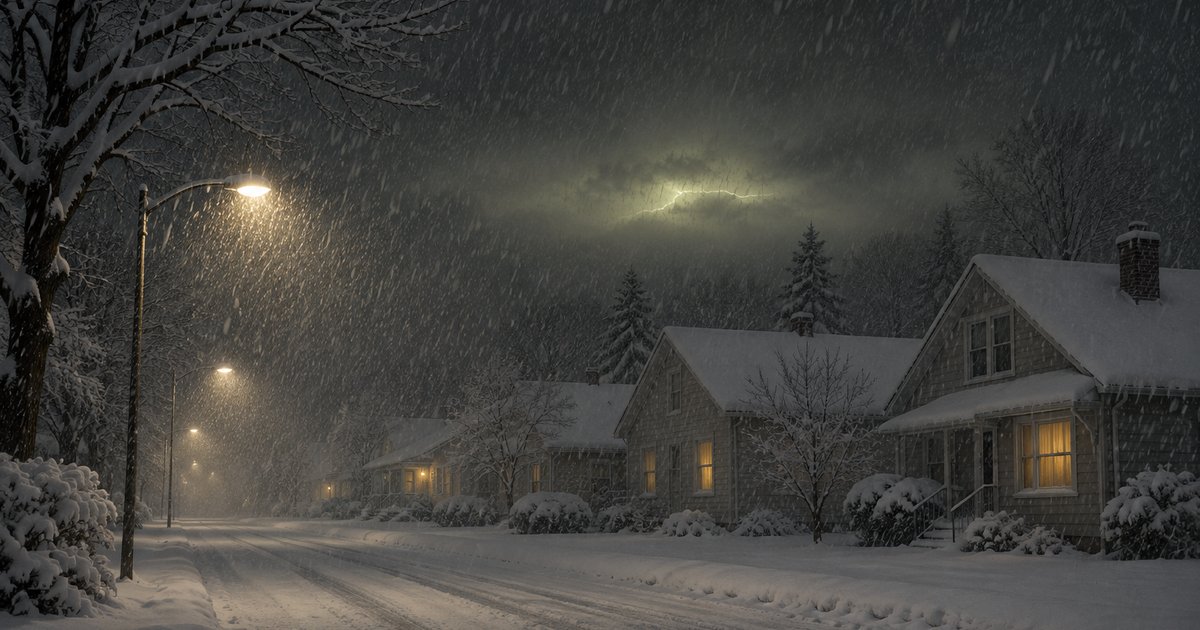
Thundersnow is a thunderstorm in which snow, not rain, is the main precipitation, and its lightning is ordinary lightning. It is rare, but it is documented in the central United States, the intermountain West and the Great Lakes region, and the snow muffles its thunder so much that you may hear it only from 2 to 3 miles away.
Thundersnow is a thunderstorm that happens to produce snow
The National Severe Storms Laboratory (NSSL) defines thundersnow as lightning within a snowstorm and notes that thunderstorms are less common in winter. Like every thunderstorm, it needs three ingredients: moisture, unstable air and a lifting mechanism, according to NOAA's JetStream education pages (updated June 2023). The difference is where the instability sits. NSSL says thundersnow can be found where instability is relatively strong and moisture abundant above the surface, such as above a warm front.
The electrical charge builds in familiar ways. A 2014 study of winter low-pressure systems, published in the Journal of the Atmospheric Sciences, measured graupel (soft pellets of frozen water), ice particles and supercooled water (liquid water below freezing) together at temperatures from −10 to −20 °C. The authors read that mix as support for a charging process called noninductive charging in these storms.
Why thundersnow is rare, and how rare nobody knows exactly
A 2002 climatology (a statistical description of where and when something occurs) in Weather and Forecasting is the standard U.S. count. It used 30 years of 3-hourly reports from 204 weather stations in the contiguous 48 states, and its maps cover 1961 to 1990. From them the authors extracted 229 reports of thunder with snow, and those reports made up 191 thundersnow events. Divided by 30 years, that is roughly six events a year across the whole station network, our arithmetic rather than a figure the paper states.
That count is a floor, not a national rate. Most events were reported at only one station, and the authors describe thundersnow as a fairly localized phenomenon of limited duration. A 2019 study by researchers at NASA's Marshall Space Flight Center and the University of Alabama in Huntsville found 2,175 lightning flashes in detected snowfall that aviation weather reports had missed, and concluded that thundersnow has been under-reported in earlier literature.
The ingredients explain the rarity. NOAA describes unstable air as warm, moist air near the surface under cold, dry air aloft. In snow weather the air near the ground is cold, so the setups that supply that contrast usually sit higher up. That is our reading of the two sources, not a statement from either.
Where and in what setting thundersnow happens
The 2002 climatology found three preferred regions for thundersnow in the United States: the central part of the country, the intermountain West and the Great Lakes region. The research describes three kinds of setting.
- Winter low-pressure systems. The 2002 study tied 52 percent of events to a transient midlatitude cyclone, a low-pressure system moving across the middle latitudes. The rest included orographic (terrain-driven) events, coastal cyclones, arctic fronts, lake-effect events and upslope flow.
- Above a warm front. NSSL names this as a place where strong instability and abundant moisture can sit above the surface.
- Downwind of big lakes. NSSL says thundersnow is sometimes observed downstream of the Great Salt Lake and the Great Lakes during lake-effect snowstorms, the bands of snow that form downwind of a large lake.
Snowfall and season: not always a blizzard
The 2002 climatology found a nationwide preference for March and no clear preference for any time of day, so thundersnow does not follow the afternoon heating that drives many summer storms. The snow itself was often light: about half of the events came with light snow, 25 percent with moderate snow and 23 percent with heavy snow. A flash of lightning in a snowstorm therefore says little about how hard it is snowing.
Snow muffles the thunder, not the lightning
The UK Met Office says the snow inside a thunderstorm dampens the sound of the thunder, so it is heard only within 2 to 3 miles of the lightning. The National Weather Service says ordinary thunder can be heard for only about 10 miles and treats any thunder as a warning that you are within striking distance. The Met Office adds that at night the lightning looks brighter, because the light reflects off the snowflakes.
The consequence is ours to draw: in a snowstorm, silence tells you less about distance than it does in summer, because thunder carries 2 to 3 miles instead of about 10. Counting seconds, as in the flash-to-bang article, still works for a bang you hear, but a missing bang is weak evidence that the lightning is far away.
Lightning in winter storms still reaches the ground
Winter lightning is not confined to the clouds. The 2014 study of 16 winter low-pressure systems found that about 55 percent of the flashes were cloud-to-ground flashes and 45 percent stayed in the cloud. Over 90 percent of the ground flashes had negative polarity. In the 2019 study of lightning in snowfall, 77.1 percent of 2,034 matched ground flashes were negative, which leaves about 23 percent positive. Neither study found a majority of positive flashes.
Tall objects take hits. The 2019 study found that at least 11.1 percent of the flashes it examined involved a tall human-made object such as an antenna or a wind turbine. The authors also cite research suggesting shorter towers are more likely to be struck in the cold season, because the charge centers sit lower in winter storms.
The research counts storms and flashes. It does not say how many people thundersnow injures, and we found no published figure.
What a map can and cannot show in a snowstorm
In the 2019 comparison, the National Lightning Detection Network logged at least one cloud or ground flash for 1,709 of the 2,214 flashes the GOES satellite saw in snowfall. In that comparison, roughly one flash in four had no ground-network match. How lightning is detected explains why networks differ and why a map can miss a strike.
Lightning Tracker, an iPhone app, shows recently detected strikes on a live map, with the distance and direction to the nearest one and how many minutes ago it happened. It alerts you when a strike is detected inside a radius you set for each place; the default is 10 miles (16 km). Detection networks miss some strikes, data can arrive late, and the app marks a delay or gap instead of treating it as quiet. Whether a given snowstorm's flashes appear on any map depends on what the detection networks catch.
What to do when thunder sounds in a snowstorm
The National Weather Service tells people to get inside if they hear thunder and to wait 30 minutes after the last lightning or thunder before going back outside. The wording is about thunder and lightning, not about the season or the kind of precipitation. The 30-minute article explains why the clock restarts with each strike, and the shelter article covers which buildings and vehicles count. Lightning Tracker's return wait follows the same logic, counting from the last strike detected inside your radius, and when it ends the app asks you to judge conditions yourself.
Not a substitute for official weather warnings.
If you hear thunder, seek shelter even if the app shows no nearby strike.
Sources
- National Severe Storms Laboratory, Severe Weather 101: Winter Weather FAQ
- NOAA JetStream, Ingredients for a Thunderstorm, updated June 2023
- Market, Halcomb and Ebert, A Climatology of Thundersnow Events over the Contiguous United States, Weather and Forecasting, December 2002
- Rauber et al., Stability and Charging Characteristics of the Comma Head Region of Continental Winter Cyclones, Journal of the Atmospheric Sciences, May 2014
- Harkema et al., Geostationary Lightning Mapper Flash Characteristics of Electrified Snowfall Events, Weather and Forecasting, October 2019
- Met Office, Thunder and lightning
- National Weather Service, Understanding Lightning: Thunder
- National Weather Service, Lightning Safety Overview