 Lightning Tracker
App Store
Storm basics
What happens when lightning hits a wind turbine?
November 19, 2026 · 9 min read
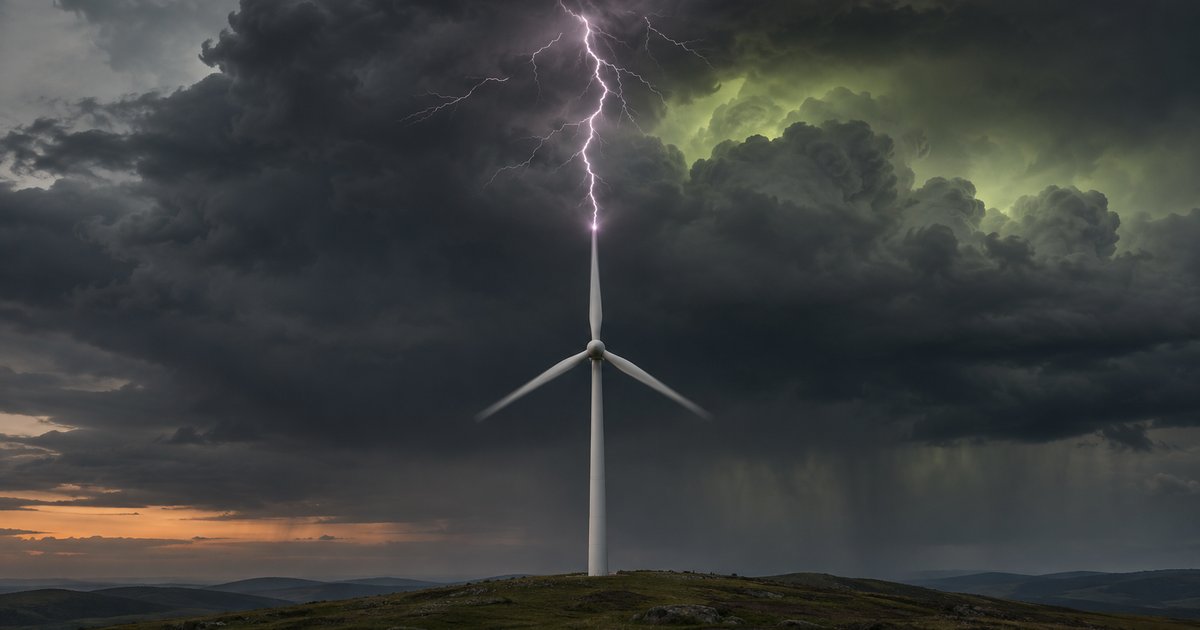
Lightning does strike wind turbines, and most strikes appear to cause no structural damage, but some damage a blade or the electronics that run the machine. Xweather, a company that sells lightning data, counted nearly one in three of more than 70,000 U.S. turbines as struck in 2025, and Oak Ridge National Laboratory calls strikes to blades frequent but rarely catastrophic. Metal receptors and a down conductor carry the current to the ground; they give a strike a path but do not prevent it.
Xweather counted lightning at nearly one in three U.S. wind turbines in 2025
Xweather, a company that sells lightning data and alerts to wind farm operators, says in a June 2026 post that its analysis of more than 70,000 operational U.S. turbines found nearly one in three, 31.4%, was struck by lightning in 2025. The number of turbines struck by four or more strokes rose 32.1% from 2024, it says, while the total number of struck turbines rose 18.4%, in a year when lightning counts across the U.S. rose 20%. Xweather uses “stroke” for a discharge between cloud and ground and notes that one flash can hold several.
An earlier Xweather post, published in April 2024, covered 2023. It reports 77,494 strokes at or near wind farms in the contiguous United States, just over one per turbine on average, with a wide spread: 33% of wind farms went through the year with no strike, and a farm in Pushmataha County, Oklahoma, averaged 14.4 strokes per turbine. Xweather says lightning is most common in the middle of the country and the Gulf Coast states, and that the taller a turbine is, the more likely it is to be struck.
A preprint by Ryan Said, Eric Grimit and Martin Murphy of Vaisala Inc., posted on arXiv in October 2024, used seven years of National Lightning Detection Network data and the U.S. Wind Turbine Database, covering over 67,000 turbine locations. Xweather’s April 2024 post names Vaisala’s detection network, so these two sources are not fully independent of each other. In the preprint’s per-turbine analysis, about 20% to 37% of turbines, depending on height group, had no detected strike during the period; for the two tallest groups the authors say a shorter time on record likely explains more zero counts. They also report that the average tip height, the blade’s height when vertical, rose from under 328 feet (100 meters) in 2000 to 538 feet (164 meters) in 2022.
| Source and date | What was counted | Result |
|---|---|---|
| NREL conference paper, August 2000 | Estimated strikes per turbine per year, from flash density and a collection area with a radius of three times the blade-tip height, at seven plants and a typical California site | 0.0 at Kotzebue, Alaska; 0.04 at the California site; 0.43 at Springview, Nebraska (late-1990s turbines) |
| Xweather, April 2024 (2023 data) | Strokes at or near wind farms in the contiguous U.S. | 77,494 strokes; 33% of farms had none |
| Said and colleagues, October 2024 | Detected strokes near over 67,000 turbine locations over seven years | About 20% to 37% of turbines had no detected strike, by height group |
| Xweather, June 2026 (2025 data) | Share of more than 70,000 turbines struck in one year | 31.4% struck |
Oak Ridge National Laboratory calls strikes to blades frequent but rarely catastrophic
Oak Ridge National Laboratory (ORNL), in a December 2024 article on blade research funded by the Department of Energy, writes that lightning strikes to turbine blades are frequent but rarely catastrophic, though they can leave internal damage that weakens a blade and raises repair costs over time. It quotes researcher Vipin Kumar saying that lightning strikes are the second leading cause of blade-related downtime and that there is not enough data to know the true scope of the challenge. The article adds that the blade tip is where lightning strikes most often.
Two companies put numbers on how often a strike does harm, using different denominators. Xweather’s April 2024 post says industry experts estimate that turbines survive 97% to 99% of lightning strikes without significant damage, and that the damaging 1% to 3% cost the industry $100 million a year and account for 60% of blade losses and almost 20% of operational losses overall, according to estimates. Its June 2026 post calls lightning the leading cause of blade damage in the United States and says most strokes cause no structural harm. Bladefence, a blade-service company, wrote in December 2023 that, by the statistics in IEC 61400-24, 4% to 8% of all wind turbines suffer lightning damage every year, more in areas of high lightning intensity. One figure is a share of strikes and the other a share of turbines per year, and neither comes from an independent field count, so the two cannot be combined.
Sandia National Laboratories’ April 2013 report from the Blade Reliability Collaborative, a Sandia-led project begun with the Department of Energy in 2010, gathered blade damage data from operators and service companies. It found large variation: almost every data source included blades with no damage, some sources had no lightning damage, and in others every turbine showed some. The report calls its preliminary analysis directional because the information does not represent a large portion of the fleet. It also records that at a July 10, 2007, meeting hosted by Sandia, a representative of AES said one lightning storm had damaged 28% of the blades on the wind farm, mostly fiberglass blades.
Candela Garolera and colleagues found blade damage clustered at the tip, and some of it hides inside
A 2016 paper in IEEE Transactions on Power Delivery by Anna Candela Garolera, Søren Find Madsen and co-authors analyzed 304 cases of damage from direct lightning attachment to the surface of blades at U.S. wind farms, covering blades of different lengths, laminate structures and protection systems. Most of the damage was at the blade tip, and blades with different geometry and materials showed great similarity in where damage fell and what it looked like.
Damage inside a blade is harder to see. Bladefence says it has seen cases where a large part of the down conductor cable inside a blade vaporized after a strike, which it says cannot be noticed without an on-site resistance measurement of the whole protection system. It contrasts this with airplanes, which it says are inspected after every strike.
NREL’s late-1990s field work found turbine controllers the most sensitive hardware
The National Renewable Energy Laboratory (NREL) published a conference paper in August 2000 on lightning at wind plants in the Department of Energy and Electric Power Research Institute Turbine Verification Program. At the 6-megawatt plant in Fort Davis, Texas, the team watched turbines with video cameras and strike sensors. It found that significant damage came from indirect strikes and that the turbine controller hardware was the most sensitive part.
The paper’s 1999 damage list shows what that meant. At Springview, Nebraska, a lightning event on July 2, 1999, kept one turbine down 140.7 hours with damage to a CPU board, matrix boards, an output controller board and a rotor driver board. At Searsburg, Vermont, a July 30, 1999, event caused extensive controller damage on one turbine, which was down 371.5 hours. At Fort Davis, damage to two power supplies and two pressure transducers on June 22, 1999, kept a turbine down 729 hours, and the paper lists spares as not available.
After retrofits to grounding and to the shielding of sensor cables, lightning downtime fell at Fort Davis. The paper’s table lists total lightning downtime per turbine of 233 hours from July 1996 to June 1997 and 41 hours from July 1998 to June 1999, and the authors say lightning damage to the project had been virtually eliminated. The paper also records a direct strike to a turbine there in May 2000 that caused no damage. The data come from late-1990s turbines at a handful of sites, and the paper traced one June 1999 damage case to mitigation that was incomplete in the turbine.
Receptors, down conductors and grounding give the current a metal path to the ground
The Department of Energy’s wind energy FAQ says lightning that strikes a turbine will typically hit the tallest parts, the blades. Each blade has one or more metal parts exposed to the air, called receptors, connected to a steel cable, the down conductor, which carries the current down the blade, through the nacelle, the housing for the turbine’s components, and down the tower to the earth.
The idea is the one behind a lightning rod system on a building. The National Weather Service says such systems do not prevent lightning from striking the structure; they intercept a strike and give it a conductive path to follow into the ground. The guidelines in NREL’s paper follow the same logic for turbines: blade conductors are essential, grounding should use plenty of conductor, and control cabling should be bonded and shielded, with fiber optic lines for communication in high-lightning areas. Two Zond turbine models without blade conductors suffered lightning-related blade damage, while the Tacke and Vestas turbines, which had them, were judged to have adequate lightning protection.
Protection systems have limits: strong strikes, missed contacts and wear
Said and colleagues write that the highest lightning protection standards target protection against 99% of lightning discharges across each current parameter, and that more frequent strikes raise the chance of a discharge energetic enough to exceed a system’s tolerances. They add that the current may not attach to a designated contact point and that protection components can deteriorate after repeated exposure to current. Xweather’s June 2026 post says more turbines are collecting repeated strokes that degrade protection systems, with damage ranging from minor receptor wear to complete blade loss. Bladefence sorts damage into two groups: strikes whose current exceeds what the system was designed for, and defects in the protection system.
The ORNL article adds a materials view. Kumar says the metal receptor and rod in a blade do not always draw the current when lightning strikes the composite. In ORNL’s lab tests at Mississippi State University, a 6.5-foot (2-meter) blade tip made with conductive carbon fiber came through high-voltage tests undamaged but did not hold up as well to intense current, while test panels of the same material showed no visible or internal damage. Those are results on a prototype in a laboratory, not field data.
IEC 61400-24 is the wind-specific lightning standard, and its full text is sold
The International Electrotechnical Commission (IEC) lists IEC 61400-24:2019+AMD1:2024 CSV, Wind energy generation systems, Part 24: Lightning protection, as a consolidated edition published November 13, 2024. The second edition replaced the first, published in 2010. IEC’s description says the document defines the lightning environment for wind turbines and the risk assessment in that environment, sets requirements for protecting blades, other structural components and electrical and control systems against direct and indirect effects of lightning, and includes test methods to validate compliance. The text is sold by IEC, and this page did not read it, so what follows about its contents rests on IEC’s description and on companies that apply it.
DNV, a certification body, says it verifies the lightning protection of blades and complete turbines against the standard, which can result in a component certificate for blades, a laboratory or shop approval, or consideration in a turbine’s type certificate. Bladefence says the standard recommends three blade designs: receptors at the tip with an internal conductor to the hub, a metal conductor around the blade’s edges, or a metal mesh on the side of the blade. It adds that many turbines were built before the first edition of 2010, so older turbines vary more in how they are protected.
Counts of struck turbines come from detection networks that miss many upward flashes
Said and colleagues write that lightning detection networks typically catch over 95% of cloud-to-ground flashes but a significantly smaller share of upward discharges, and their conclusion says a long-range network typically misses over half of them. Upward flashes start at a tall structure and climb toward the cloud, and the preprint says they affect structures above approximately 328 feet (100 meters). Because a network reports each stroke’s location with some error, the preprint treats a detected stroke within about 295 feet (90 meters) of a turbine as a probable attachment, a rule it estimates captures about 86% of true attachments while counting some nearby ground strokes by chance. In these reports, a “struck” turbine is therefore a statistical judgment from detection data, not the result of an inspection.
Lightning Tracker, an iPhone app that shows recently detected strikes on a live map, takes its strike observations from Xweather, the company behind the 2025 turbine count above, and notes that detection networks miss some strikes.
Not a substitute for official weather warnings.
If you hear thunder, seek shelter even if the app shows no nearby strike.
Sources
- U.S. Department of Energy, Frequently Asked Questions About Wind Energy
- Oak Ridge National Laboratory, Thunderstruck: Researchers demonstrate lightning strike protection tech for composites, December 4, 2024
- National Renewable Energy Laboratory, Lightning Activities in the DOE-EPRI Turbine Verification Program, NREL/CP-500-28604, August 2000
- Sandia National Laboratories, Blade Reliability Collaborative: Collection of Defect, Damage and Repair Data, SAND2013-3197, April 2013
- Candela Garolera et al., Lightning Damage to Wind Turbine Blades From Wind Farms in the U.S., IEEE Transactions on Power Delivery, 2016 (abstract)
- Said, Grimit and Murphy, A multi-year CONUS-wide analysis of lightning strikes to wind turbines, arXiv preprint, October 2024
- International Electrotechnical Commission, IEC 61400-24:2019+AMD1:2024 CSV, Wind energy generation systems – Part 24: Lightning protection
- National Weather Service, Lightning Rods
- Xweather, Xweather reveals lightning risks for U.S. wind farms, April 2024
- Xweather, 32% more US wind turbines hit by 4+ lightning strokes in 2025, June 2026
- Bladefence, Lightning Strikes and Wind Turbine Blades, December 2023
- DNV, Lightning protection of wind turbines