 Lightning Tracker
App Store
Places and activities
What happens when lightning hits a plane
November 10, 2026 · 7 min read
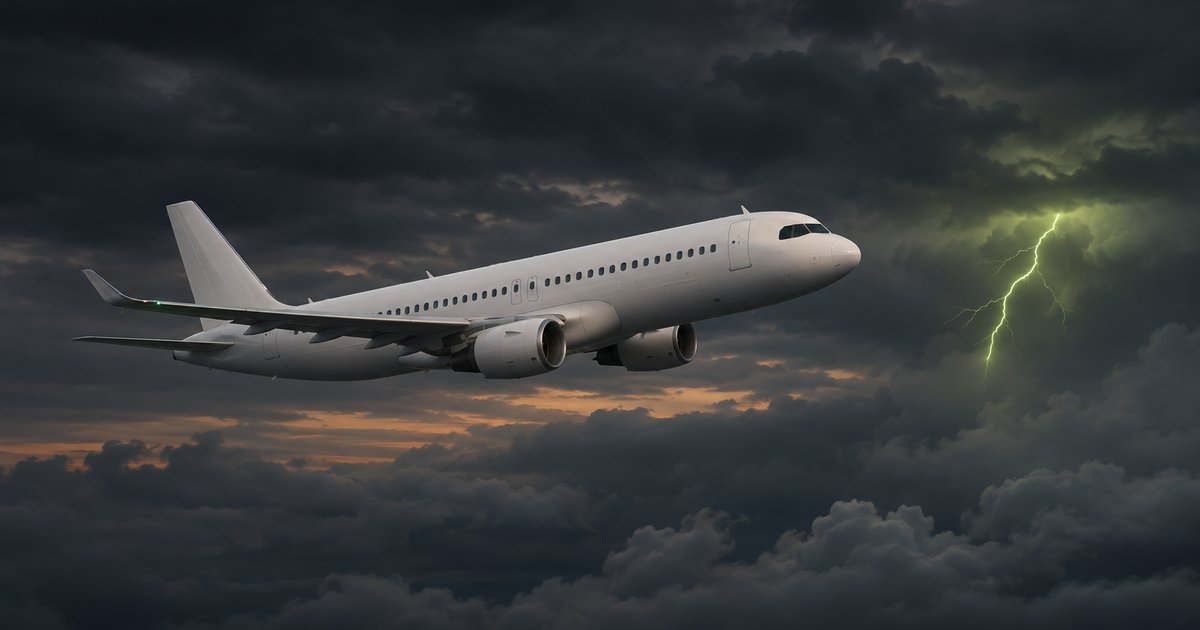
Usually very little. The Federal Aviation Administration (FAA) says that, on average, each transport airplane is struck once or twice a year, and airliners are built so the current enters at one point, travels through the structure and leaves at another. Passengers typically notice a flash and a bang, the aircraft is inspected on the ground, and the National Weather Service (NWS) says there has not been a lightning-caused commercial transport crash in many decades. Small private and experimental aircraft are a different story, and so was 1963.
Airliners are struck about once or twice a year
The National Weather Service gives an average of one or two lightning hits a year for commercial transport passenger planes. The FAA’s accident-lessons page for Pan American Flight 214 draws on several decades of transport airplane strike data and gives the same average for each airplane. A separate FAA advisory circular from 2018 states the rate per flight hour instead. The figures use different units, so this article does not convert one into another.
| Source | What is counted | Rate it gives |
|---|---|---|
| National Weather Service, Lightning and Planes (undated) | Commercial transport passenger planes | An average of one or two hits a year |
| FAA Lessons Learned, Pan Am Flight 214 (page last updated December 19, 2022) | Each transport airplane, from several decades of strike data | On average, once or twice a year |
| FAA Advisory Circular 25.954-1 (September 24, 2018) | Worldwide transport airplane fleet | On the order of once in several thousand flight hours |
| Finnair, airline article (July 13, 2025) | One airline’s fleet | Dozens of strikes a year for an airline of its size |
A count can only include strikes someone noticed. Phil Derner of New York City Aviation told CBS New York in 2016 that a pilot sometimes does not even realize the plane was struck. No source we found says how many strikes go unrecorded, so that number is unknown.
Aircraft are not just unlucky bystanders. The NWS says planes often initiate the strike: their presence strengthens the electric fields typical of thunderstorms and makes it easier for the air to break down electrically. The FAA says the same thing in different words, noting that an airplane passing near a building lightning leader can trigger the strike. The FAA’s Aeronautical Information Manual adds that the chance of a strike is greatest at altitudes where the outside temperature is between minus 5 and plus 5 degrees Celsius (23 to 41°F), and that lightning can hit aircraft flying in clear air near a thunderstorm.
Airlines steer around storms for that reason and others. The NWS says they avoid thunderstorms as much as possible, partly for turbulence and partly because a suspected strike requires an inspection that can delay flights and cost a great deal.
The current enters the airplane at one point and leaves at another
The FAA describes each strike as having an attachment point and an exit point, with the airplane becoming part of the path. The first attachment points are typically the extremities: wingtips, nose and tail surfaces. As the airplane flies through the lightning channel, the channel can re-attach to other surfaces, especially along the fuselage and across the tips of the wings and tail. Finnair, describing the same path from an airline’s side, says the discharge typically exits from the tips of the wings, the control surfaces or the tail.
The FAA also says these currents travel both on the surface of the airplane and through its internal structure. That is why protection is more than keeping current outside a metal shell: wiring, sensors and fuel tanks have to tolerate what flows nearby. The NWS puts the design goal simply, saying airliners are built with conducting paths through the plane to carry the current.
FAA rules for transport airplanes cover structure, wiring and fuel
Transport category airplanes are certified under Part 25 of Title 14 of the Code of Federal Regulations, and three of its sections set lightning requirements. As of the November 2026 edition of the regulations, they read as follows.
| Rule | What it requires |
|---|---|
| 14 CFR 25.581, Lightning protection | The airplane must be protected against catastrophic effects from lightning. Metal parts can meet this by being bonded properly to the airframe; nonmetallic parts by being designed to minimize a strike’s effect or to divert the current. |
| 14 CFR 25.1316, Electrical and electronic system lightning protection | Systems whose failure would prevent the airplane from continuing to fly and land must keep working during and after exposure to lightning and recover normal operation automatically in a timely manner. |
| 14 CFR 25.954, Fuel system lightning protection | Catastrophic ignition of fuel vapor must be extremely improbable. The design must also identify the protective features and set inspection and test intervals and mandatory replacement times for them. |
FAA advisory circulars explain acceptable ways to show compliance. Advisory Circular 20-136B states that it is not mandatory and describes a means, not the only means, of compliance. It also says the standards for protecting electrical and electronic systems rest on the aircraft’s exposure to lightning and the consequences of a system failure. Advisory Circular 25.954-1 (2018) says that lightning strike zones, the places where lightning is likely to attach, often vary from one airplane type to another, so each design is assessed on its own geometry.
Pan Am Flight 214 shows why the fuel rules exist
Pan American Flight 214, a Boeing 707-121, was struck by lightning on December 8, 1963, while holding at 5,000 feet west of the New Castle, Delaware, radio beacon (VOR) on a flight from Baltimore to Philadelphia. The FAA says the airplane was immediately seen to be on fire, a large part of the left wing separated, and it crashed near Elkton, Maryland. All 73 passengers and eight crew members died. The Civil Aeronautics Board found the probable cause to be lightning-induced ignition of the fuel and air mixture in the number 1 reserve fuel tank. The FAA adds that investigators never found where the spark occurred.
The accident overturned an assumption. During the 707’s development, engineers assumed that electrical bonding of fuel system parts gave inherent protection against lightning. The FAA says testing afterward showed more was needed, including shielding, thicker skins and a better understanding of strike zones. The FAA’s page, last updated in December 2022, says airplane aluminum skins are defined to be at least about 0.080 inches thick to protect against melt-through where lightning attaches, while the 707’s wing skin in the area of attachment was 0.064 inches at its thinnest. An airworthiness directive effective December 12, 1964, required additional aluminum skin over the vent surge tank area of the wing, and two later directives took effect in 1965 and 1967.
A 2026 FAA directive shows protection also depends on how aircraft are built
On February 24, 2026, the FAA proposed an airworthiness directive for certain Boeing 787-8, 787-9 and 787-10 airplanes after a report that some center wing fuel tank sealant installations did not receive required visual and adhesion inspections during production. The FAA said possible defects could create an ignition source and a risk of fuel tank explosion during a lightning strike.
The FAA issued the final directive, AD 2026-22-05, on November 2, 2026. It requires detailed inspection of specified sealant installations, an adhesion test and applicable follow-up actions for the airplanes it covers. The directive takes effect December 7, 2026; as of November 10, it has been published but is not yet effective.
Passengers usually notice a flash and a bang, then the plane is inspected
Finnair says passengers often notice a strike as a bang with a simultaneous flash outside the aircraft. On an American Airlines flight from Raleigh, North Carolina, to LaGuardia Airport in March 2016, one passenger told CBS New York, “There was a giant flash and then what sounded like an explosion.” The pilot diverted to John F. Kennedy Airport, and CBS reported only minor damage to the side and wing. The crew prepares for the flash too: the Aeronautical Information Manual tells pilots who cannot avoid a storm to turn the cockpit lights to the highest setting to lessen temporary blindness from lightning.
Afterward the routine is procedural. Finnair says the pilots check that equipment such as the radios still works, report the strike to technical staff, and the aircraft gets a thorough inspection after landing, with overhangs and rivets of the surface plates the most typical damage. The FAA sorts lightning effects on aircraft into three groups: physical damage such as punctured non-conductive enclosures like radomes and pitted or melted fasteners, indirect effects on electrical circuits, and ignition of fuel tank vapors. It also lists a rare fourth effect, engine failure, and says the engine is usually undamaged and can be restarted.
The sources we reviewed give no count of passengers or crew injured by lightning strikes on airliners, so none is given here.
Small private and experimental aircraft are not covered the same way
The National Weather Service says many planes are not required to be designed for protection from lightning, including small private and experimental aircraft. Its statement that there has not been a lightning-caused commercial transport crash in many decades comes with an addition: the same is not true of the other groups of aircraft. The NWS page gives no year or count for either claim, so treat “many decades” as the agency’s wording, not a measured figure.
What an airliner’s protection does not change on the ground
Aircraft certification says nothing about a person standing outside an airport terminal, in a parking lot or in a field. For people on the ground, the guidance is in where to shelter from lightning, in ten lightning myths, which covers cars and rubber tires, and in why wait 30 minutes, which explains why the clock restarts with every strike. If you want a look at the sky before heading to the airport, Lightning Tracker, an iPhone app, shows recently detected strikes on a live map, with the distance and direction to the nearest one and how many minutes ago it happened.
Not a substitute for official weather warnings.
If you hear thunder, seek shelter even if the app shows no nearby strike.
Sources
- National Weather Service, Lightning and Planes
- Federal Aviation Administration, Lessons Learned: Pan American World Airways Flight 214, Boeing 707-121
- Federal Aviation Administration, Advisory Circular 25.954-1, Transport Airplane Fuel System Lightning Protection (September 24, 2018)
- Federal Aviation Administration, Advisory Circular 20-136B, Aircraft Electrical and Electronic System Lightning Protection (September 7, 2011)
- Electronic Code of Federal Regulations, 14 CFR 25.581, Lightning protection
- Electronic Code of Federal Regulations, 14 CFR 25.1316, Electrical and electronic system lightning protection
- Electronic Code of Federal Regulations, 14 CFR 25.954, Fuel system lightning protection
- Federal Aviation Administration, Aeronautical Information Manual, Chapter 7, Section 1, Meteorology (Thunderstorms)
- Federal Aviation Administration, Federal Register, Airworthiness Directives; The Boeing Company Airplanes (91 FR 8791, February 24, 2026)
- Federal Aviation Administration, Federal Register, Airworthiness Directives; The Boeing Company Airplanes (91 FR 68877, November 2, 2026)
- Finnair, What happens if lightning strikes an aircraft? (July 13, 2025)
- CBS New York, Passengers Recall Moment Of Fear When Lightning Struck NYC-Bound Plane (March 18, 2016)