 Lightning Tracker
App Store
Storm basics
Apollo 12 and lightning: what happened 36 seconds after launch
November 11, 2026 · 9 min read
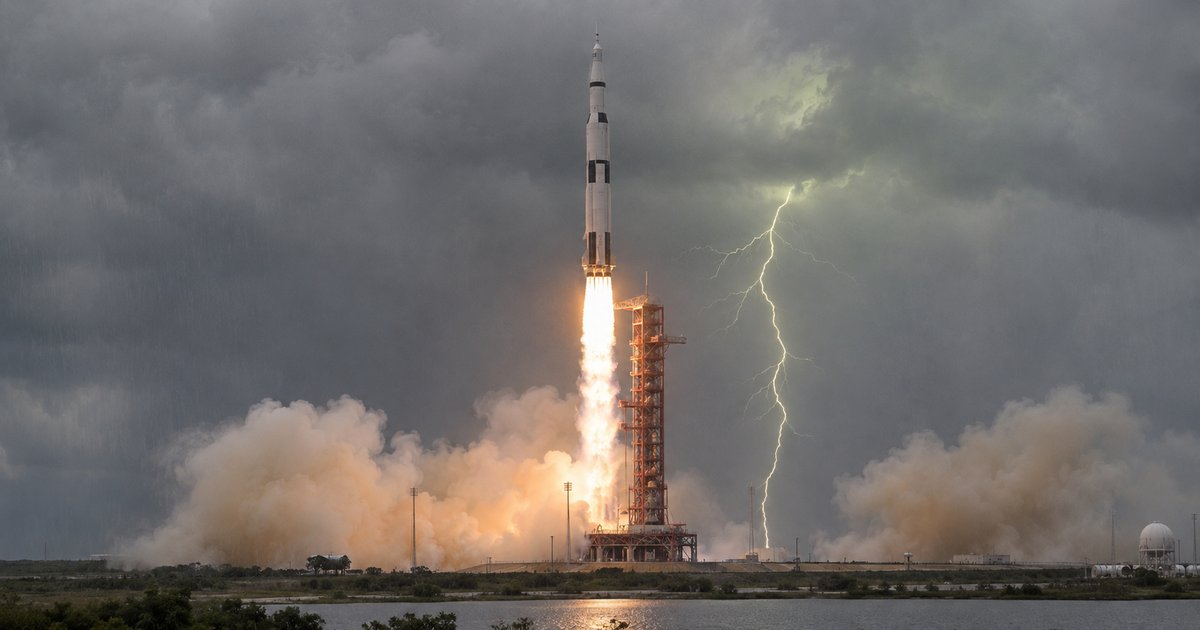
Lightning struck the Apollo 12 Saturn V rocket twice in its first minute, 36.5 and 52 seconds after liftoff on November 14, 1969, and NASA's investigators concluded that the rocket and its exhaust plume had most likely triggered both discharges inside rain clouds that held no thunderstorm. The crew completed the mission, and the episode led NASA to add weather rules to its launches.
Apollo 12 left Kennedy Space Center through rain clouds, not a thunderstorm
Apollo 12 lifted off from Kennedy Space Center in Florida at 11:22 a.m. Eastern Standard Time on November 14, 1969. NASA's 1970 analysis of the incident says a cold front was passing through the center at launch time, with a band of radar echoes about 20 miles wide, cumulus clouds topping out at 23,000 feet and light rain showers near the pad. The same analysis says no lightning had been observed before liftoff. Electric field meters on the ground did show charge in the clouds overhead, and the freezing level sat near 12,400 feet, so ice was forming in clouds that were raining, which the analysis says is nearly always tied to strong electrification of clouds.
Before Apollo 12, the analysis says, lightning mattered to a launch only in the period before liftoff. The chance that the vehicle would become involved with lightning after leaving the ground was not a launch consideration unless natural lightning was actually present at the launch complex. NASA's 2010 history of its lightning rules states the same gap more simply: through 1969, the only lightning constraint was not to launch through a thunderstorm.
Two discharges hit within 15.5 seconds, at about 6,400 and 14,400 feet
The Apollo 12 mission report, published in March 1970, records two lightning discharges during the first minute of flight. The first, 36.5 seconds after liftoff, went from the clouds to the ground through the vehicle. The second, at 52 seconds, went from cloud to cloud. The two discharges were distinctly recorded by ground-based instrumentation. The 1970 analysis puts the vehicle at about 6,400 feet at the first discharge and about 14,400 feet at the second; other NASA pages round the first altitude to 6,000 or 6,500 feet, and this page uses the analysis.
| Time | What NASA's records show |
|---|---|
| 36.5 seconds | Cloud-to-ground discharge through the vehicle at about 6,400 feet; the fuel cells disconnected from the spacecraft buses and nine instrumentation measurements were lost for good |
| 52 seconds | Cloud-to-cloud discharge at about 14,400 feet; the spacecraft's inertial platform lost its reference |
| 1 minute 36 seconds | Mission Control tells the crew to try the signal conditioning equipment (SCE) on auxiliary power |
| 2 minutes 22 seconds | The crew restores fuel cell power to the buses; bus voltages stay normal for the rest of the flight |
The first discharge was also recorded on film and video. The 1970 analysis says photographs and video from the abort advisory camera show two discharge channels, one about 1,500 feet from the launch umbilical tower and another about 100 feet from it, and that the second channel developed about 60 milliseconds after the first. The mission report adds that the launch vehicle itself apparently sustained no permanent damage.
The fuel cells came off the buses and the guidance platform lost its reference
The Apollo 12 mission report explains the first failure as an electrical transient: the discharge induced a voltage spike on a battery relay bus, and the spike exceeded the rate-of-change limits of silicon controlled rectifiers in the fuel cell overload sensors, which disconnected the fuel cells from the bus. Entry batteries A and B then carried the entire 75-ampere main bus load. Main bus voltage fell to about 18 or 19 volts and recovered within a few milliseconds, according to the report, but undervoltage warning lights came on and the signal conditioning equipment dropped out.
The only permanent effect on the spacecraft was the loss of nine measurements at the first discharge: four service module outer-surface temperature sensors, four reaction control propellant quantity gauges and one temperature reading on the nuclear particle analyzer. The mission report says the second discharge caused the loss of reference in the inertial platform, most likely through the platform's coupling display unit, and that a change to stop the computer's mode switching during launch was made for Apollo 13. Both discharges temporarily interrupted spacecraft communications. The 1970 analysis notes that every effect it recorded involved solid-state circuits, the circuits most susceptible to a discharge.
Flight controller John Aaron's SCE to AUX call brought the readings back
NASA's own account names John Aaron, a flight controller, as the person who realized that normal readings could be restored by putting the signal conditioning electronics (SCE) on its auxiliary (AUX) setting, which keeps working at low voltage. The Apollo Flight Journal, a NASA-hosted transcript collection, shows the suggestion passing from Aaron to Flight Director Gerry Griffin and then to the capsule communicator, astronaut Gerald Carr, who radioed the crew at 1 minute 36 seconds. NASA's history of the lightning rules says astronaut Alan Bean threw the switch near his seat and that this restored flight telemetry to Mission Control. The Smithsonian National Air and Space Museum says a flight controller passed the information to Bean, who flipped the correct switch.
Power was a separate step. The mission report says the crew put the fuel cells back on the buses at 2 minutes 22 seconds. The mission report says the flight then gave special attention to verifying all spacecraft systems, and NASA's history says the mission evaluation team soon judged the permanent damage minimal and the mission fit to continue.
The rocket and its exhaust plume triggered the lightning
The 1970 analysis says there was general agreement among atmospheric electricity scientists that the Apollo 12 vehicle triggered both discharges. The reasoning runs as follows. A rocket is an excellent conductor, and its exhaust plume extends that conductor. Launching one suddenly puts a long conducting path into air that had none, which concentrates the electric field at the top of the vehicle and below the plume; at the top, the analysis says, the field may rise by a factor of several hundred. Once the enhanced field becomes large enough, the air breaks down, and the discharge can then develop in a manner similar to natural lightning.
The analysis also tested and rejected a simpler explanation, that the rocket built up static electricity as it climbed. The vehicle is 364 feet long, and treating its plume as a conductor up to five times that length, the analysts estimated the energy that static charge on the vehicle could supply. The discharge at 36.5 seconds looked and registered like natural lightning, so they assumed it carried the energy of natural lightning, and the static estimate came out four orders of magnitude, about 10,000 times, too small. Static charge on the rocket, they concluded, could not be the source. The vehicle had instead flown into clouds that already held charge.
The idea was not new in principle. The analysis points to experiments by researcher M. M. Newman, who had fired small rockets trailing a grounded wire into thunderclouds at sea to trigger lightning, and NASA's 2010 history says the hazard of triggering lightning was already known to the aviation community. The analysis says the possibility that an Apollo vehicle might trigger lightning had not been considered before. The analysis calls the discharges at 36.5 and 52 seconds a cloud-to-ground and an intracloud discharge, respectively.
NASA wrote new launch weather rules within months of Apollo 12
NASA's 1970 incident analysis recommended avoiding electrified clouds rather than hardening the spacecraft. The mission report says protecting the spacecraft completely from lightning was not considered practical, and that the low risk of triggering lightning was acceptable if hazardous electric fields were avoided. NASA's history adds that the investigation team opposed spacecraft changes because of schedule, cost and weight, and that scientists at the December 1969 American Geophysical Union meeting helped design the new rules, which were used for the first time at the Apollo 13 launch. The mission report lists the restrictions imposed for future missions:
| Condition on the flight path | Restriction |
|---|---|
| Thunderstorm (cumulonimbus) cloud | No launch through it, within 5 miles of thunderstorm clouds, or within 3 miles of an associated anvil |
| Cold-front or squall-line clouds reaching above 10,000 feet | Do not launch through them |
| Middle cloud layers 6,000 feet or more deep, with the freezing level inside the cloud | Do not launch through them |
| Cumulus clouds with tops at 10,000 feet or higher | Do not launch through them |
The rules had a price. NASA's history says the agency estimated that the chance of a delay on a February day would rise from 10% to 18%, and the chance of a summer scrub from 3% to 18%. It adds that the new criteria were used for Apollo's remaining Moon missions and, until 1988, for expendable launch vehicles such as Atlas-Centaur.
Atlas-Centaur 67 showed in 1987 how much the rules still missed
A second triggered-lightning accident, the 1987 loss of the Atlas-Centaur 67 rocket, led to further changes. A NASA conference paper on the accident says the vehicle, launched on March 26, 1987, during a typical winter storm, flew through clouds that built up precipitation static on it and triggered a cloud-to-ground discharge with at least four return strokes. The current entered the wiring to the rocket's computer, changed one word of its memory and produced a hard-over engine steering command, and the rocket broke up. NASA's 2010 history says a major cause was that the rules for uncrewed rockets lacked a criterion based on ground electric field measurements, which the Space Shuttle rules had included since 1979 and which would have barred that launch. After several investigations and a Congressional hearing, it says, a lightning peer review committee was formed, a predecessor of today's Lightning Advisory Panel.
The lasting product is a NASA technical standard for lightning launch commit criteria; its revision B was approved on August 27, 2026. The foreword names Apollo 12 and Atlas-Centaur 67 and says that following the 1987 accident and the rigorous use of the criteria, no other launch vehicle has intercepted or triggered lightning on launch in the United States. Distances in the standard are in nautical miles, and a few of its rules show how directly they descend from Apollo 12:
- A launch operator must wait 30 minutes after any lightning within 10 nautical miles (about 11.5 miles) of the flight path, with an exception that depends on working field mills reading under 1,000 volts per meter for 15 minutes.
- A launch operator must wait 15 minutes after a surface electric field reading of 1,000 volts per meter or more within 5 nautical miles of the flight path, unless specific conditions are met.
- No launch if the flight path crosses a cloud tied to a front, trough or squall line, with tops colder than 0 °C, that holds moderate or heavier precipitation or melting precipitation within 5 nautical miles.
- No launch through a cloud layer 4,500 feet (1.4 kilometers) thick or more, with any part between 0 and -20 °C, within 5 nautical miles of the path, unless the standard's exceptions apply.
NASA's rationale document for the criteria says the disturbed-weather rule generalizes the weather present at Apollo 12 and Atlas-Centaur 67, which was widespread rain with no evidence of natural lightning in the area. The 30-minute figure also appears in outdoor guidance: the National Weather Service tells people to wait 30 minutes after the last lightning or thunder before going back outside.
On the ground, the weather to watch is the storm near you. Lightning Tracker, an iPhone app, shows recent detected strikes on a live map, with the distance and direction to the nearest one and how many minutes ago it was detected.
Not a substitute for official weather warnings.
If you hear thunder, seek shelter even if the app shows no nearby strike.
Sources
- NASA Johnson Space Center, Apollo 12 Mission Report (MSC-01855), March 1970
- NASA Marshall, Kennedy and Manned Spacecraft Centers, Analysis of Apollo 12 Lightning Incident (MSC-01540), February 1970; Internet Archive copy of NASA's file
- NASA, A History of the Lightning Launch Commit Criteria and the Lightning Advisory Panel for America's Space Program (NASA/SP-2010-216283), August 2010
- NASA, NASA-STD-4010B, Lightning Launch Commit Criteria for Space Flight, approved August 27, 2026
- NASA, Rationales for the Lightning Launch Commit Criteria (NASA/TP-2016-219439), 2016
- Christian et al., The Atlas-Centaur 67 incident, NASA conference paper, 1988
- NASA, Lightning Strikes Twice, November 12, 2019
- NASA Apollo Flight Journal, More than SCE to AUX: Apollo 12 Lightning Strike Incident (J. Kemppanen, 2019); Internet Archive copy of NASA's page
- Smithsonian National Air and Space Museum, Apollo 12
- National Weather Service, Overview: Lightning Safety