 Lightning Tracker
App Store
Storm basics
Artificial lightning: from Tesla's lab to rocket-triggered strikes
November 10, 2026 · 9 min read
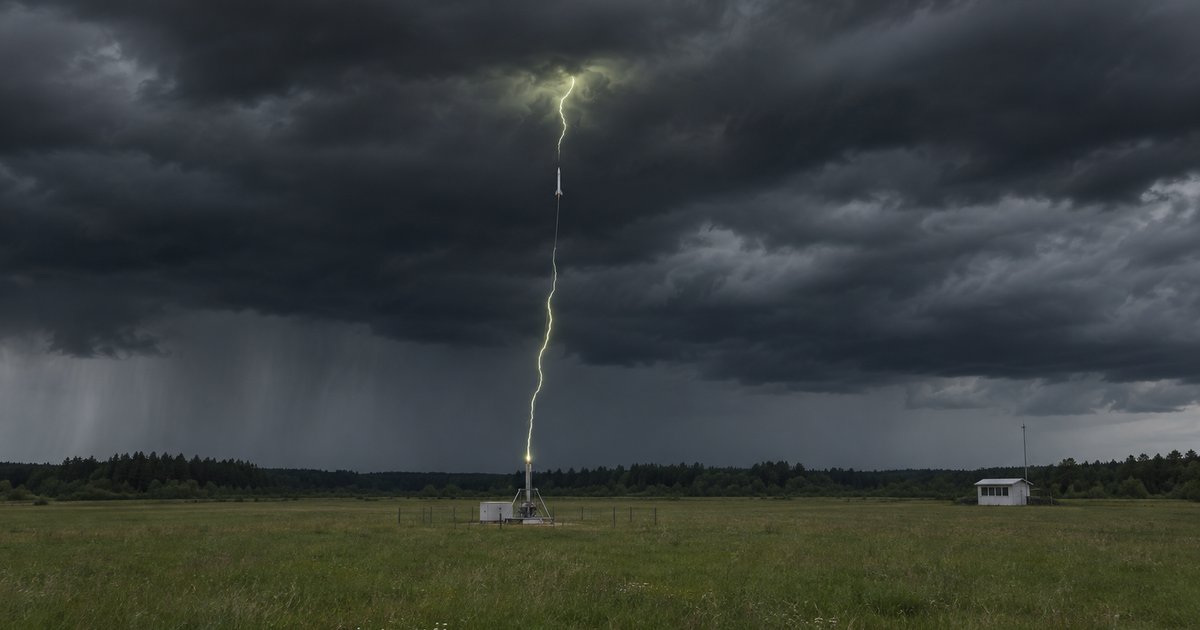
Artificial lightning is either a high-voltage spark made with equipment or a real strike that researchers trigger by firing a small rocket, trailing a grounded wire, into a thunderstorm. Laboratory sparks, from Tesla's Colorado Springs station in 1899 (PBS) to a 2.2-million-volt generator described in 2009 (Physics Today), are made with electrical equipment and imitate lightning. Triggered strikes are genuine lightning that University of Florida researchers have used to study how a stroke behaves (2012 paper by University of Florida researchers and colleagues). Neither changes the National Weather Service guidance for people outdoors: if you hear thunder, go indoors.
Artificial lightning means two different things
The phrase covers high-voltage sparks made with equipment and real lightning that researchers set off on purpose. The National Severe Storms Laboratory (NSSL) says natural lightning can carry 100 million to 1 billion volts and contains billions of watts. The laboratory equipment described below works at a few million volts. Triggered lightning takes the opposite approach: according to the 2012 paper described below, it borrows the electric charge of a real thunderstorm, starts the discharge and gives it a path. The table sets out the five methods this article found, with what each source reports.
| Method | Example in the sources | Scale reported | Uses a storm's charge? |
|---|---|---|---|
| Tesla's magnifying transmitter | Colorado Springs, 1899 (PBS) | Bolts "more than a hundred feet" in PBS's summary; 22 feet in the one photograph PBS captions | No |
| Utility laboratory generator | General Electric, Pittsfield, Massachusetts (Science News, 1934) | 250,000 amperes for eight millionths of a second | No |
| Impulse generator for equipment testing | Georgia Tech test center (Physics Today, 2009) | A 6-meter (about 20-foot) discharge from 2.2 million volts | No |
| Rocket-and-wire triggering | Camp Blanding, Florida (University of Florida) | Rockets launched to 2,400 feet (about 730 meters); 35 strikes from 75 to 80 rockets in a good summer | Yes |
| Laser guiding | Säntis mountain, Switzerland, summer 2021 (Nature Photonics) | An upward leader guided over 50 meters (about 164 feet) | Yes |
The first three rows imitate lightning with electricity from a generator. The last two start with an actual storm, which is why researchers treat what they record there as lightning and not as a model of it.
Tesla's Colorado Springs station aimed at lightning-scale sparks, but the measurements are thin
Nikola Tesla arrived in Colorado Springs in May 1899, according to PBS, and set up an experimental station near Pikes Peak with $30,000 from Colonel John Jacob Astor. PBS describes a laboratory with a roof that rolled back to keep it from catching fire, a wooden tower eighty feet high and a 142-foot (43-meter) metal mast carrying a large copper ball. Tesla spent nine months experimenting there.
His interest in lightning was practical. PBS says he came to think that a lightning strike on the ground set off powerful waves that crossed the earth, and that proving it would require electrical effects on the scale of lightning. His own application of May 16, 1900, granted in 1905 as U.S. Patent 787,412, says he had investigated how lightning discharges affect the electrical condition of the earth. The same patent claims that his generator reached rates of energy delivery which, "as shown in many comparative tests and measurements," were surpassing those of lightning discharges. That is Tesla describing his own apparatus. None of the sources read for this article reproduces those tests, so the claim stays unverified.
The famous numbers are harder still. PBS writes that bolts of man-made lightning more than a hundred feet (30 meters) long shot from the mast, and that the run burned out a dynamo at the local electric company and left the city without power; the page cites no document for either statement. A second PBS page captions the well-known photograph of Tesla seated beside his coil as a publicity photo and a double exposure, with a discharge twenty-two feet long. A double exposure joins two pictures, so it shows what the photographer combined, not one event that someone measured. Another PBS page says his largest coil there generated pulses as high as 12 million volts, and a University of Wisconsin demonstration manual credits him with discharges 135 feet long; neither says how those figures were measured. PBS adds that although Tesla kept a detailed diary, the results of his experiments are not clear, and that whether he actually transmitted wireless power has never been definitively answered.
Early high-voltage laboratories made lightning to protect power lines
The utility industry built artificial lightning to find out what a stroke does to its equipment. The Henry Ford museum records that Thomas Edison observed a lightning generator that Charles Steinmetz developed to test new electrical equipment during a highly publicized visit in 1922, and that newspapers hailed Steinmetz as a "modern Jove."
Science News described the next stage. In an item from July 21, 1934, it reported that engineers at General Electric's high-voltage laboratory in Pittsfield, Massachusetts, put on display man-made lightning with a current of 250,000 amperes, expending 30 billion watts during eight one-millionths of a second. In an item from August 10, 1935, it reported a 100,000-ampere stroke at the Westinghouse testing laboratories in Sharon, Pennsylvania, loud enough that spectators held their ears. It said the laboratory tests showed engineers the futility of conventional protective apparatus and the ability of a device called the "deion gap" to protect against even direct strokes.
The goal has not changed. A 2009 Physics Today photograph shows a 6-meter discharge from a 2.2-million-volt impulse generator at Georgia Tech's National Electric Energy Testing Research and Applications Center, which tests arresters, transformers, insulators and other parts of the grid. The caption adds that, by some estimates, lightning causes 30 percent of all power interruptions. Set beside the NSSL figure of 100 million volts or more for natural lightning, that generator reaches about 2 percent of the low end, so a laboratory discharge is a small, controlled sample and not a copy of a storm. That comparison is this article's own arithmetic. Readers comparing manufactured sparks with reported natural fireballs can use ball lightning to see which sightings have been measured.
Rocket-triggered lightning uses the storm's own charge
The rocket-and-wire technique launches a small rocket that trails a grounded triggering wire into a thunderstorm. A 2012 conference paper by University of Florida researchers and colleagues, hosted by NASA, says that in Florida the rockets are launched when the electric field measured at the ground passes a typical threshold of about 5 kilovolts per meter. As the rocket climbs, an upward-propagating, positively charged leader, a growing channel of electrified air, starts from the wire top and heads toward the negative charge in the cloud. The wire typically explodes when the leader reaches about 2 kilometers (1.2 miles) of altitude. Dart leader and return stroke sequences, the bright strokes that follow, often come next along the same path.
The work happens at the International Center for Lightning Research and Testing at Camp Blanding, a National Guard base near Starke, Florida. A University of Florida research magazine profile, which carries no date but has a sidebar about work in the summer of 1997, says the Electric Power Research Institute, a consortium of utility companies, founded the facility in 1993 and donated it to the university in 1994. Its engineers launched slender rockets from steel tubes 2,400 feet into storm clouds, each trailing a Kevlar-coated wire, and each rocket was built on site for about $700. In a good summer the crew fired 75 to 80 rockets and scored 35 strikes. The profile adds that researchers still did not understand lightning well enough to say when a rocket would produce a strike. In June 2010 the university announced, in a news release, a $9.8 million grant from the Defense Advanced Research Projects Agency to expand the center's research.
What triggered strikes taught researchers about natural lightning
Triggered strikes give researchers a lightning flash that arrives where the instruments already are. The university magazine says natural lightning is random, lasts less than a second, and has its birthplace in the clouds hidden from view. The papers read for this article report these results:
- Return strokes look alike. The 2012 paper says the dart leader and return stroke sequences in triggered lightning are very similar to subsequent strokes in natural lightning, so measurements of them describe part of what a real flash does.
- X-rays. A 2010 University of Florida news release says a team from the university and the Florida Institute of Technology was the first to document X-rays produced by triggered lightning.
- A surprise in the current. In nine flashes triggered in summer 2011, the current at the channel base did not change significantly when branching occurred, which the authors called an unexpected result.
- Protection. The center's investigations have spanned how to protect power lines, homes and airplanes, according to the 2010 release. The magazine profile describes a runway built to Federal Aviation Administration standards that researchers struck on purpose to learn how lightning affects runway lighting.
The limit matters just as much. In 2010 Martin Uman, the center's co-director, said the whole initiation process, meaning how a flash starts inside a cloud, was basically unknown. A triggered flash starts from the top of a launched wire, so it is not a direct view of that stage. Other work looks at natural flashes in the cloud: the magazine profile describes a University of Florida professor who spent ten years at Kennedy Space Center using a lightning detection system to gather data on how lightning forms. The same profile credits Uman and two colleagues with an early-1970s method of locating lightning by triangulating its radio signals, now central to the U.S. National Lightning Detection Network, which how lightning is detected explains.
Laser-guided lightning is one more attempt to steer a strike
A research team published a paper in Nature Photonics on January 16, 2023 that it calls the first demonstration that filaments formed by short, intense laser pulses can guide lightning discharges over considerable distances. The campaign ran on the Säntis mountain in northeastern Switzerland in summer 2021, and two high-speed cameras recorded an upward negative lightning leader guided over 50 meters. The authors describe the result as a significant step forward toward laser-based lightning protection for airports, launchpads and large infrastructures. It remains research, not a protective system in use.
What artificial lightning means for staying protected from real lightning
The National Weather Service guidance does not depend on any of this research. The service says that if you hear thunder you are likely within striking distance of the storm, that the best protection is to avoid the threat, and that substantial buildings and hard-topped vehicles are the options that work, while rain shelters, small sheds and open vehicles do not. After the last lightning or thunder, it advises waiting 30 minutes before going back outside. The articles on where to shelter, why the wait is 30 minutes and how lightning strikes people go through each step.
The equipment-testing side has a household echo. The Weather Service says lightning generates surges that can damage electronic equipment some distance from the actual strike, and that typical surge protectors will not protect equipment from a lightning strike. Rocket triggering, by contrast, takes place at a National Guard base, and none of the sources describes a way for the public to make or steer lightning.
Lightning Tracker is an iPhone app that shows detected strikes on a live map, with the distance and direction to the nearest one and how many minutes ago it was detected. Detection networks miss some strikes and data can arrive late, so the app marks a delay or a gap instead of treating it as a lull. It does not replace official warnings or local procedures.
Not a substitute for official weather warnings.
If you hear thunder, seek shelter even if the app shows no nearby strike.
Sources
- PBS, Tesla: Master of Lightning, Colorado Springs (undated)
- PBS, Tesla: Master of Lightning, Tesla seated by coil (undated)
- PBS, Tesla Coil (undated)
- University of Wisconsin–Madison Physics, Physics Demonstrations, Chapter 4: Electricity (undated)
- U.S. Patent and Trademark Office, Nikola Tesla, U.S. Patent 787,412, Art of Transmitting Electrical Energy Through the Natural Mediums (filed May 16, 1900; granted April 18, 1905)
- The Henry Ford, Charles Steinmetz and Thomas Edison Watch Steinmetz's Lightning Generator, October 1922
- Science News, From the July 21, 1934, issue: Artificial Lightning More Powerful Than Nature's (reprinted online in 2004)
- Science News, From the August 10, 1935, issue: Artificial Lightning Now Without Deafening Noise (reprinted online in 2005)
- Physics Today (American Institute of Physics), Artificial lightning, March 1, 2009
- NOAA National Severe Storms Laboratory, Severe Weather 101: Lightning FAQ
- University of Florida, Explore magazine, volume 3, issue 2: Learning About Lightning (undated)
- Hill et al., University of Florida and partners, Correlated Lightning Mapping Array and Radar Observations of the Initial Stages of Florida Triggered Lightning Discharges, 2012 International Conference on Lightning Protection (PDF, via NASA Technical Reports Server)
- University of Florida News, Lightning researchers receive $9.8 million defense agency grant, June 28, 2010
- Houard et al., Nature Photonics, January 16, 2023, “Laser-guided lightning” (journal page; arXiv abstract)
- National Weather Service, Overview: Lightning Safety
- National Weather Service, Lightning Indoors