 Lightning Tracker
App Store
Storm basics
Tesla coil vs. real lightning: voltage, length and why a coil is no thunderclap
November 10, 2026 · 7 min read
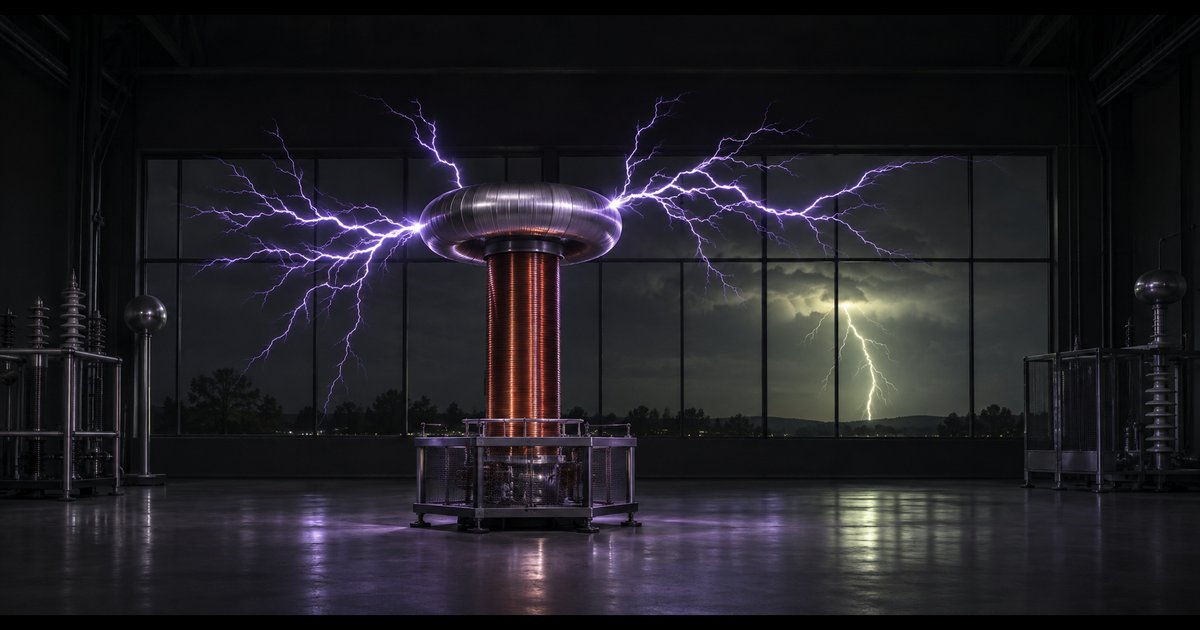
A Tesla coil throws sparks that look like small lightning, but it does so on a tiny fraction of lightning's current. The National Weather Service puts a typical lightning flash at about 300 million volts and 30,000 amps, while university pages describe coils from about 50,000 volts to over a million with very little current. NOAA says thunder starts when a large current heats the air, which is the part a coil spark lacks. The figures for Tesla's own giant coil in 1899 are historical claims that sources report differently.
A Tesla coil is a resonant transformer that trades current for voltage
Georgia State University's HyperPhysics site explains that a Tesla coil works on the principle of the transformer, with few turns on the primary coil and many on the secondary. A high-frequency input is stepped up to about a million volts, and because the voltage rises the current stays very small. The same page says a well-designed coil produces discharges with an appearance similar to lightning. UCLA's lecture demonstration manual describes the circuit: a step-up transformer raises line voltage to ten or twenty thousand volts, the voltage arcs across a spark gap 60 times a second, and each arc sets a tuned circuit ringing at 1 to 3 million cycles per second (megahertz).
So does a coil create lightning? It creates a high-voltage spark, not a storm's discharge. The Long Now Foundation notes that the builder of some of the world's largest coils uses them in a quest to understand the physics of lightning, which suggests coils can help study parts of the process without being the same thing. Tesla patented a transformer of this kind in his U.S. patent 593,138, issued November 2, 1897, which says it rests on an apparatus built for developing "electrical currents of high potential."
Lightning carries millions of times more current than a classroom coil
The National Weather Service gives a typical lightning flash as about 300 million volts and about 30,000 amps, against 120 volts and 15 amps for household current. NOAA's National Severe Storms Laboratory (NSSL) gives a wider voltage range, 100 million to 1 billion volts. NWS Melbourne adds that the peak current of a return stroke, the bright surge up the channel, is about 30,000 amps and can reach 300,000, rising to its peak in about a microsecond. The coil side is much smaller: a Louisiana State University demonstration handout says a classroom coil produces 50,000 volts but only a milliamp at most.
| Quantity | Tesla coil | Lightning |
|---|---|---|
| Voltage | About 50,000 V (classroom coil, LSU); 500,000 to 1,000,000 V (small coils, Duke); over 1 million V (UCLA) | About 300 million V typical (NWS); 100 million to 1 billion V (NSSL) |
| Current | Very small; 1 milliamp at most for a classroom coil (LSU) | About 30,000 A typical, up to 300,000 A at the peak (NWS Melbourne) |
| Timing | Spark gap fires 60 times a second and the circuit rings at 1 to 3 MHz (UCLA) | Peak in about 1 microsecond, half-value in about 50 microseconds; a whole flash usually under half a second (NWS Melbourne) |
| Spark length | About 1 ft (0.3 m) for UCLA's small coil, 4 ft (1.2 m) for its giant one; Tesla's Colorado Springs coil reportedly over 100 ft (30 m) | Longest certified flash spanned 515 miles (829 km), measured across a storm (WMO, 2025); unlike one spark, this is a whole flash |
The gap is easiest to see in current. For the 1 milliamp classroom coil, a typical lightning peak of 30,000 amps is about 30 million times larger. That is arithmetic on two sourced numbers, and it applies to a small coil only; none of the pages checked gives a measured current for a large one. Voltage is a gentler contrast: a coil at a million volts is roughly one three-hundredth of the typical 300 million, while its current is millions of times smaller.
Tesla's Colorado Springs coil is remembered for 100-foot sparks, and sources differ on the rest
PBS's Tesla site says his largest coil, built at Colorado Springs in 1899, was 52 feet (16 m) in diameter and generated pulses as high as 12 million volts, and that bolts of man-made lightning more than a hundred feet long shot from the mast. PBS frames his goal there in the same terms: he would have to become the first to create electrical effects on the scale of lightning. A University of Wisconsin demonstration manual repeats the 12 million volts but gives 135-foot discharges instead.
The record is looser than these figures suggest. PBS says that although Tesla kept a detailed diary, the results of his experiments are not clear. An IEEE Milestone proposal, quoting a 2013 biography, says that earlier at his New York laboratory he reached 2.5 million volts and 16-foot sparks. It also quotes Tesla recalling "powerful discharges 100 feet" in 1900. His own 1900 patent, number 645,576, describes impulses of "many hundred thousands or millions of volts", a range that does not name 12 million. None of the pages checked explains how any of these voltages was measured, so treat them as period figures rather than instrument readings.
The famous photograph of Tesla seated beside a roaring coil adds a caution. PBS's caption says it was a double exposure, with a discharge of twenty-two feet. Duke University's physics department quotes Tesla's own notes saying the discharge was not playing when the experimenter was photographed.
Thunder needs a large current, which a coil spark does not supply
NSSL explains that thunder starts as a shock wave from the explosively expanding lightning channel when a large current causes rapid heating. The return stroke heats the air in the channel to above 50,000 °F in a few millionths of a second, so the air cannot expand at once and is left at very high pressure. NWS Melbourne adds that air heated that fast expands faster than the speed of sound, producing a sonic boom. The disturbance is a shock wave for roughly the first 10 yards (9 m) and then becomes an ordinary sound wave. NSSL says thunder seems to go on and on because every point along the channel produces its own wave.
Put the two descriptions side by side and the reasoning follows: a coil spark carries a very small current, so it deposits far less energy in the air along its path, and a spark a few feet long has no channel miles long to stretch the sound into a rumble. That is an interpretation of sourced facts. None of the pages checked measures a coil's noise against thunder, and the article states no decibel figure for that reason.
Touching a coil is a risk the university pages do not agree on, so keep clear
Duke University's physics department calls the voltages and currents in coil equipment far beyond lethal levels, says nobody should come into contact with them, and warns that coils can cause severe burns without the sensation of pain. It adds that the skin effect, the idea that high-frequency current stays on the surface, does not apply to people. UCLA's demonstration manual takes a milder view of the small coil: it says the current through the body is too small to heat tissue enough to injure someone. It also warns that its giant coil does sting a person who gets into its path to the ground, and that people with pacemakers should move to the back of the room.
The Wisconsin manual describes the high frequency as what makes a coil a relatively low-risk way to demonstrate high voltage, yet its own instructions for drawing sparks from the fingers call for wet hair and metal thimbles to prevent burns. Because the sources disagree on how much harm a touch does, the guidance to follow is Duke's: stay far away from a running coil.
What a coil has to do with protecting yourself from a storm
The National Weather Service states that if you hear thunder, even a distant rumble, you are already in danger of becoming a lightning victim, and normally thunder carries about 10 miles. Its guidance is short: when thunder roars, go indoors to a substantial building or a hard-topped vehicle, then wait 30 minutes after the last lightning or thunder before going back outside. Flash to bang explains what the count of seconds tells you, Where to shelter from lightning lists where to go, Why wait 30 minutes covers the clock, and Ten lightning myths corrects the beliefs that keep people outside.
Lightning Tracker, an iPhone app, shows recent detected strikes on a live map with the distance and direction to the nearest one and how many minutes ago it happened. It does not replace official warnings or local procedures.
Not a substitute for official weather warnings.
If you hear thunder, seek shelter even if the app shows no nearby strike.
Sources
- National Weather Service, How Powerful Is Lightning?
- National Weather Service, Melbourne, What Is Lightning?
- National Weather Service, Understanding Lightning Science
- National Weather Service, Overview: Lightning Safety
- NOAA National Severe Storms Laboratory, Severe Weather 101: Lightning FAQ
- World Meteorological Organization, WMO certifies megaflash lightning record (July 31, 2025)
- Georgia State University, HyperPhysics, Tesla Coil
- UCLA Physics & Astronomy, Instructional Resource Lab, 120. Tesla Coils
- Duke University Physics, Tesla Coil Safety Warning
- University of Wisconsin–Madison Physics, Physics Demonstrations, Chapter 4: Electricity
- Louisiana State University Chemistry, Energy: Electricity, Heat, and Light (demonstration handout)
- The Long Now Foundation, The Secret Life of Lightning: The Science of Giant Tesla Coils (talk of September 26, 2017)
- PBS, Tesla: Master of Lightning, Colorado Springs
- PBS, Tesla Coil
- U.S. Patent and Trademark Office, via Google Patents, US 593,138, Electrical Transformer (Nikola Tesla, November 2, 1897)
- PBS, Tesla seated by coil
- U.S. Patent and Trademark Office, via Google Patents, US 645,576, System of transmission of electrical energy (Nikola Tesla, March 20, 1900)
- IEEE Milestones Wiki, Milestone-Proposal: Tesla 1899 (proposal, quoting W. Bernard Carlson, 2013)