 Lightning Tracker
App Store
Storm basics
Back to the Future: could lightning deliver 1.21 gigawatts?
November 11, 2026 · 6 min read
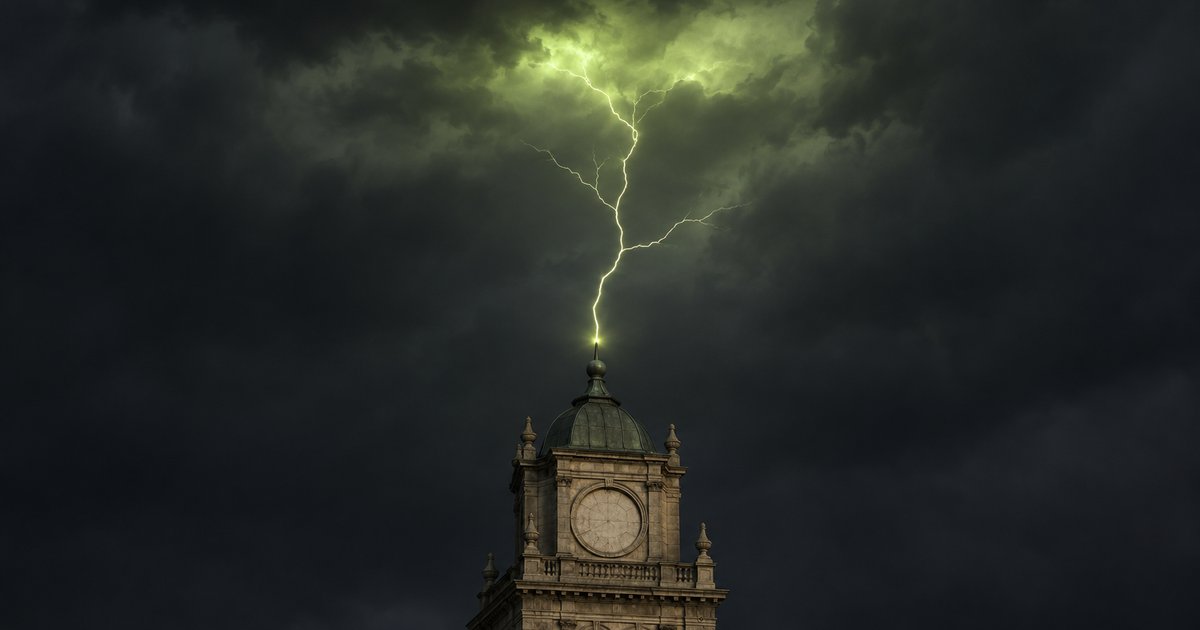
A lightning flash briefly exceeds 1.21 gigawatts by a wide margin, but it holds that rate for only a fraction of a second, so the real question is how much energy the film’s machine needs. The NOAA National Severe Storms Laboratory says lightning contains billions of watts, and the National Weather Service’s typical 300 million volts and 30,000 amps multiply to about 9 trillion watts. Published estimates of the energy in one flash would run 1.21 gigawatts for anywhere from under a millisecond to about 1.2 seconds, and only a small share of that energy would reach a collector.
The film asks for 1.21 gigawatts, and a gigawatt measures a rate, not an amount
A September 2026 Universal Orlando blog post places the lightning strike on the Hill Valley clock tower in Back to the Future at 10:04 p.m. on November 12, 1955. Syfy Wire’s March 2024 explainer reports that Doc Brown says the time machine needs 1.21 gigawatts of electricity, and that “a bolt of lightning” is the power source that could supply it. The film is fiction, and this article takes only those two stated facts from it, the power and the lightning.
The National Institute of Standards and Technology (NIST) lists the prefix giga as 109, a billion, with gigawatt as its example. A watt is one joule per second, as Rhett Allain writes in Wired (September 2013), and Georgia State University’s HyperPhysics site describes electric power in watts as the rate at which energy is converted, equal to volts times amperes. So 1.21 gigawatts is 1.21 billion joules every second, and the energy involved is that rate multiplied by the time it lasts. For scale, the U.S. Department of Energy (DOE) calls a 1-gigawatt plant “large.” A voltage alone says little: a Louisiana State University chemistry handout multiplies a Tesla coil’s 50,000 volts by its milliamp maximum and gets a power of 50 watts.
Published figures put a flash’s peak power far above 1.21 gigawatts
Agency and university pages agree on the scale of a flash’s voltage and current and differ in the details. The peak current belongs to the return stroke, the bright surge up a channel that a stepped leader has already opened.
| Source | Voltage | Current | Timing or power |
|---|---|---|---|
| National Weather Service (NWS), typical flash | About 300 million V | About 30,000 A | Not given |
| NOAA National Severe Storms Laboratory (NSSL) | 100 million to 1 billion V | Not given | “Billions of watts” |
| NWS Melbourne | About 100 million V on the leader near the ground, up to 1 billion | Peak about 30,000 A, up to 300,000 A | About 1 microsecond to peak, about 50 microseconds to half; the whole process usually under half a second |
| Coalition for Plasma Science, text by Vladimir Rakov, 2006 | 50 to 500 million V | Tens of thousands of amperes | Most energy in pulses about one-hundred-millionth of a second long; three to five strokes typical |
| HyperPhysics, citing Williams and Uman | Several hundred million V | Most measurements 5,000 to 20,000 A; over 200,000 A reported | Flash about 0.2 second; each stroke under a millisecond |
Peak power is voltage times current. At the NWS typical values that is 300 million volts times 30,000 amps, about 9 trillion watts, or roughly 7,400 times 1.21 gigawatts. The NWS publishes no power figure, and the sources do not say that the voltage and the peak current are present together, so this is an order-of-magnitude estimate made here. Even the lowest pairing in the table, 100 million volts (NSSL) with 5,000 amps (HyperPhysics), gives about 500 billion watts, roughly 400 times the film’s figure. Seen the other way, at 300 million volts a power of 1.21 gigawatts is a current of only about 4 amps.
Published statements of lightning’s power themselves differ by more than a thousand times. The NSSL says only that lightning contains billions of watts. Syfy Wire’s explainer says the average bolt carries an estimated 10 gigawatts. The calculation above gives about 9,000 gigawatts. All three put a flash at or above the film’s figure, and none is a measured power.
A whole storm sits on a different scale. HyperPhysics, summarizing E. R. Williams’s Scientific American article, says a moderate thunderstorm generates several hundred megawatts of electrical power, which is under one gigawatt. Lightning beats 1.21 gigawatts in short bursts, not as a steady supply.
One flash holds energy for 1.21 gigawatts for between a millisecond and about a second
Energy estimates for a single flash span a factor of about 1,500, and they decide how long a flash could sustain the film’s 1.21 gigawatts. Dividing each published energy by 1.21 billion watts gives the time.
| Source | Energy per flash as published | Seconds at 1.21 gigawatts (calculated here) |
|---|---|---|
| MIT School of Engineering, March 2015 | About 1 million joules | About 0.0008 |
| U.S. Environmental Protection Agency (EPA), AP-42, September 1996 | 100 to 800 million joules | About 0.08 to 0.66 |
| Coalition for Plasma Science, 2006 | About 360 kilowatt-hours (about 1,300 million joules) | About 1.1 |
| DOE, Electricity 101 (undated) | About 1,500 million joules | About 1.2 |
None of these pages explains the gap between them. The kilowatt-hour figure is converted at 3.6 million joules per kilowatt-hour. A flash lasts about 0.2 second (HyperPhysics) to under half a second (NWS Melbourne), so an estimate above about 240 million joules (1.21 billion times 0.2) averages more than 1.21 gigawatts across the whole flash. The EPA’s upper figure, the Coalition’s and DOE’s do, and MIT’s does not. MIT’s engineer also says the energy arrives in only a few microseconds, and the Coalition sheet says most of it is released in pulses about a hundred-millionth of a second long.
The sources used here give no duration for the film’s machine. Allain, using video analysis of the film’s footage, concluded in 2013 that in the lightning case the time machine gets power for at most 0.46 second. At 1.21 gigawatts that is about 560 million joules, which falls inside the EPA’s range, under the Coalition’s and DOE’s totals, and about 560 times MIT’s figure. The Coalition sheet adds that only about one-thousandth to one-hundredth of a flash’s energy is delivered to the strike point, the bulk going into heating the air and producing thunder, light and radio waves. Applied to 360 kilowatt-hours, that leaves about 1.3 to 13 million joules, or 0.2% to 2% of what the film’s 0.46 second needs.
The DOE counts the grid-scale cost in strikes per day
The Department of Energy’s Electricity 101 page answers the question “Can we harness lightning as an energy source?” with a count: you would need to harness over 58,000 lightning strikes each day to equal the production capability of a large 1-gigawatt power plant. Our own check, 86,400 seconds at 1 billion watts divided by its 1,500-million-joule strike, gives about 57,600, within 1% of the page’s figure. The Coalition sheet concludes that extracting useful energy from lightning appears to be impractical, and MIT’s engineer lists the reasons: the few-microsecond delivery, a handling voltage of several million volts, and the need to equalize positive and negative strikes.
The NWS thunder rule does not depend on any of these numbers
The National Weather Service says that if you hear thunder, you are likely within striking distance of the storm, and it sums up its guidance as “When Thunder Roars, Go Indoors.” It advises waiting 30 minutes after the last lightning or thunder before going back outside, the clock explained in why the wait restarts with each strike. None of the energy estimates above changes that advice.
Real lightning is easier to watch than to catch. Lightning Tracker, an iPhone app, shows recent detected strikes on a live map, with the distance and direction to the nearest one and how many minutes ago it was detected.
Not a substitute for official weather warnings.
If you hear thunder, seek shelter even if the app shows no nearby strike.
Sources
- Universal Orlando Resort, Universal Blog, Behind-the-Scenes of Back to the Future: OUTATIME at Universal’s Great Movie Escape (September 3, 2026)
- Syfy Wire, Cassidy Ward, What Is 1.21 Gigawatts? The Science Behind Back to the Future (March 19, 2024)
- Wired, Rhett Allain, How Do You Get 1.21 GigaWatts For Your Time Machine? (September 16, 2013)
- National Institute of Standards and Technology, Metric (SI) Prefixes
- Georgia State University, HyperPhysics, Electric Power (undated)
- Georgia State University, HyperPhysics, Lightning (undated)
- Louisiana State University, Chemistry, Chemistry demonstration handout on energy (PDF, undated)
- National Weather Service, How Powerful Is Lightning?
- NOAA National Severe Storms Laboratory, Severe Weather 101: Lightning FAQ
- National Weather Service, Melbourne, What is Lightning?
- Coalition for Plasma Science, text by Vladimir Rakov, University of Florida, about Plasmas: Lightning (PDF, 2006)
- MIT School of Engineering, Ask an Engineer, James Kirtley, Is there a way to harness electricity from lightning? (March 23, 2015)
- U.S. Environmental Protection Agency, AP-42, Section 14.3: Lightning Emissions – Greenhouse Gases (PDF, September 1996)
- U.S. Department of Energy, Electricity 101 (undated)
- National Weather Service, Overview: Lightning Safety