 Lightning Tracker
App Store
Storm basics
Can lightning be harnessed for energy? The physics and Tesla’s tower
November 10, 2026 · 8 min read
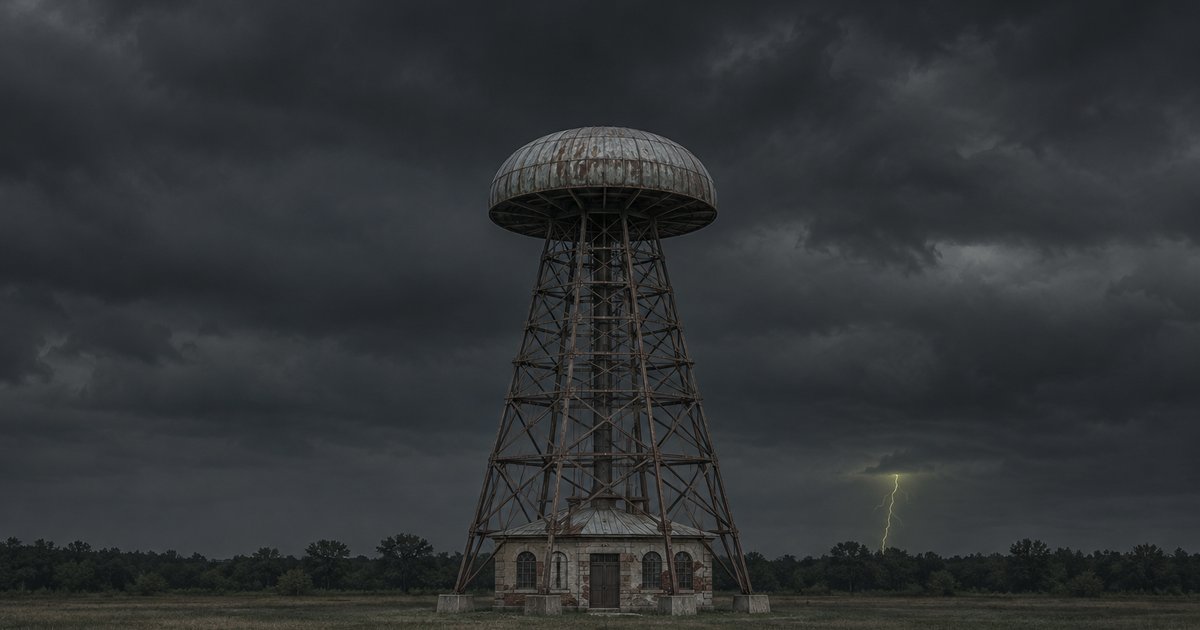
Not so far, and the sourced numbers show why. Published estimates put the energy in one lightning flash between about a quarter of a kilowatt-hour (MIT, 2015) and about 360 kilowatt-hours (Coalition for Plasma Science, 2006), and only one-thousandth to one-hundredth of that reaches the strike point. Nikola Tesla’s Wardenclyffe tower, often linked to the idea, was meant to transmit power, not to capture lightning, according to the Tesla Science Center and historian Iwan Morus.
A lightning flash has enormous power but little energy
The National Weather Service (NWS) gives a typical lightning flash as about 300 million volts and about 30,000 amps, against 120 volts and 15 amps for household current. The NOAA National Severe Storms Laboratory (NSSL) says lightning can have 100 million to 1 billion volts and contains billions of watts. Those numbers describe power, the rate at which energy moves. The amount of energy is power multiplied by time, and the time is tiny. A 2006 fact sheet from the Coalition for Plasma Science, with text by Vladimir Rakov of the University of Florida, says lightning releases most of its energy in pulses about one-hundred-millionth of a second long, and an MIT engineer puts the delivery time at only a few microseconds. A very high rate for a very short time adds up to much less energy than the voltage suggests.
Published estimates of the energy in one flash differ by a factor of about 1,400
Three publishers give figures that can be traced and compared. They do not agree.
| Source | Figure as published | In kilowatt-hours (kWh) |
|---|---|---|
| MIT School of Engineering, Ask an Engineer, March 2015 | About 1 million joules per strike | About 0.25 (stated by MIT) |
| U.S. Environmental Protection Agency, AP-42 section 14.3, September 1996 | 100 to 800 million joules per flash | About 28 to 220 (converted here) |
| Coalition for Plasma Science, 2006 | About 360 kWh per cloud-to-ground flash | 360 |
The largest figure is roughly 1,400 times the smallest (360 divided by 0.25). None of the three pages explains the gap. The EPA document, a section on lightning emissions, says its flash figure assumes that later strokes in a flash carry one-quarter of the first stroke’s energy. Larger figures circulate on science sites and forums. This article found no named measurement behind them, so it does not use them.
Even the top estimate overstates what a collector could get. The Coalition fact sheet says only about one-thousandth to one-hundredth of a flash’s energy is delivered to the strike point, and the bulk goes into heating the air and producing thunder, light and radio waves. Applied to 360 kWh, that leaves about 0.36 to 3.6 kWh. The U.S. Energy Information Administration (EIA) reports that the average U.S. home customer bought 10,791 kWh in 2022, about 899 kWh a month, or roughly 30 kWh a day. By that arithmetic, the energy at the ground from one flash is between about 1% and 12% of one average day of household use.
MIT and the University of Florida name obstacles beyond the small total
The Coalition for Plasma Science fact sheet, with text by Rakov, concludes that extracting useful energy from lightning appears impractical. James Kirtley of MIT lists the problems:
- Speed. The energy arrives in microseconds, so capture and storage equipment would have to absorb it almost instantly.
- Voltage. To obtain 1 million joules, Kirtley says, a system would handle several million volts, and it would need mechanisms to contain the burst so the facility is not destroyed.
- Polarity. A strike may carry positive or negative charge, so capacitors and rectifiers would be needed to equalize the incoming currents.
- Hit rate. The Coalition sheet says a grounded 60-meter (about 200-foot) tower in Florida is expected to be struck only once every other year, and most of the U.S. sees two to three times less lightning than Florida. Collecting strikes would take an impractically large number of tall towers.
- Location and value. Kirtley cites NOAA for about 44 strikes per second worldwide, most in the tropics and remote mountains. At the roughly 20 cents a kWh he cited in 2015, he says, the energy of a strike would be worth about a nickel.
Kirtley leaves room for a smart engineer to someday figure out how to harness lightning. A rough scale check shows why the economics would still be hard. The NWS counts about 25 million lightning flashes a year in the United States. If every one carried 360 kWh and a collector took all of it, the total would be about 9 billion kWh, the yearly use of roughly 830,000 average homes. At the one-thousandth to one-hundredth share that reaches the strike point, it would be about 830 to 8,300 homes, and only if a tower stood at every strike point. These are calculations from the sources above, using the highest of the three estimates.
Nikola Tesla studied lightning at Colorado Springs but aimed to transmit power
Tesla’s own account, published in Electrical World and Engineer on March 5, 1904 and reprinted by PBS, says he reached Colorado Springs late in May 1899 and his research aimed to “ascertain the laws of propagation of currents through the earth and the atmosphere.” The Tesla Science Center says he chose the site for its frequent lightning storms. In that account, lightning is a signal source for his instruments. On July 3 of that summer, he wrote, a storm retreating to about 300 kilometers away made his recorder fade out and return in regular cycles, which he read as stationary waves, meaning the Earth behaved like a conductor of limited size. From that he concluded it was possible “to transmit power, in unlimited amounts, to any terrestrial distance and almost without loss.”
That conclusion is Tesla’s claim. PBS says that for Tesla to test it he “would have to become the first man to create electrical effects on the scale of lightning,” and that his notes do not make clear how he meant to send the power. His 1905 patent 787,412, filed May 16, 1900, says the work began with studying “the effects of lightning discharges upon the electrical condition of the earth,” after which he conceived producing such waves “by artificial means.” He then writes that he found it possible to “reproduce whenever desired phenomena in the earth the same as or similar to” those from lightning. In that text lightning is what he imitated, not a fuel. His earlier patent 645,576, filed in 1897, mentions lightning as a comparison, to “silent lightning discharges frequently witnessed on hot and sultry days,” and its claims describe sending energy from a generating station to a receiver at a distance.
Wardenclyffe was a transmitter that never became operational
The Tesla Science Center says the Wardenclyffe tower was intended to be a transmitter for wireless power and communication, that construction began in 1901 with funding from financier J.P. Morgan, and that the tower never became operational. The building and tower stood silent until 1917, when they were sold for scrap. The American Physical Society (APS) placed a plaque at the site in a ceremony on December 11, 2016. It says Tesla tried to create a worldwide wireless system for communications and power transmission, and that while long-distance wireless power transmission remains a dream, worldwide wireless communication was achieved within a century.
Sources differ on the emphasis. The APS page quotes a site history stating the laboratory’s purpose as a wireless telegraphy plant, and the same page says the only testing of Tesla’s equipment there came in the last week of July 1903. None of these sources describes a lightning collector. Historian Iwan Morus told AAP FactCheck in 2022 that the tower was designed to transmit energy, not generate it, and that the electricity was to be generated conventionally by steam-powered dynamos.
Popular claims about Tesla and free energy split into supported, disputed and unsupported
The table sorts five claims that circulate about Tesla, lightning and Wardenclyffe by what the sources support.
| Claim | What the sources say | Status |
|---|---|---|
| Tesla studied lightning at Colorado Springs | His 1904 account and patent 787,412 describe observing lightning-driven waves in the Earth. | Documented by Tesla’s own writing |
| Wardenclyffe was meant to collect lightning for free power | The patents and the historian above describe sending generated power, with lightning as a comparison or a subject of study. | No support in the sources |
| Tesla sent usable power wirelessly at Colorado Springs | PBS says whether he did “has never been definitively answered.” | Unverified |
| His apparatus delivered energy at rates beyond lightning | Tesla says so in patent 787,412. The sources used here cite no independent measurement. | Tesla’s claim only |
| The U.S. government destroyed the tower to stop free power | AAP FactCheck rated this false on September 26, 2022, citing a sale to pay debts. A site history quoted on the APS page says the government ordered the 1917 demolition, and a U.S. Department of Energy blog says it feared spies. | Reason for demolition disputed; free-power motive unsupported |
Low harvestable energy does not change the advice to go indoors
The National Weather Service’s lightning safety overview says that if you hear thunder, you are likely within striking distance of the storm, and it sums up the guidance as “When Thunder Roars, Go Indoors.” It advises waiting 30 minutes after the last lightning or thunder before going back outside. The energy estimates do not change this advice: a flash can carry too little energy to be worth collecting, and that says nothing about the danger it poses to a person. For where to go, read Where to shelter from lightning; for the clock, Why wait 30 minutes after the last strike?; for the thunder count, Flash to bang; and for how that energy reaches people, Five ways lightning strikes people. Ten lightning myths covers more ideas that do not hold up.
Lightning Tracker, an iPhone app, shows recent detected strikes on a live map with the distance and direction to the nearest one and how many minutes ago it happened.
Not a substitute for official weather warnings.
If you hear thunder, seek shelter even if the app shows no nearby strike.
Sources
- National Weather Service, How Powerful Is Lightning?
- NOAA National Severe Storms Laboratory, Severe Weather 101: Lightning FAQ
- MIT School of Engineering, Ask an Engineer, James Kirtley, Is there a way to harness electricity from lightning? (March 23, 2015)
- Coalition for Plasma Science, text by Vladimir Rakov, University of Florida, about Plasmas: Lightning (PDF, 2006)
- U.S. Environmental Protection Agency, AP-42, Section 14.3: Lightning Emissions – Greenhouse Gases (PDF, September 1996)
- U.S. Energy Information Administration, How much electricity does an American home use? (2022 data)
- National Weather Service, Understanding Lightning Science
- National Weather Service, Overview: Lightning Safety
- Nikola Tesla, Electrical World and Engineer, March 5, 1904, as reprinted by PBS, The Transmission of Electric Energy Without Wires
- PBS, Tesla: Master of Lightning, Colorado Springs (undated)
- Nikola Tesla, U.S. Patent 787,412, Art of transmitting electrical energy through the natural mediums, filed May 16, 1900, granted April 18, 1905, as scanned and machine-read by Google Patents
- Nikola Tesla, U.S. Patent 645,576, System of transmission of electrical energy, filed September 2, 1897, granted March 20, 1900, as scanned and machine-read by Google Patents
- Tesla Science Center at Wardenclyffe, Tesla’s Wireless Power and the Wardenclyffe Tower (undated)
- American Physical Society, Wardenclyffe Historic Site (plaque ceremony December 11, 2016)
- U.S. Department of Energy, Top 11 Things You Didn’t Know About Nikola Tesla (November 18, 2013)
- AAP FactCheck, Jacob Shteyman, Tesla free energy meme shockingly short on truth (September 26, 2022)