 Lightning Tracker
App Store
Storm basics
Nikola Tesla’s Colorado Springs experiments, 1899: the summer he chased lightning
November 19, 2026 · 8 min read
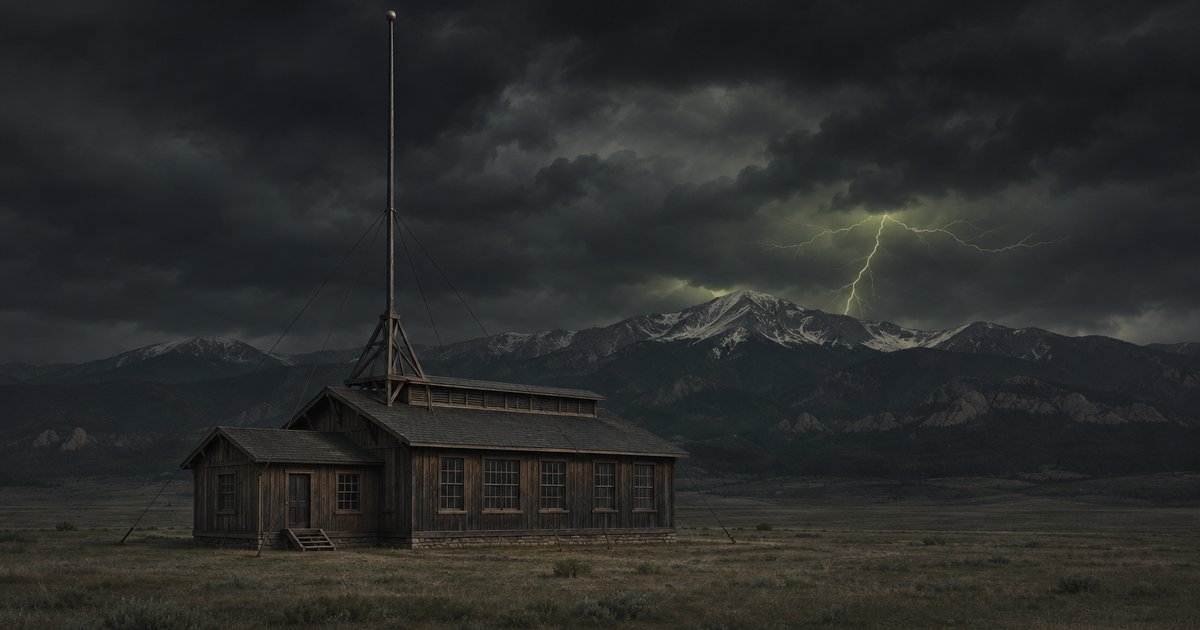
Nikola Tesla’s Colorado Springs experiments of 1899 took place at a laboratory he built on a high plateau outside the city, partly for its frequent thunderstorms: there he recorded distant storms with sensitive receivers and made large artificial discharges. Several famous figures are weaker than they are repeated: his own notes measure straight-line streamers in tens of feet, not hundreds, the well-known seated photograph is a double exposure (PBS), and a Colorado Springs museum says there is no evidence for the city-wide blackout. What he concluded from the storms is still unsettled.
Why Tesla chose a plateau near Colorado Springs
Tesla wrote in March 1904 that he reached a plateau about 2,000 meters (roughly 6,500 feet) above sea level near Colorado Springs in late May 1899, helped by his friend Leonard E. Curtis and the local electric company. The Tesla Science Center says he picked the site for its elevation above 6,000 feet and its frequent lightning storms. A National Weather Service meteorologist in Pueblo told Colorado Public Radio in March 2026 that the Pikes Peak region is “one of the lightning capitals of the United States.”
PBS’s Tesla site gives his aim: wireless power, meaning electrical energy sent through the ground or air instead of along a cable. Tesla thought it might work at high altitude, where thinner air conducts better. The Colorado Springs Pioneers Museum says he went back to New York in January 1900. PBS adds a warning that frames everything below: his diary was detailed, yet the results of his experiments are not clear.
What Tesla’s receivers recorded in the July 1899 storms
Tesla’s diary, published in 1978 in Belgrade as Colorado Springs Notes, 1899–1900, prepared by the Nikola Tesla Museum, shows what he did with the storms. In the entry for July 4, 1899, he described an instrument wired to the ground and to a raised plate. It reacted to lightning when a storm was still 80 to 100 miles away, by his estimate, and later it began to respond again in periodic bursts when, in his words, the storm was “greater than 200 miles at least.” Thunder carries only about 10 miles, according to the National Weather Service, so Tesla could not check those distances by ear; they are his estimates, not measurements.
Tesla’s 1904 article in Electrical World and Engineer, which PBS reproduces, dates the decisive night to July 3 and says the storm had retreated to about 300 kilometers (about 185 miles) while the signals kept coming. It adds that roughly twelve thousand discharges occurred in two hours within 50 kilometers of the laboratory, and that some looked like “gigantic trees of fire.” He wrote that he never saw fire balls. The two accounts give different distances, one more reason to read each number as an approximation.
Tesla drew a bold conclusion. In the Notes he wrote that the signals showed the existence of stationary waves, which are fixed patterns of strong and weak signal that appear when a wave is reflected back on itself. He first called reflection from the far side of the Earth hard to believe, “though it may be possible,” and favored reflection from the point where the lightning path began. His patent 787,412, filed in May 1900 and granted April 18, 1905, went further and said the globe may behave “in the same manner as a conductor of limited size.”
Whether Tesla anticipated the Schumann resonances
Schumann resonances are standing electromagnetic waves in the cavity between the Earth’s surface and the ionosphere, and lightning drives them. A NASA Goddard paper dated 2011 puts the five lowest measured frequencies at about 7.8, 14.3, 20.8, 27.3 and 33.8 hertz, and says a resonance forms when the Earth’s circumference matches a whole number of wavelengths.
Sources disagree on how close Tesla came. PBS says he calculated the resonant frequency of that space as approximately 8 hertz. The scientific commentary in the 1978 edition of the Notes instead says he predicted resonances at 6, 18 and 30 hertz, against measured values of 8, 14 and 20. His own patent reports wavelengths of 25 to 70 kilometers from his observations, which is a different scale from the Earth-sized waves in the NASA paper. As of November 2026, the sources reviewed for this article contain no independent test of whether his receivers saw Earth-wide standing waves, so the supportable statement is that lightning does excite such waves (NASA Goddard, 2011), and that Tesla’s claim to have measured them is unsettled.
The artificial lightning, and how long it was
To test his idea Tesla built a huge coil, and PBS describes a wooden tower with a metal mast above it that held a large copper ball. PBS gives the mast as 142 feet; the Colorado Springs Pioneers Museum says 150. PBS also states that bolts of man-made lightning more than a hundred feet long shot out from the mast. The table shows where each length comes from.
| Source | Length given | What it describes |
|---|---|---|
| Tesla, Century Magazine, June 1900 (PBS copy) | “Probably more than one hundred feet” | Path of a discharge from end to end, hedged by Tesla himself |
| Tesla, Colorado Springs Notes, late December 1899, Photograph IX | 31–32 feet straight; 124–128 feet by his path estimate | Longest streamers in Photograph IX |
| Tesla, Colorado Springs Notes, Photograph VI | 50–55 feet | End to end of the longest streamers, straight line |
| PBS, caption of the seated photograph | 22 feet | The discharge shown in that publicity photo |
| Colorado Public Radio, March 2026, photo caption | “Hundreds of feet” | Caption text; no source in this article supports it |
The 100-foot figure is real but needs careful reading. In the Notes, Tesla gave 31 to 32 feet in a straight line, then estimated the path through the air, allowing for the curve, at 124 to 128 feet. It is an estimate of path length, not one straight bolt. He also wrote that a larger building and more copper could reach 372 to 384 feet, which was a projection, not a result.
The famous seated photograph is a double exposure
PBS captions the image of Tesla seated beside his coil as a publicity photo that was a double exposure, meaning two exposures on one photographic plate. The Public Domain Review adds that it was staged for The Century Magazine and that Tesla made the arcs by switching the machine rapidly on and off. CPR’s 2026 story says Tesla admitted the photo is fake in his Notes. What the Notes show is milder. For plate XI, Tesla wrote that the sparks were produced “in the dark” and that a human figure was added “to give an idea of the magnitude of the discharge.” For plate XII he recorded sparks about 20 feet long and a flash of powder “to bring out my features,” which fits a seated portrait of Tesla himself and sits close to the 22 feet PBS gives for the famous image. The Notes do not name the publicity photograph, so that match is an inference.
The Colorado Springs blackout: one museum finds no evidence
PBS says Tesla’s experiment burned out the dynamo at the El Paso Electric Company and the entire city lost power. The Colorado Springs Pioneers Museum calls the blackout an oft-repeated tale and says there is no evidence for it; it cites Tesla’s 1917 recollection that dynamos in a power house six miles away were repeatedly burned out. Tesla’s own diary, in an entry headed January 1, 1900, says the dynamo at the supply station was short-circuited in rapid succession. The documented fact is trouble at the power station; a city-wide outage rests on retelling.
Where was Tesla’s Colorado Springs lab, and what happened to it?
After Tesla left for New York in January 1900, the Colorado Springs Pioneers Museum says, he was sued for unpaid electricity, water and caretaker’s wages, and his laboratory was sold to C.E. Maddocks, who planned to use the lumber to build a house. History Colorado quotes the museum’s curator saying the sheriff’s department auctioned the property on the courthouse steps and the laboratory was dismantled to pay his debt. She adds that the exact spot cannot be pinpointed because it is now occupied by private homeowners; History Colorado says a plaque in the Knob Hill area of Colorado Springs is all that remains to commemorate his time there.
Other claims the sources leave open
Five further claims about Tesla’s Colorado Springs work remain unverified or disputed in the sources reviewed for this article.
| Claim | What the sources say | Status as of November 2026 |
|---|---|---|
| He heard thunder 700–800 km away | Tesla wrote this in 1904. The National Weather Service says thunder is heard only about 10 miles from a strike. | Conflicts with the NWS figure; no independent record |
| His oscillator made over 12 million volts | Tesla stated it in Century Magazine in 1900; CPR’s 2026 caption says 20 million. | Tesla’s own estimate; no measurement in the sources reviewed |
| He transmitted wireless power at Pikes Peak | PBS says it has never been definitively answered, and that lit vacuum tubes may be explained by conductive ground. | Open question |
| His oscillator surpassed lightning | The 1905 patent says his tests showed rates of energy delivery surpassing lightning’s. | Tesla’s claim; the sources give no independent check |
| He detected radio signals from space | PBS says it is possible he was the first to detect radio waves from space, after he was widely ridiculed. | Unverified; PBS itself hedges |
Real lightning, for scale
The National Severe Storms Laboratory says lightning can carry 100 million to 1 billion volts. The World Meteorological Organization certified in July 2025 a flash from October 2017 that was 829 km (515 miles) long, running from eastern Texas to near Kansas City. Next to that, streamers measured in tens of feet and an estimated 12 million volts (Tesla’s 1900 figure) are on a much smaller scale.
What Tesla’s storm-watching means when a storm is near you
Tesla’s receivers found storms nobody nearby could hear, and a similar idea underlies today’s detection networks: sensors in the U.S. National Lightning Detection Network (Nag et al., 2014) time the electromagnetic waveforms that lightning produces to locate each discharge, as how lightning is detected explains. Radio can see a storm far beyond earshot, but the National Weather Service’s trigger for action is simpler: if you hear thunder, you are likely within striking distance of the storm. Thunder carries only about 10 miles, and flash to bang shows how to read the gap between flash and sound.
The National Weather Service lists substantial buildings and hard-topped vehicles as shelter options and says rain shelters, small sheds and open vehicles do not qualify; where to shelter from lightning covers the difference, and ten lightning myths checks other beliefs. Tesla’s notes record that his shop caught fire a number of times from sparks and that the noise of his discharge was irritating and pain was often felt in the ears afterward. Those were laboratory hazards, not an example to follow.
Lightning Tracker, an iPhone app, shows detected strikes on a live map, with the distance and direction to the nearest one and how many minutes ago it struck. It does not replace official warnings or local procedures.
Not a substitute for official weather warnings.
If you hear thunder, seek shelter even if the app shows no nearby strike.
Sources
- Tesla Science Center at Wardenclyffe, Tesla’s Wireless Power and The Wardenclyffe Tower, as of November 2026
- PBS, Tesla: Master of Lightning, Life and Legacy: Colorado Springs
- PBS, Tesla: Master of Lightning, “The Transmission of Electric Energy Without Wires,” by Nikola Tesla, Electrical World and Engineer, March 5, 1904
- PBS, Tesla: Master of Lightning, “The Problem of Increasing Human Energy,” by Nikola Tesla, Century Magazine, June 1900
- PBS, Tesla: Master of Lightning, Tesla seated by coil (photo caption)
- Nikola Tesla, Colorado Springs Notes, 1899–1900, Nolit, Belgrade, 1978 (prepared by the Nikola Tesla Museum); scan on the Internet Archive
- U.S. Patent and Trademark Office, U.S. Patent 787,412, “Art of transmitting electrical energy through the natural mediums,” Nikola Tesla, granted April 18, 1905
- Colorado Springs Pioneers Museum, Nikola Tesla, as of November 2026
- History Colorado, July 14, 2023, The Wizard in the Mountains
- NASA Goddard Space Flight Center (Simões, Pfaff and Freudenreich), 2011, Observation of Schumann Resonances in the Earth’s Ionosphere (NASA Technical Reports Server, PDF)
- National Weather Service, Understanding Lightning: Thunder
- National Weather Service, Overview: Lightning Safety
- NOAA National Severe Storms Laboratory, Severe Weather 101: Lightning FAQ
- World Meteorological Organization, July 31, 2025, WMO certifies megaflash lightning record in USA
- Nag et al., Recent Evolution of the U.S. National Lightning Detection Network, 2014 (PDF)
- Colorado Public Radio, March 10, 2026, Colorado Springs’ reliable mountain lightning attracted inventor Nikola Tesla to the city in the late 1890s
- The Public Domain Review, Earthen Messages: Nikola Tesla in his Laboratory (ca. 1899)