 Lightning Tracker
App Store
Storm basics
Ball lightning: what scientists know
November 10, 2026 · 8 min read
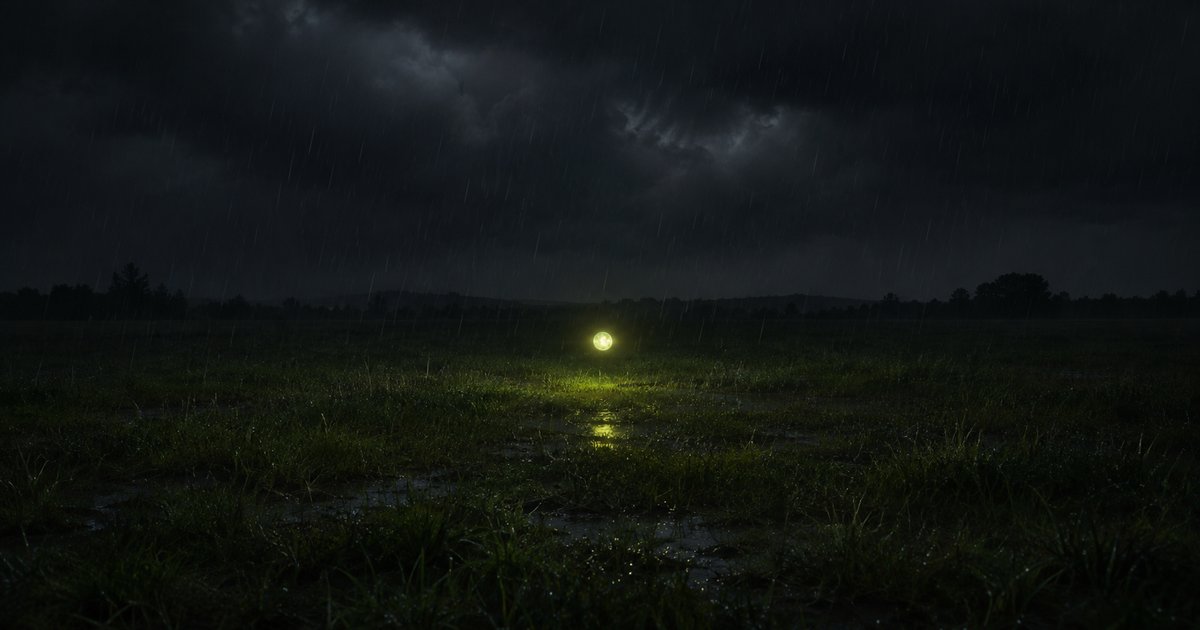
Ball lightning is a glowing sphere that people report during thunderstorms, and as of November 2026 it remains unexplained. Eos reported in 2021 that scientists cannot explain it or re-create it in the lab, and a New Mexico Tech page updated in August 2026 says there is still no idea what mechanisms create or power it. A 2012 field observation in China, published in Physical Review Letters in 2014, recorded its light spectrum, but no theory is confirmed, and Texas State University reported in February 2026 that researchers are still waiting for a clear, verifiable recording.
What people say they see
Eyewitnesses describe ball lightning as a floating, glowing sphere that lasts seconds and then fades or bursts, but published summaries disagree on its size, duration and color. The table sets out five of them. Treat the figures as ranges built from eyewitness accounts, not as measurements.
| Source | Size | Duration | Brightness or color |
|---|---|---|---|
| Abrahamson and Dinniss, Nature, February 2000 | “Average” of 300 mm (about 12 in) | About 10 seconds | Similar to a 100-watt lamp |
| Physics World, January 2014 | 1–100 cm (0.4–40 in) | About 1–10 seconds | White, orange, yellow, purple or green |
| APS Physics, January 2014 | Golf ball to several meters | One second to tens of seconds | Not given |
| Eos (AGU), July 2021 | Typically about 20 cm (8 in) | Seconds to up to a minute | White, yellow, orange, blue, or rarely green |
| Texas State physics abstract, October 2024 | Typically 300–400 mm (12–16 in) | On the order of seconds | Like a domestic incandescent lamp |
The same sources report odder behavior. A 2024 abstract by Texas State University researchers says the balls have been reported inside closed rooms and metal-skinned aircraft, and passing through closed glass windows. The 2000 Nature paper says they end either in an explosion or by fading from view. Eos reported in 2021 that sightings may, in very rare cases, have led to burn injuries or deaths. All of this rests on witnesses, and Physics World noted in 2014 that accounts vary dramatically.
Reports go back centuries, but they are still anecdotes
Chemical & Engineering News reported in April 2024 that an illuminated manuscript written by an English monk in 1195 may be the oldest report of ball lightning. It describes a fiery globe falling into the River Thames. The same article says that nearly 600 years later the scientist Georg Richmann was killed in his Saint Petersburg laboratory by what was described as a globe of blue and whitish fire.
Stories like these show how old the question is, but they do not give a rate. The New Mexico Tech ball lightning project noted, in a page last updated in August 2026, that Rakov and Uman pointed out in their 2001 book that about 5,000 reports had been published, and that scientists still had no idea what mechanism creates or powers the phenomenon.
The 2012 measurement in China
A team from Northwest Normal University in Lanzhou, China, recorded what appears to be the first emission spectrum of ball lightning, in a paper published in Physical Review Letters on January 17, 2014. They were filming thunderstorms in July 2012 when a ball appeared just after a cloud-to-ground strike about 1,000 yards (900 meters) away. Their abstract reports that the light from soil elements was present for the whole life of the ball.
APS Physics added that the spectrum showed emission lines from silicon, iron and calcium, and that the glow lasted about a second and changed from white to reddish. The recorded glow was about 16 feet (5 meters) across, though the actual ball was much smaller.
The observation still leaves questions. Physics World reported in January 2014 that Eli Jerby of Tel Aviv University, who has made laboratory fireballs, said the unusually large apparent size and a 100 Hz flicker in the light stopped him from labeling the event ball lightning with certainty. The event happened near 50 Hz power lines, and the authors suggested the flicker could be related to that proximity. Martin Uman, a lightning specialist, called it probably ball lightning, “or one type of ball lightning,” and added that the data do not reveal which theory is correct.
Competing explanations, and how far each has got
Researchers have proposed many mechanisms for ball lightning, and none has been confirmed. Karl Stephan of Texas State University told Eos in 2021 that there are literally dozens of theories because the situation is unconstrained, and Uman said there are probably multiple causes behind what gets called ball lightning. The table covers four ideas that appear in the sources.
| Idea | Proposed | Status as of November 2026 |
|---|---|---|
| Burning soil: a strike ejects silicon-based nanoparticles that slowly oxidize in air, giving off heat and light | Abrahamson and Dinniss, Nature, February 2000 | The 2012 spectrum is consistent with soil elements; Uman said it does not show which theory is right |
| Microwave fireballs: glowing balls made in a laboratory by aiming high-power microwaves at silicon and other solids | Jerby and Dikhtyar, Tel Aviv University, 2006 | Physics World noted there was no direct evidence that natural ball lightning forms this way |
| Brain stimulation: a long lightning pulse magnetically stimulates the visual cortex, producing a perceived glow | Peer and Kendl, 2010 | An erratum added to the arXiv paper says the corrected induced fields are more than an order of magnitude smaller for average lightning |
| Magnetic monopoles: a particle that has proved elusive to observe triggers nuclear fission that powers the ball | Idea from 1990; Stephan, August 2024 | Posted on arXiv as a preprint, with proposals for further research; speculative |
Physics Focus warned in 2014 that laboratory experiments may bear no relation to how ball lightning forms in nature. The brain-stimulation idea is also a different kind of claim from the rest, since it says some sightings are perceptions rather than objects.
What Tesla wrote about making fireballs
Nikola Tesla wrote in 1904 that he had never seen a natural fireball but had later worked out how they form and produced them artificially. The sentence appears in his article in Electrical World and Engineer of March 5, 1904, which looks back on the experiments he began near Colorado Springs, Colorado, after arriving in late May 1899. As reprinted by PBS, the passage gives no voltage, apparatus, size, duration or date for the fireballs, and “later” does not say whether the work happened in Colorado. PBS says that despite a detailed day-to-day diary, the results of his Colorado Springs experiments are not clear.
Two things therefore have to be kept apart. What Tesla wrote is a one-sentence claim, published about five years after he reached Colorado. What was measured is a different matter: none of the sources used for this article reports an independent measurement of Tesla’s fireballs, or a replication that matches his description. Popular accounts claim that modern experimenters reproduced them with Tesla coils; those accounts were not checked against primary sources here, so this article does not repeat them.
Laboratory fireballs that have been documented come from other work. In a January 2007 paper in Physical Review Letters, researchers at the Universidade Federal de Pernambuco in Brazil ran electric arcs in pure silicon and produced luminous balls that lasted on the order of seconds and shared several properties usually reported for natural ball lightning. The Tel Aviv microwave fireballs in the table above belong to the same family of experiments. The Physics Focus caution applies to all of them, and applies to Tesla’s as well, with the added limit that, as far as these sources show, Tesla’s claim rests only on his own report.
Why cameras have not settled it
Researchers still lack a recording that they agree shows ball lightning, and a 2023 case shows how easily lookalikes arise. Texas State University reported in February 2026 that a security camera in Bozeman, Montana, captured two glowing objects that appeared to hit the ground, shrink and fade within seconds. The team’s October 2024 conference abstract called them probably ball lightning. Reviewers later pointed elsewhere: a brief power outage was reported just before the recording, and they judged the lights were most likely distant lightning or an electrical arc from a power line. They also concluded that camera sensor overload probably made them look larger. Arcs can fling tiny bits of burning metal that glow for several seconds.
The lesson is that a video of a glowing orb is not, on its own, evidence of ball lightning. Eos described the perfect sighting as one with several witnesses whose accounts agree, video from more than one angle, a shadow cast by the object, and enough detail to compare with radar. In July 2025, a Global News report on a 23-second video from Alberta quoted a planetarium manager saying the glow could be ball lightning or an artifact of the strike itself. The report did not say any researcher had confirmed it.
Researchers want more precise records, because modern lightning-location networks and weather radar can show how close a storm was to a sighting. The New Mexico Tech page says that time and place would let them test whether ball lightning is usually tied to nearby lightning. Texas State said in 2026 that its sighting-report site, launched in 2020 with New Mexico Tech, had received more than a thousand submissions. Lightning Tracker, an iPhone app, shows recent detected strikes on its live map, with the distance to the nearest one and how many minutes ago it happened. For how those networks work and where they miss strikes, see how lightning is detected.
If you see a glowing ball in a storm
The National Weather Service lightning FAQ page, as of November 2026, lists cars, planes, fish, heat lightning, temperature, power, myths and crouching, but not ball lightning, so the general thunderstorm rules apply. The Service also says that if you hear thunder, you are likely within striking distance of the storm. Eos reported that the balls typically happen during thunderstorms, so the response is the same as for any lightning. The Service names substantial buildings and hard-topped vehicles as options, and says rain shelters, small sheds and open vehicles are not; where to shelter from lightning explains the difference. The seconds between flash and bang, covered in flash to bang, give a rough distance to the storm.
Eos described burns and deaths as very rare cases, and no source gives a rate, so this article does not claim a number. Ball lightning is a reported phenomenon, not something you can plan around, while many common beliefs about ordinary lightning are checked in ten lightning myths.
What remains uncertain
- What it is made of. The soil-vapor idea fits the 2012 spectrum, but the same data do not rule out other explanations, and the unusual size and flicker leave the event itself open to doubt.
- Whether it is one phenomenon. Uman’s view, reported by Eos in 2021, is that reports probably have several causes.
- Whether any video shows it. In February 2026 the Texas State team was still looking for a clear, verifiable recording.
- How often it happens. No source in this article gives a reliable rate; the roughly 5,000 published reports are a count of reports, not of events.
Not a substitute for official weather warnings.
If you hear thunder, seek shelter even if the app shows no nearby strike.
Sources
- Abrahamson and Dinniss, Nature 403, February 2000, Ball lightning caused by oxidation of nanoparticle networks from normal lightning strikes on soil
- Cen, Yuan and Xue, Physical Review Letters 112, January 2014, Observation of the Optical and Spectral Characteristics of Ball Lightning (abstract)
- American Physical Society, Physics 7, January 2014, First Spectrum of Ball Lightning
- Physics World, January 2014, Burning soil fuels ball lightning
- Eos (American Geophysical Union), July 2021, Have You Seen Ball Lightning? Scientists Want to Know About It
- Chemical & Engineering News, April 2024, What is ball lightning, a reality or myth?
- Texas Section of the American Physical Society, October 2024, Implications of Closeup Video of Probable Ball Lightning (meeting abstract)
- Texas State University, February 2026, Texas State researcher chases the glow behind ball lightning
- New Mexico Tech, Sonnenfeld research page, updated August 2026, Ball lightning reports and publications
- Peer and Kendl, arXiv, 2010, Transcranial stimulability of phosphenes by long lightning electromagnetic pulses
- Stephan, arXiv, August 2024, Could Ball Lightning Be Magnetic Monopoles? (preprint)
- Tesla, Electrical World and Engineer, March 5, 1904, as reprinted by PBS, The Transmission of Electric Energy Without Wires
- PBS, Tesla: Master of Lightning, Colorado Springs (undated)
- Paiva and others, Physical Review Letters 98, January 2007, Production of Ball-Lightning-Like Luminous Balls by Electrical Discharges in Silicon (abstract)
- Global News, July 2025, Alberta storm lightning ball video
- National Weather Service, Lightning Safety Overview
- National Weather Service, Lightning FAQs