 Lightning Tracker
App Store
Storm basics
St. Elmo’s fire: what the glow is and what it means
November 18, 2026 · 7 min read
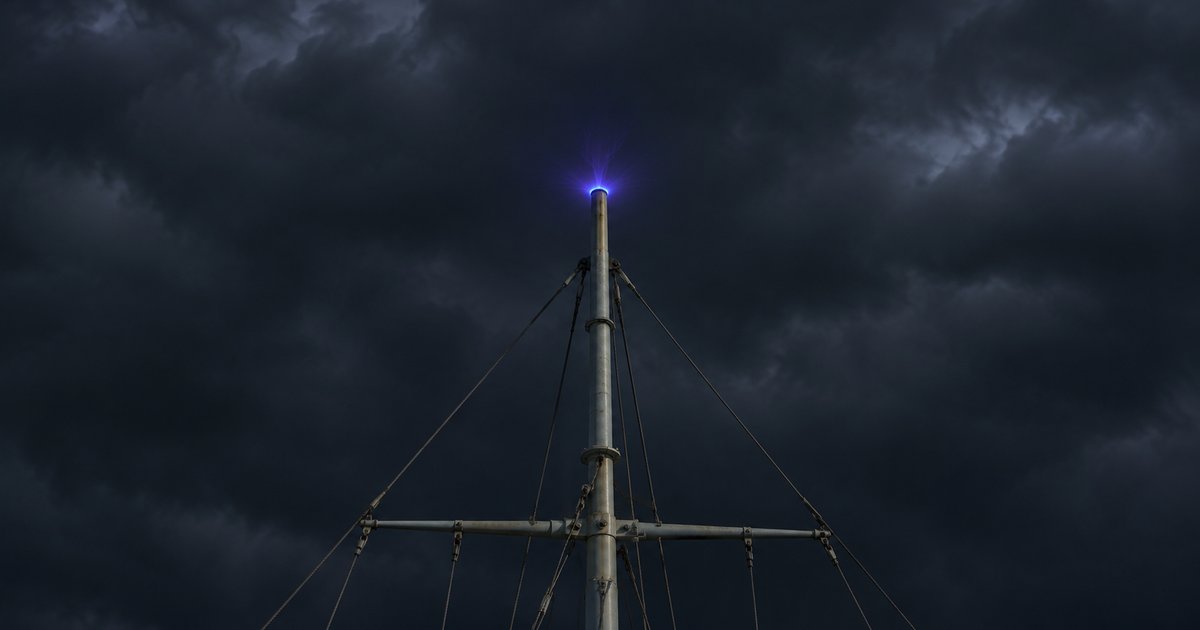
St. Elmo’s fire is a corona discharge: a faint blue or violet glow that forms on pointed or sharp objects when the electric field around them is strong enough to ionize the air. It is not a flame and not a lightning flash. The National Weather Service treats it as a reason to move at once: its glossary says unprotected mariners should move to shelter immediately and that lightning may strike the mast within five minutes after it begins to glow.
St. Elmo’s fire is air glowing in a strong electric field
An MIT News report from August 11, 2020 describes the mechanism. Charge in a storm cloud builds an electric field that can reach the ground, and if the field is strong enough it breaks apart nearby air molecules and turns the air into a plasma, a charged gas. That happens most readily around sharp, conductive objects such as cell towers and wing tips, because points concentrate the field. Electrons then knock the molecules into excited states, and as the molecules settle back they give off light that, for oxygen and nitrogen, is the characteristic bluish glow.
The Hong Kong Observatory, in a December 2019 educational article, adds that the effect is strongest where an object has a sharp curve, such as a ship’s mast, and that the glow is usually violet or blue because of the nitrogen and oxygen in air. NOAA’s Ocean Service compares it to a neon sign. In a 1997 Scientific American answer, the electrical engineer William Beaty makes the same comparison: in a neon atmosphere the glow would be red-orange, but air gives blue-violet.
The glow is not a lightning flash. Steven Ackerman, then of the University of Wisconsin–Madison, answering in the same Scientific American piece, calls St. Elmo’s fire a continuous corona discharge and says it is not a form of lightning. MIT’s Carmen Guerra-Garcia, in the 2020 report, describes corona discharge as the first stage of lightning in general, so the glow is a sign of electrically stressed air, not itself a flash. Beaty adds that St. Elmo’s fire stays attached to an object, while ball lightning can drift like a soap bubble.
The glow appears on masts, steeples, towers, wings and peaks
Any pointed, conductive object in a strong field can glow, and the sources name several places. NOAA’s Ocean Service calls it a rare phenomenon but gives no frequency.
| Place | What the source says | Source |
|---|---|---|
| Ship masts | Sailors saw corona discharges at the tips of masts during storms at sea. | MIT News, 2020 |
| Steeples and spires | It can appear around church spires and has been seen atop tall steeples. | NASA ASRS, 2006; Scientific American, 1997 |
| Towers and poles | At the height of a thunderstorm, the tips of cell towers and telephone poles can emit a flash of blue light. | MIT News, 2020 |
| Aircraft | Wing tips and nose cones are common spots; the FAA lists a glow on the windshield. | Hong Kong Observatory, 2019; FAA |
| Mountain peaks | A crackling noise and, in the dark, a bluish glow at a projection; a person’s hair can crackle too. | American Alpine Journal, 1962 |
In aviation the glow is discussed under precipitation static. The Federal Aviation Administration’s Aeronautical Information Manual (section 7-6-12) says an aircraft flying through rain, snow, fog, sleet, hail, volcanic ash or dust picks up a substantial negative charge on its skin. Without working static dischargers it may go into corona from its wing tips, tail surfaces, antennas and propeller tips. The manual lists “St. Elmo’s Fire” on the windshield among the symptoms, beside weak radio transmissions and erratic instrument readouts. Roland Stull’s 2017 course notes at the University of British Columbia say P-static does not directly damage the aircraft but can make radio communication and navigation difficult.
The charge does not always come from a thunderstorm. The same manual’s section on volcanic ash says flightcrews who flew into ash clouds have reported, at night, St. Elmo’s fire or other static discharges with a bright orange glow in the engine inlets, and the Hong Kong Observatory lists a nearby volcanic eruption beside thunderstorms as a setting for the glow.
A 2006 bulletin from NASA’s Aviation Safety Reporting System, which publishes pilots’ own reports, shows how a crew can experience it. A Boeing 757 captain wrote that they were climbing through heavy rain, massive St. Elmo’s fire and lots of lightning when a burning smell began, then the captain’s airspeed indicator showed about 120 knots, his altimeter failed, there were more warnings than the crew could read and the radios seemed to have failed. The captain wrote that he had met the burning smell before in a 757 during St. Elmo’s fire, that everything went back to normal, and, as his own unconfirmed understanding, that maintenance found nothing wrong. His own guess was a massive static buildup or discharge, or a lightning strike on the airplane. That is one pilot’s account, and the bulletin does not establish the cause.
Mountaineers have described the same effect on foot. A 1962 American Alpine Journal article by Alvin E. Peterson says the local breakdown of air around a projection gives off a crackling noise and, in the dark, a bluish glow, which engineers call corona and navigators call St. Elmo’s fire. If a person’s head is the projection, he writes, the hair will crackle and stand on end. Peterson reports that he and others noted corona on peaks when the nearest thunderclouds seemed too far away to have local effects, and that the surroundings may even have been in bright sunshine.
Sailors read the glow as a saint, and the name stuck
The name comes from the patron saint of sailors. NOAA’s Ocean Service says “St. Elmo” derives from St. Erasmus of Formia, one of the two patron saints of sailors, and the Hong Kong Observatory notes that in Chinese culture the same glow is called the fire of Mazu, a goddess who guards the seas. Ackerman writes that mariners have traditionally taken it as a good omen.
Two first-hand accounts describe the glow at sea. In an English edition of the narrative of Antonio Pigafetta, who sailed with Magellan’s fleet in 1519, the ships turned south past Cape Verde on October 3, and in the storms before they reached the equator the holy body, that is St. Elmo, appeared many times. On one very dark night it burned like a blazing torch on the maintop for about two hours or more, to the consolation of men who were weeping. Charles Darwin, on the passage from Rio de Janeiro to the River Plate that began on July 5, 1832, recorded in his journal that on a second night the mast-head and yard-arm ends of the ship shone with St. Elmo’s light, while the sea was highly luminous and the sky was lit by vivid lightning.
The National Weather Service treats the glow as a reason to take shelter
The National Weather Service glossary defines St. Elmo’s fire as the glow on a masthead produced by an extreme buildup of electrical charge. It says unprotected mariners should immediately move to shelter when it occurs, and that lightning may strike the mast within five minutes after it begins to glow. A National Weather Service Houston fact sheet repeats the definition and the five-minute warning. Neither says how often a strike follows, so the five minutes is the agency’s wording, not a measured figure.
The glow itself is not the hazard. The Hong Kong Observatory calls it generally harmless and without scorching heat, while saying the storm conditions that produce it are the main hazard to aircraft. Peterson’s 1962 article puts the difficulty plainly: the sound or sight of corona does not necessarily indicate hazard, but without a more precise indication it should be treated as a danger sign, especially with thunderclouds nearby.
Sources also place the glow at different moments of a storm. Ackerman says it tends to occur toward the end of a thunderstorm, while the Weather Service says a strike may come within five minutes after it begins. Those two descriptions do not fit one timetable, so there is no way to plan around the glow. The Weather Service says that promoting the crouch as a last resort when a person’s hair stands on end gives people the impression that they will get a warning sign, and that such beliefs could make people apathetic about seeking shelter before the threat becomes significant.
Read together, the sources point to one action: treat the glow as a reason to go in at once, not as a signal that time is left. The Weather Service’s guidance is to get inside a substantial building or hard-topped metal vehicle and to wait 30 minutes after the last lightning or thunder before going back outside. The agency adds that when neither is within reach there may be nothing outdoors that lowers the risk significantly, and lists what to avoid: open areas, the tallest objects and tall or isolated trees.
Lightning Tracker, an iPhone app, shows recently detected strikes on a live map, with the distance and direction to the nearest one and how many minutes ago it was detected.
Not a substitute for official weather warnings.
If you hear thunder, seek shelter even if the app shows no nearby strike.
Sources
- NASA Aviation Safety Reporting System, CALLBACK No. 322, October 2006, “Uncanny from ASRS” (PDF)
- Federal Aviation Administration, Aeronautical Information Manual, chapter 7, section 6 (7-6-10 and 7-6-12)
- National Weather Service, Glossary: S (St. Elmo’s Fire)
- National Weather Service Houston/Galveston, Lightning facts (PDF)
- National Weather Service, The NWS stopped recommending the crouch in 2008
- National Weather Service, Overview: Lightning Safety
- NOAA National Ocean Service, Weird ocean weather
- MIT News, Jennifer Chu, How airplanes counteract St. Elmo’s fire during thunderstorms (August 11, 2020)
- Hong Kong Observatory, NG Cho-wing, St. Elmo’s Fire as Seen from Aircraft (December 2019)
- University of British Columbia, Roland Stull, Practical Meteorology (2017), Chapter 15: precipitation static
- Scientific American, “What causes the strange glow known as St. Elmo’s Fire?” (September 22, 1997; answers by William Beaty and Steven Ackerman)
- Alvin E. Peterson, American Alpine Journal, 1962, Lightning Hazards to Mountaineers
- Antonio Pigafetta, in Blair and Robertson, The Philippine Islands, 1493–1898, vol. 33 (1906), Project Gutenberg edition
- Charles Darwin, Journal of Researches (voyage of H.M.S. Beagle), Project Gutenberg edition