 Lightning Tracker
App Store
Places and activities
Lightning on a boat: what to do in a thunderstorm and after a strike
November 19, 2026 · 10 min read
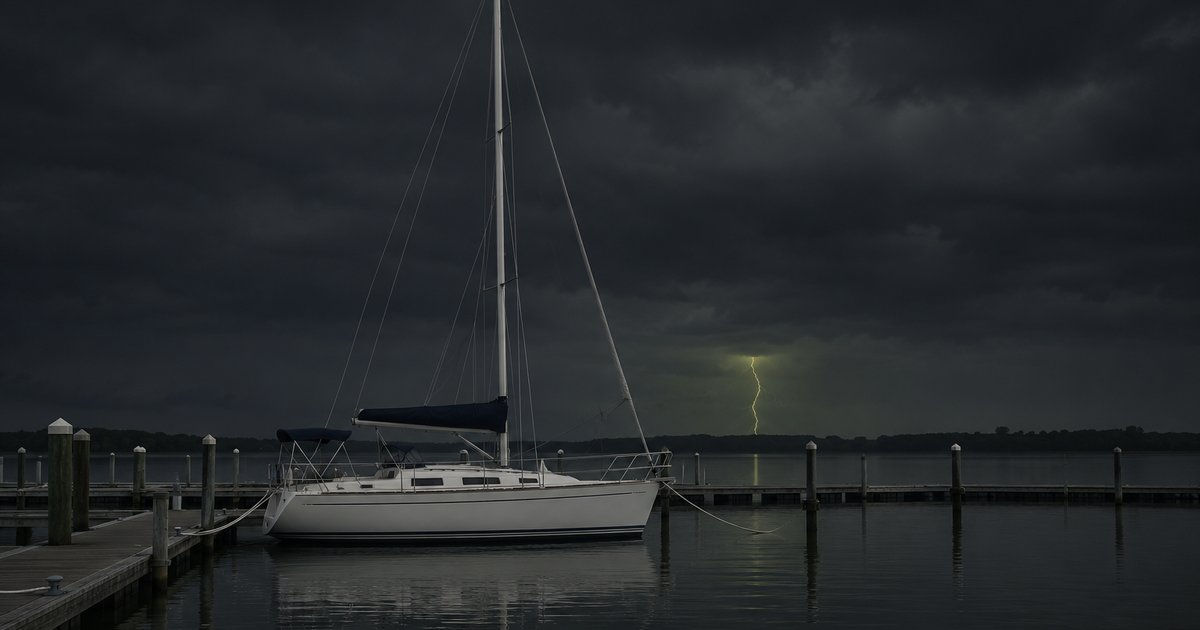
In a thunderstorm on a boat, the National Weather Service says to head to port or shelter as quickly as possible, to stay inside the cabin and avoid touching metal or electrical devices if the boat has one, and to stay as low as you can in the boat if it does not. The same service says the vast majority of lightning injuries and deaths on boats happen on small boats with no cabin, and that large boats with cabins, especially those with properly installed lightning protection systems, are relatively protected. That makes a cabin boat better than an open one, but not shelter in the way a building is, and none of the sources we read says how much a protection system lowers the risk to the people aboard. What holds for every boat is to stay off the water when thunderstorms are forecast and to head in at the first thunder.
A boat is usually the tallest object on the water
The Ohio Department of Natural Resources says in a page dated July 10, 2020 that lightning most often strikes the highest object in the immediate area, and that on a body of water that object is a boat. Once the boat is struck, the page says, the charge takes the most direct route to the water and spreads out in all directions. This fits the National Weather Service (NWS) rule that height, a pointed shape and isolation decide where lightning lands, and that metal makes no difference.
The Ohio page, which credits a University of Florida extension publication, walks through how the current can cross a person aboard. It names four cases: a hand on a radio wired to a struck antenna, hands on a struck mast or its rigging, a direct hit on the person at the helm, and a hand on a graphite fishing rod in a rowboat. In all four, the page says, the person could be seriously injured or killed. It adds that touching the struck part is not required, because a side flash can jump to a person who happens to be the better path to ground. Five ways lightning strikes people explains side flash and ground current.
Insurance claims and casualty reports measure different things
BoatUS, the Boat Owners Association of The United States, which also insures boats, analyzed 10 years of its insurance claims. A trade-press reprint of its February 2015 release puts the odds of a boat being struck at about one in a thousand, and shows how widely the odds differ by boat. Boating Magazine, reporting BoatUS claim data in February 2020, adds that Florida accounts for 33 percent of all claims and the Chesapeake Bay area for 29 percent.
| Boat group | Chances of a lightning claim per 1,000 boats |
|---|---|
| Boats 40 to 65 feet long | 6 |
| Monohull sailboats | 3.8 |
| All boats, national average | 0.9 |
| Boats 16 to 25 feet long | 0.2 |
| Bass boats, runabouts and pontoon boats | 0.1 |
BoatUS ties the pattern to height. Its release says that raising a sailboat's mast from 35 to 45 feet nearly triples the odds of being hit, that a multihull sailboat is almost twice as likely to have a claim as a monohull, and that pontoon boat claims are well below average.
These are claims on insured boats, not injuries to people. The NWS looks at the other end: the vast majority of lightning injuries and deaths on boats happen on small boats with no cabin, a group that appears to overlap heavily with the bottom rows of the BoatUS table, though neither source sorts boats that way. The two do not conflict, but neither gives a casualty rate per boat type, so the sources cannot say how much more dangerous an open boat is once lightning is near.
A pontoon boat belongs in the open-boat decision if it has no enclosed cabin: its low BoatUS claim rate does not make its passengers protected. The NWS directs boaters toward port or shelter when thunderstorms are nearby and says that, if land cannot be reached, people in an open boat should get as low as possible.
The National Lightning Safety Council (NLSC) counted 25 boating deaths among the 492 U.S. lightning deaths from 2006 through 2024, and found that fishing and boating together made up 14 percent of all of them. Its reading: people on boats are in the open, motor and wave noise can hide thunder, and they may need extra time to reach shelter. Many victims, it says, were already heading in and did not react soon enough. Who gets struck by lightning? has the rest of that study.
What a cabin and a ground plate do, and what no source measures
The NWS rates large boats with cabins, especially those with properly installed lightning protection systems, and metal marine vessels as relatively protected, and tells people aboard to stay inside the cabin and away from any metal surface. In a boating message issued with a national boating organization, it adds that a strike to a vessel can be catastrophic, especially if it causes a fire or knocks out electronics, and that people in a cabin should avoid touching metal or electrical devices. The Ohio page says to stay in the center of the cabin.
A lightning protection system, as Boating Magazine describes it, is an air terminal (a lightning rod) above the boat, joined by thick wire to a metal ground plate under the waterline, with large metal objects such as tanks, engines and rails connected as well. The magazine says an immersed ground plate of one square foot with hard edges gives lightning current a low-resistance path instead of sending it through the boat or its crew, and that some experts favor multiple rods and electrodes near the water. It says larger enclosed boats, trawlers and sailboats sometimes come with a conventional system installed, while on an open boat it is typically up to the owner to carry a portable pole with a wire and ground plate. It also says research shows boats without a system suffer more damage, without naming the research.
That is the closest the sources come to answering whether a boat is “grounded.” None of them describes a whole boat that way. They describe a strike looking for the water, and a protection system as giving it a route there. Two limits follow from the same sources:
- The evidence is about damage, not injuries. The magazine's point is that unprotected boats and their electronics suffer more. The NWS says “properly installed” and “relatively.” None of the sources we read says how much a system lowers the risk to people, and Ohio's page does not say what makes a system adequate. Nothing here promises that a particular boat's system is.
- A route to the water is not a route around the people. Ohio's page advises having an adequate system installed and inspected regularly, and never being in contact with two components connected to it at the same time, since a hand on both puts the person in the current's path.
A cruise ship is not exempt from a lightning strike: the NWS calls metal marine vessels relatively protected and tells people to stay inside, away from metal surfaces. Royal Caribbean says its crews monitor storms, may change an itinerary when a tropical system threatens, and give guests weather updates from the captain. On an exposed deck, go into the enclosed ship and follow the crew’s directions about where to remain; Royal Caribbean’s guest policy requires passengers to follow instructions from its crew.
If you are caught out, the advice by source
The NWS says that a boater who cannot get back to land should drop anchor and get as low as possible. Ohio's page, which lists a University of Florida extension publication as its reference, adds to keep arms and legs inside the boat rather than dangling in the water, and to stop fishing, water skiing, tubing, swimming and other water activities when there is lightning or when conditions even look threatening, because the first strike can come a mile or more ahead of the storm cloud.
If the closest shore is an island or beach, reaching land is only part of the decision. Read together, the NWS boating advice to head for shelter and its lightning guidance on buildings, vehicles and open picnic shelters point to a substantial building or hard-topped vehicle on shore; an open beach or picnic shelter does not provide that protection. If you cannot get to land and shelter, follow the NWS last-resort instruction to drop anchor and get low in the boat.
The top-ranked boating pages blend agency lines with magazine tips. The table separates them for the points where the three sources we compared say something.
| Situation | NWS | Ohio DNR (cites a University of Florida publication) | Boating Magazine, February 2020 |
|---|---|---|---|
| Boat with a cabin | Stay inside; avoid touching metal or electrical devices | Stay in the center of the cabin | Go inside, well away from metal objects, outlets and appliances |
| Open boat, shore out of reach | Drop anchor; get as low as you can | Stay low in the boat; keep arms and legs in | Drop anchor, remove metal jewelry, put on life jackets, get low in the center |
| Radio | Stay off unless it is an emergency | Disconnect; do not use or touch major electronics, radio included | No VHF unless it is an emergency; handhelds are fine |
| Heading in | Head to port or shelter as quickly as possible | Get off the water whenever conditions are threatening | Dash to the dock if it is close; otherwise ride it out |
The three agree on the core: get low, away from metal, and off the water early. They differ on the radio, and the life jacket and jewelry steps appear only in the magazine. Where they differ, this article follows the NWS, the national agency.
What to do if lightning strikes your boat
Boating Magazine's checklist for a direct hit starts with people: check for unconscious or injured persons first, and begin CPR on anyone unconscious who has no pulse or is not breathing. Have someone check the bilges for water at the same time; it says lightning can, though rarely, blow out a transducer or a through-hull fitting. If there are no injuries and no major leaks, wait out the storm, then check the engine and all electronics. Tips that BoatUS published in 2011, reprinted by the Bangor Daily News, add the compass to that check and say that if all is well so far, a short haul to check the bottom thoroughly is worth considering. Boating Magazine recommends a professional survey even when no damage shows, because minor through-hull damage can cause slow leaks.
Leaving before the first strike is the plan that works
The NWS says plainly that mariners are especially vulnerable because they may be unable to reach port quickly, and strongly recommends not going out if thunderstorms are a possibility. Its boating message adds that thunderstorms are usually brief, so waiting ashore is better than riding one out. The NWS also stresses that if you hear thunder, you are likely within striking distance.
Before leaving shore, the NWS boating message says to use extra caution in thunderstorm conditions and have a plan of escape. Decide which port or substantial shore shelter you can reach before a storm arrives; if thunderstorms are possible, its recommendation is to wait ashore.
On a boat, hearing is the weak link. The NLSC points to motor and wave noise, so counting seconds from flash to thunder, covered in Flash to bang, only works while you can hear. Once you are in, the NWS says to wait 30 minutes after the last lightning or thunder before going back out; Why wait 30 minutes after the last strike? explains why the count restarts.
A marina is not shelter by default. The NWS says rain shelters and small sheds do not protect from lightning. A covered slip or open dock canopy looks like the same class, which is our reading, not an NWS statement about docks. Where to shelter from lightning covers what does count: a substantial building or a hard-topped vehicle.
A lightning map and the radius for a boat
Lightning Tracker is an iPhone app that shows recently detected strikes on a live map, with the distance and direction to the nearest one and how many minutes ago it was detected. It alerts you when a strike is detected inside a radius you set for each place, which defaults to 10 miles (16 km). For boaters the radius is really a time budget: the distance to the nearest harbor, divided by the speed you can make, is the time you need. As plain arithmetic, a harbor 6 miles (10 km) away at 15 mph is 24 minutes. How to choose an alert radius shows how to fit the two.
The limits matter on the water. Detection networks miss some strikes, especially weak ones, and data can arrive late; the app marks late or missing data instead of treating it as quiet. It does not replace official warnings or your own judgment.
Not a substitute for official weather warnings.
If you hear thunder, seek shelter even if the app shows no nearby strike.
Sources
- National Weather Service, boating and thunderstorms public service announcement
- National Weather Service, Lightning Safety Outdoors
- National Weather Service, Lightning Myths
- National Weather Service, Lightning Safety Overview
- Ohio Department of Natural Resources, Lightning Safety for Boaters (July 10, 2020)
- Claims Journal, Certain Boats at Higher Risk for Lightning Strike: BoatUS (February 18, 2015), a trade-press reprint of a BoatUS release
- Bangor Daily News, BoatUS has tips for summer lightning storms (May 25, 2011), a newspaper reprint of BoatUS advice
- National Lightning Safety Council, J. Jensenius, A Detailed Analysis of Lightning Deaths in the United States from 2006 through 2024 (PDF, January 2025)
- Boating Magazine, What to Do in a Lightning Storm on a Boat (updated February 10, 2020), secondary source
- Royal Caribbean, weather alert and itinerary policy
- Royal Caribbean, cruise weather monitoring and captain announcements (updated February 27, 2026)
- Royal Caribbean, Guest Health, Safety, and Conduct Policy