 Lightning Tracker
App Store
Places and activities
Lightning at the beach: no shelter on the sand, and thunder is hard to hear
November 13, 2026 · 8 min read
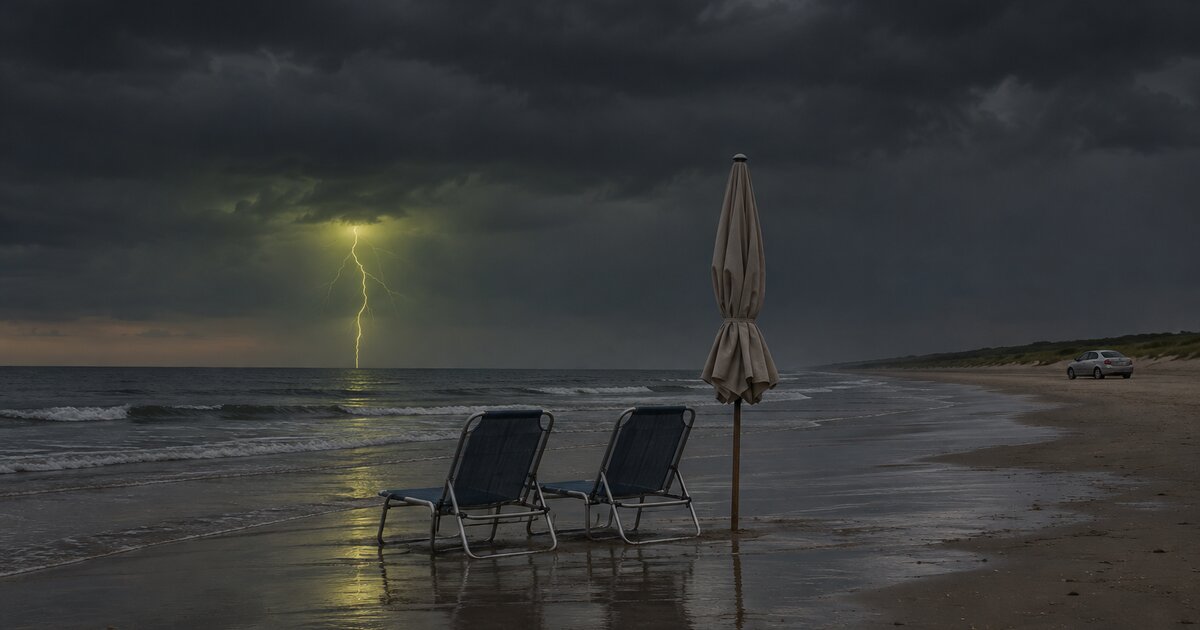
At a beach, the first thunder or lightning is the signal to get out of the water, leave the sand and go to a hard-topped car or a large, fully enclosed building. That is the guidance of the National Weather Service (NWS) and NOAA. A beach has nothing on it that counts as shelter, and it is a place where people hear warnings late and have a long way to go, so the decision to leave has to come early.
Why beaches appear so often in lightning death data
The National Lightning Safety Council (NLSC), which compiles U.S. lightning deaths together with the NWS, counted 32 beach deaths from 2006 through 2025 in its March 2026 analysis. Only fishing, at 48, ranks higher; boating has 26 and camping 23. The NWS beach hazards page likewise calls beach activities the second greatest cause of lightning deaths. Who gets struck by lightning? has the full activity list from the earlier 2006 through 2024 edition of the analysis.
The NWS gives three reasons for the toll. The sound of thunder is hidden by the surf and by people having fun. The car or other vehicle that would protect you may be some distance away. And on the U.S. East Coast, people mostly face the ocean to the east while many storms arrive from the west. The NLSC adds that some victims had walked or run along the beach and may have been far from shelter when a storm approached. The sources we read do not say how many of the 32 deaths fit each pattern.
Seven beach deaths on the NWS lists for 2024 through 2026
The NWS publishes a yearly table of U.S. lightning deaths with the place, the type of location and the victim's activity. Seven entries across the 2024, 2025 and 2026 tables give the location as a beach.
| Date | Place | Activity listed by the NWS |
|---|---|---|
| June 23, 2024 | Seaside Park, New Jersey | Warning children of storm |
| August 31, 2024 | Naples, Florida | Swimming |
| June 20, 2025 | New Smyrna Beach, Florida | Standing in water |
| July 26, 2025 | Lake Texoma, Oklahoma | Beach activities |
| July 3, 2026 | Fort Myers Beach, Florida | In water |
| July 25, 2026 | Wrightsville Beach, North Carolina | Walking |
| August 20, 2026 | Cape Charles, Virginia | Sitting |
Three entries describe someone in or standing in the water. The other four describe walking, sitting, beach activities and warning children of a storm. All seven fall between June 20 and August 31, and one, Lake Texoma, is a lake beach, so the guidance is not only for ocean coasts. The NWS calls its tables preliminary and says they do not necessarily represent all fatalities to date; the 2026 table was last updated on September 22, 2026. The tables list no weather details, so they do not show whether a victim heard thunder, had a car nearby or had been told to leave.
What counts as shelter at a beach, and what does not
The Lifeguard Lightning Safety Guidelines, a document the United States Lifesaving Association (USLA) hosts on its website, name three kinds of place that protect people at the water: fully enclosed buildings grounded with wiring and plumbing, fully enclosed lifeguard towers that meet the NFPA 780 lightning protection standard (the National Fire Protection Association's rules for installing lightning protection systems), and fully enclosed metal vehicles, with soft-top convertibles excluded. The same guidelines list places that do not protect:
- the beach itself and the water
- open-sided pavilions, such as picnic areas
- restrooms, changing facilities and showers
- lifeguard stands that are not fully enclosed and built to the NFPA 780 standard
- tents
- boats not built or retrofitted to that standard, and small personal watercraft such as jet skis
The guidelines give no reason for individual entries, and the restroom and changing-room line is the one many beachgoers would not expect. The NWS describes the choice in plain terms: a vehicle or a large, fully enclosed building, "not a picnic shelter or other opensided structure." Its own beach example has a parking lot a five-minute walk from the sand, distant thunder and only picnic shelters nearby; the answer is to go to the car and wait 30 minutes after the last rumble. For people camping on the beach, the NWS says to keep a hard-topped metal vehicle nearby and get into it at the first sign of a thunderstorm. Where to shelter from lightning explains why open-sided shelters and tents fail.
What a strike on the beach does to people nearby
The NWS says that when lightning strikes a tree or another object, much of the energy travels outward in and along the ground surface, and that anyone outside near a strike is potentially a victim of this ground current. It is one of the five ways lightning strikes people, and the NWS says it causes the most lightning deaths and injuries. The NWS page does not single out sand, and none of the sources we read gives a distance at which ground current from a beach strike stops being dangerous. NOAA's Ocean Today video adds that when lightning does strike the ocean, it spreads out over the water, which acts as a conductor.
For surfers, NOAA Ocean Today says to get out of the water and off the beach when you first hear thunder or see lightning, then enter a building or car. The United States Lifesaving Association’s lifeguard guidelines list both water and beaches as places that offer no lightning protection. A surfboard does not change that advice: it leaves you on the water where NOAA says a strike’s current spreads, rather than inside either shelter the agencies name.
How lifeguard agencies decide when to clear a beach
The USLA-hosted guidelines describe what a lifeguard agency's lightning plan should contain. They suggest naming a "weather watcher" each day. The watcher combines the flash-to-bang count (how to count it) with any lightning detection system, and uses the closest strike detected or observed as the guide. The guidelines say it is generally recommended that patrons be notified, or evacuated under the agency's emergency action plan, and that staff take shelter when thunderstorms move within 10 miles. They add that a larger radius may be prudent when attendance is high or shelter is not close, and that organized storms such as squall lines call for more lead time than an isolated storm. Tools for reaching the public include radios, loudspeakers, air horns, whistles, sign boards and flags.
Each agency writes its own plan. The guidelines point agencies to a model plan to edit for their location, and the NWS has run a lightning safety toolkit program since 2011 in which a lifeguard or beach patrol agency drafts a plan and emails it to its local NWS office for review. A beach can therefore have different rules from the next one down the coast. Staff are not exempt from the hazard: the guidelines note that as recently as 2011 a lifeguard was fatally struck by lightning in Florida.
Two sources put different numbers on how far lightning reaches from a storm. The guidelines say lightning most often occurs within 10 miles of a thunderstorm and that "bolts from the blue" can strike up to 20 miles away. The NWS lightning myths page gives 10 to 15 miles for the same strikes. Both reach as far as or beyond the 10-mile line at which staff act, so that line is a trigger for action, not the edge of the danger. On a beach with no staff, nobody holds the weather watcher's job, which makes it yours. That is our reading, not a statement in the guidelines.
A beach plan that starts before the first cloud
- Find the shelter and time the walk. The NWS notes that the vehicle may be some distance away, and its beach example counts the walk at five minutes. Time the walk before you settle in; the longer it is, the earlier you need to start.
- Watch in every direction, not only over the water. The NWS advises keeping watch on the sky in all directions and checking the forecast and radar on a phone. Because surf can hide thunder, a quiet beach says little about the storm behind you. The lightning myths article shows how far from a storm strikes can land.
- Leave at the first sign. NOAA's Ocean Today says that if you hear thunder or see lightning at the beach, you should get out of the water, get off the beach and take shelter in a building or a car. The NWS says too many people wait far too long to reach shelter when storms approach.
- Wait before going back. The NWS advises waiting 30 minutes after the last lightning or thunder before going back outside; why the wait restarts with every strike is covered separately.
Using Lightning Tracker at the beach
Lightning Tracker is an iPhone app that shows recently detected strikes on a live map, with the distance and direction to the nearest one and how many minutes ago it was detected. It alerts you when a strike is detected inside a radius you set for each place; the default is 10 miles (16 km). At a beach, the number to fit is the walk to the car or building. The USLA-hosted guidelines suggest a larger radius when shelter is not close, and the same reasoning fits a family with a long walk over sand. How to choose an alert radius shows how to match radius to walking time.
The app has limits that matter here. Detection networks miss some strikes, especially weak ones, and data can arrive late; the app marks late or missing data instead of treating it as quiet. iOS decides when a closed app may check for data in the background, so a closed app might see recent strikes only when you open it. After a storm, the app's 30-minute wait starts after the last detected strike inside your radius and restarts with each new one. When it ends, the app tells you what it observed and asks you to judge conditions yourself; it does not announce that the storm is over. It does not replace official warnings or local lifeguard instructions.
Not a substitute for official weather warnings.
If you hear thunder, seek shelter even if the app shows no nearby strike.
Sources
- National Weather Service, Beach Hazards and Safety
- National Weather Service, Lightning Safety Overview
- National Weather Service, Lightning Safety Outdoors
- National Weather Service, Five Ways Lightning Strikes People
- National Weather Service, Lightning Myths
- National Weather Service, Lightning Safety Toolkits
- National Weather Service, Lightning Fatalities in 2026 (preliminary, last updated September 22, 2026)
- National Weather Service, Lightning Fatalities in 2025 (preliminary)
- National Weather Service, Lightning Fatalities in 2024 (preliminary)
- NOAA Ocean Today, When Lightning Strikes
- United States Lifesaving Association, Lifeguard Lightning Safety Guidelines (PDF, undated)
- National Lightning Safety Council, J. Jensenius, A Detailed Analysis of Lightning Deaths in the United States (PDF, March 2026)