 Lightning Tracker
App Store
Places and activities
Fishing during a thunderstorm: what the lightning data says
November 10, 2026 · 8 min read
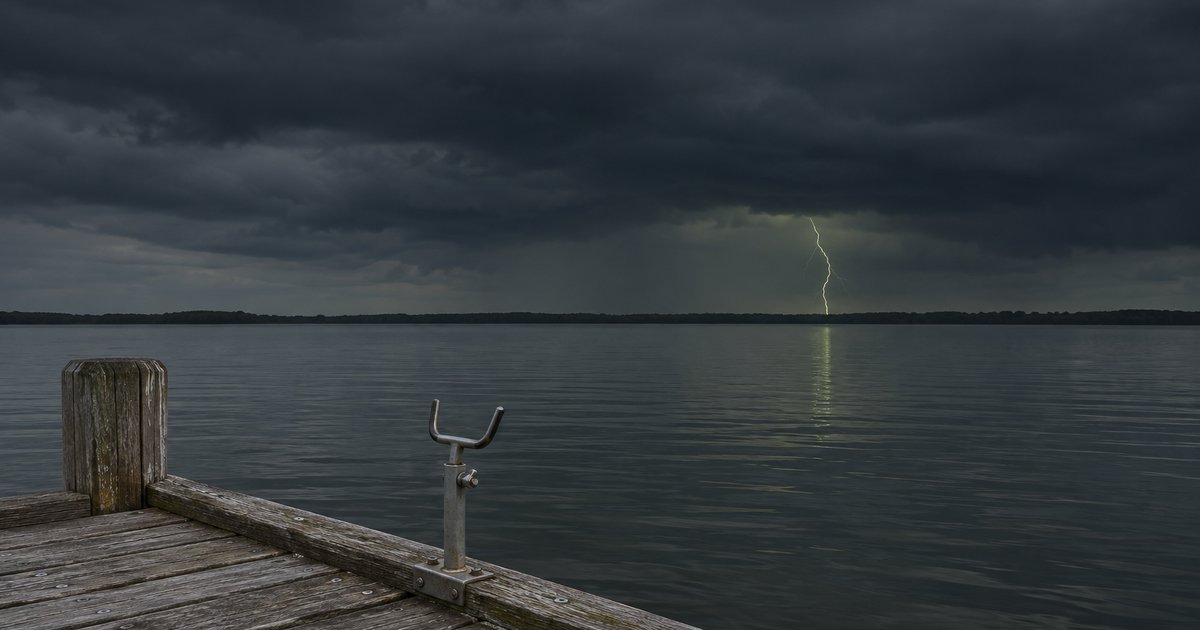
Stop fishing and leave the water when you hear thunder. The National Weather Service (NWS) says that if you can hear thunder, lightning is close enough to strike you, and its boating guidance says to stop all activities when there is lightning. National Lightning Safety Council (NLSC) data for 2006 through 2024 show why anglers are singled out: 42 of the 492 U.S. lightning deaths happened to people who were fishing, more than in any other activity. The data cannot give the risk of a single trip, but they show a pattern. Many of the fishing and boating victims were already heading for shelter and started too late.
What 19 years of lightning deaths say about fishing
The NLSC's analysis of U.S. lightning deaths from 2006 through 2024, published in January 2025, counted 492 deaths. Of these, 42 were people fishing, about 9 percent. That put fishing first in the report's list of the twelve deadliest activities, ahead of beach activities (32), boating (25) and camping (23). Fishermen accounted for three times as many deaths as golfers, who had 14. Fishing and boating together made up 14 percent of all lightning deaths, and about 90 percent of the deaths in the fishing, sports and work categories were men. Who gets struck by lightning sets these numbers beside the other activities.
Three limits matter before reading much into them:
- They are counts, not rates. The NLSC says it made no attempt to test the statistical significance of its findings because the samples were small, and the report does not say how many people fish or play golf. The 42 against 14 shows where deaths piled up over 19 years. It does not show that one fishing trip carries three times the risk of one round of golf.
- Fishing is the activity, not the spot. The NLSC sorted each death by the activity that put the victim at risk. Its own example is a person who had been fishing but was walking to a car when struck, who counts as fishing. Some of the 42 therefore died away from the water's edge.
- The detail comes from news reports. The report's statement that many victims were headed for shelter, or just steps from it, is based on media reports of the fatal incidents.
Why anglers are caught out
The NLSC points to three conditions that make fishing and boating especially deadly. Anglers and boaters are likely to be in the open and more exposed to a direct strike, the noise of a motor or waves can keep them from hearing thunder, and they may need extra time to reach a place that protects them. The NWS agrees on the first point: direct strikes happen most often to people in open areas. A shore angler does not have to be the one struck, either. The NWS says ground current, the energy that spreads outward along the ground surface after a strike, causes the most lightning deaths and injuries, a mechanism covered in five ways lightning strikes people.
Timing is the other half. The NLSC says many of the fishing and boating victims saw that a dangerous situation was developing and were heading toward shelter, but did not react soon enough. It adds a point about planning: many outdoor activities are called off in advance for steady rain, but few are called off for the threat of a deadly thunderstorm. The first strike may also give no warning of its own. The NWS says it can come out of a clear blue sky many miles ahead of an approaching thunderstorm cloud.
What the sources say for each place you might fish
The table collects what the NWS and Environment and Climate Change Canada, the Canadian government's weather agency, say about the places anglers stand, as of November 2026.
| Where you are | What the sources say | What they leave open |
|---|---|---|
| Bank or shoreline | In its last-resort tips for people caught outside with no shelter nearby, the NWS says to get out and away from ponds, lakes and other bodies of water. Its beach example sends a family to the car, not to an open-sided picnic shelter, and has them wait 30 minutes after the last thunder. | The pages we read do not treat river or stream banks separately; they speak of bodies of water in general. |
| Pier, dock or bridge | Environment and Climate Change Canada says people have been killed or injured in or on the water, boats, docks and piers, or while fishing. The NWS says rain shelters, small sheds and open vehicles do not protect against lightning. | Neither source discusses bridges. A bridge, pier or dock is not on the NWS list of protective places: a substantial building or a hard-topped vehicle. |
| Boat with no cabin | The NWS says the vast majority of lightning injuries and deaths on boats happen on small boats with no cabin, and that boaters should not go out if thunderstorms are forecast. A boater who cannot reach land is told to drop anchor and get as low as possible. Environment and Climate Change Canada says small or open boats are especially at risk. | No source says how long it takes to reach shore. That depends on your boat, your distance and the water. |
| Boat with a cabin | The NWS says large boats with cabins, especially those with properly installed lightning protection systems, and metal vessels give relatively good protection. Stay inside, away from metal surfaces, in the center of the cabin. | The NWS does not define "large". Without a completely enclosed cabin, its advice is to stay low. |
On any boat, the NWS also advises keeping arms and legs inside the boat, disconnecting electronic equipment including the radio, and lowering or tying down antennas that are not part of a lightning protection system. For anglers already on the water, Environment and Climate Change Canada says to get to land as quickly as possible at the first sign of a storm, because strong winds, waves and fast-moving storms can make the trip to shore hard, so the plan has to exist well before the storm arrives.
What angling pages say about rods and bites
Angling websites repeat two claims that the official sources do not address: that the rod is the danger, and that storms make fish bite.
On rods, three pages we read in November 2026 take the same line. A WindRider guide calls rod height and conductivity contributing risk factors, but says the root cause is being on open water in a thunderstorm at all. A Weeders Digest page says graphite rods act as conductive antennas in open environments. An On the Lake article describes a streamer rising from a carbon fiber rod that sticks up above a flat lake. None of them cites a measurement. The NWS and NLSC pages cited here do not mention fishing rods. The NWS does say that metal makes no difference to where lightning strikes, that height, pointy shape and isolation are the dominant factors, and that a person can be part of an upward streamer. Our reading is that an angler on a flat bank or in a boat is tall and isolated with or without a raised rod, so setting the rod down is not a substitute for leaving. Whether a rod adds risk is not answered by these sources. It also does not need to be: the NWS tells people not to waste time removing metal when lightning threatens, and a rod is not worth a delay.
On bites, the Weeders Digest page argues that storm winds push food toward shore and names the Journal of Freshwater Ecology as support without citing a specific paper. We did not test the biology and make no claim about it. Even that page tells readers to avoid open water during active cloud-to-ground lightning and to fish only before the front arrives or after the storm settles. The after-storm window is where the casualty data matter. Environment and Climate Change Canada says about one third of lightning-related casualties occur after the storm because people return to outdoor activities too soon, and the NWS says to wait 30 minutes after the last thunder. Why the 30-minute wait restarts with every strike explains the count.
A leave-early plan for anglers
- Before you go. The NWS says to check the forecast before boating or fishing and, if severe weather is predicted, to stay home or go earlier than normal. The NLSC goes further: where shelter is not readily available and thunderstorms are forecast, it names canceling or postponing as the only option.
- Before the first cast. Find the nearest substantial building or hard-topped vehicle and work out how long it takes to reach it from your farthest spot, on foot or by boat. That number is the time you need once a storm shows up. Where to shelter from lightning explains what counts.
- Pick the trigger. Thunder is the NWS trigger. Motor and wave noise can hide it, so add a second cue: watch the sky and use a source with radar or lightning data, which the NWS lists among the ways to monitor storms. Counting from flash to bang works only while you can hear.
- Leave at the trigger, not at the next bite. The NWS says to stop all activities when there is lightning or the weather looks threatening.
- Wait it out. Stay in shelter for at least 30 minutes after the last thunder.
Where a lightning map fits
Lightning Tracker is an iPhone app that shows recently detected strikes on a live map, with the distance and direction to the nearest one and how many minutes ago it was detected. It alerts you when a strike is detected inside a radius you set for each place; the default is 10 miles (16 km). For fishing, the number worth setting is the shelter time from step two: How to choose an alert radius shows how to match the two. Because the NLSC found that a motor or waves can keep anglers from hearing thunder, an alert is a second cue, not a replacement for the first.
The app has limits that matter on the water. Detection networks miss some strikes, especially weak ones, and data can arrive late; the app marks late or missing data instead of treating it as quiet. iOS decides when a closed app may check for new data, so it may not see the latest strikes until you open it. The app does not replace official warnings or local procedures.
Not a substitute for official weather warnings.
If you hear thunder, seek shelter even if the app shows no nearby strike.
Sources
- National Lightning Safety Council, J. Jensenius, A Detailed Analysis of Lightning Deaths in the United States from 2006 through 2024 (PDF, January 2025)
- National Weather Service, Lightning Tips
- National Weather Service, Lightning Safety Outdoors
- National Weather Service, Inland Boating Tips
- National Weather Service, Lightning Safety Overview
- National Weather Service, Lightning Myths
- National Weather Service, Five Ways Lightning Strikes People
- Environment and Climate Change Canada, Lightning safety on the water
- WindRider, How to Fish in a Thunderstorm: Safety Rules for Anglers (May 9, 2026), retailer blog, cited for what angling pages say
- Weeders Digest, Why Fish Bite Better Before and During Thunderstorms, angling site, cited for what angling pages say
- On the Lake, Lightning: A Serious Hazard While Fishing, angler's article, cited for what angling pages say