 Lightning Tracker
App Store
Places and activities
Lightning on the golf course: when to stop and where to go
November 18, 2026 · 8 min read
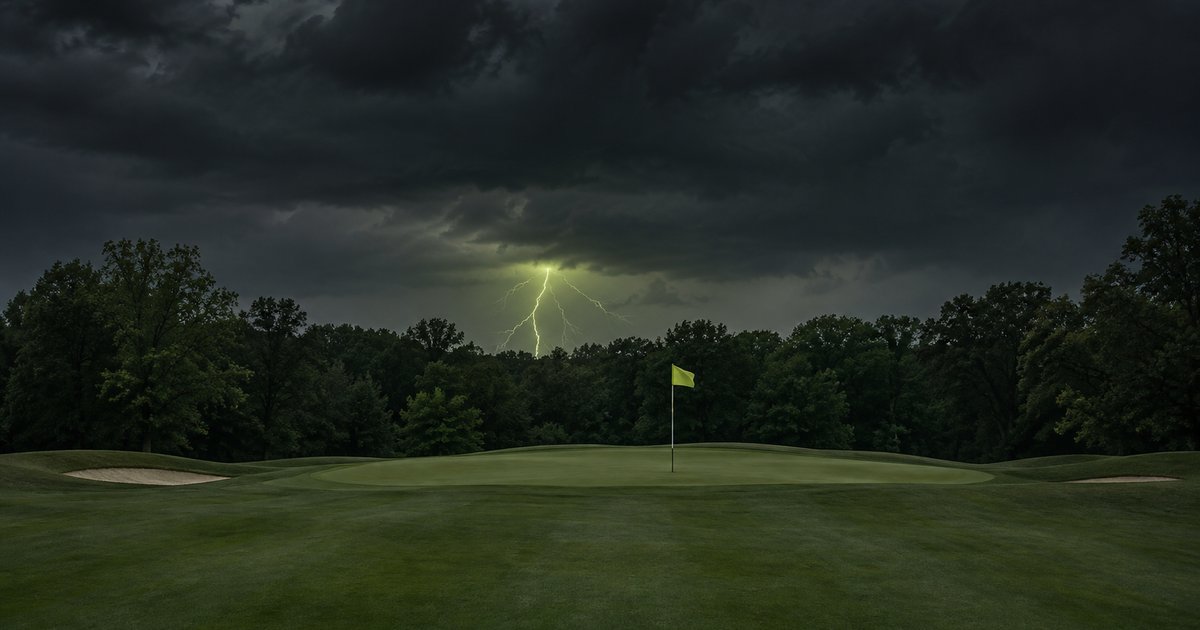
Stop playing when you hear thunder or see lightning, and go to the clubhouse or another substantial building, or to a hard-topped car with the windows closed. The National Weather Service says no place outside protects you, and it asks for at least 30 minutes after the last thunder before going back out. The Rules of Golf let any player stop for lightning but set no distance or waiting time, so the numbers on your course come from its own written policy or the tournament's.
What the Rules of Golf say about stopping for lightning
The R&A's online edition of the Rules of Golf lets a player stop play in a round if they reasonably believe there is danger from lightning (Rule 5.7a). The player must then report to the Committee as soon as possible. The Rules use "Committee" for the person or group in charge of a competition or the course. Leaving the course is not, by itself, stopping play, and a player who stops for a reason the Rule does not allow, or who does not report when required, is disqualified.
When the Committee acts first, Rule 5.7b separates two kinds of suspension. After an immediate suspension, such as one for imminent danger, no player may make another stroke until the Committee resumes play. After a normal suspension, a group that has already started a hole may choose to play it out. The Rules' Committee Procedures recommend one prolonged siren note for an immediate suspension, three consecutive notes for a normal one and two short notes to resume play. They describe these signals as generally used and ask Committees to adopt them where possible, so a given course may use others. The pro shop can tell you what its horn means.
Neither rule gives a distance or a waiting time. Rule 5.7c says only that a player resumes at the time the Committee sets, and not before it. The numbers come from the course's written policy or the tournament's.
The R&A said in January 2026 that the next edition of the Rules of Golf will be published on January 1, 2028. For a 2027 tournament, check the Committee's published suspension and evacuation procedure.
Where the stop-and-wait numbers come from
The National Weather Service (NWS) says a significant lightning threat reaches about 6 to 10 miles (10 to 16 km) outward from the base of a thundercloud, and that thunder can usually be heard about 10 miles away when there is no background noise. Traffic, wind and rain can shorten that range. For outdoor sports the NWS lists three signals to stop: lightning seen, thunder heard and threatening skies. It asks people to wait at least 30 minutes after the last thunder before resuming. Flash to bang shows how to estimate distance from the count, and Why wait 30 minutes after the last strike? explains why each new rumble restarts the clock.
A 2021 article on PGA.com, the PGA of America's site, says many golf courses now have a lightning detection system that sounds a horn when lightning comes within a set distance of the course. It does not say what that distance is, and no national standard for it appears in the sources listed below, so the distance on your course is unknown until you ask. The same article suggests keeping a personal radius for when strikes get too close and calls ten miles ideal. That is one author's advice, at the upper end of the NWS range, not a rule.
Cover on a golf course: what the sources say
The NWS and the National Athletic Trainers' Association (NATA), in a 2013 position statement on lightning safety for athletics and recreation, sort the structures a golfer meets into those that protect and those that do not.
| Where | What the sources say |
|---|---|
| Clubhouse or another building with wiring and plumbing | The NWS says substantial buildings with wiring and plumbing give the greatest protection. |
| Hard-topped car, windows closed | The NWS says that without a substantial building, a hard-topped metal vehicle with the windows closed gives good protection. |
| Golf cart | NATA lists golf carts among open vehicles that provide no lightning protection. The PGA.com article says not to sit in a cart and to get away from the cart and the clubs. |
| Rain shelter, gazebo or refreshment stand on the course | The NWS says rain shelters and small sheds are not protected. NATA adds that a structure called a shelter typically is not, and lists gazebos and refreshment stands as unprotected. |
| Under a tree | The NWS says never to shelter under an isolated tree. It adds that most side-flash victims had taken shelter under a tree. |
| Beside a pond or lake | The NWS says to get out and away from ponds, lakes and other bodies of water immediately. |
The upshot is that the only two places the sources endorse are a building and a hard-topped car. Where to shelter from lightning covers the reasons in more detail.
What the death records say about golf
The National Lightning Safety Council's (NLSC) March 2026 analysis counted 517 lightning deaths in the United States from 2006 through 2025. Golf accounted for 16 of them, about 3 percent, and fishing for three times as many. Among sports, golf and soccer had the most deaths, 16 and 14, and golf made up 36 percent of the sports-related deaths. The NLSC author describes the old belief that golfers suffer the most lightning deaths as a myth. Sports as a whole made up about 9 percent of all deaths, and 89 percent of the sports victims were male.
The same report says that in most sports cases a building or vehicle was nearby and many victims failed to react quickly. That points to timing rather than a lack of cover. NATA, citing NWS figures for 2006 to 2011, lists the most common places of death as under or near trees (25 percent), open or sports fields (25 percent), close to water (23 percent) and in the yard (10 percent). A course has trees, open ground and ponds, but none of the sources listed below breaks the golf deaths down by location, and none counts golf injuries, so those numbers are unknown. More on who gets struck is in Who gets struck by lightning?
Plan the walk before the round
For staff setting a course policy, NATA's 2013 position statement calls for a written lightning plan before the season starts: name who can suspend play and order evacuation, assign a weather watcher, list the specific buildings and vehicles to use, and set criteria for stopping, moving people and giving the all-clear. Players should know the course's signals and route to those places before teeing off; under Rule 5.7a, a player who reasonably believes there is danger from lightning may stop play, but must report to the Committee as soon as possible.
NATA says a lightning policy should tell people where to go and how long it takes to reach the designated place from each field or event site. A golf course poses that problem across 18 holes, because the walk to a building is different on every hole. The PGA.com article advises scouting the shelter locations on the course before the round. One way to do it is to note the nearest building or parking lot for each stretch of holes, and to time the walk from the farthest one. That time is what an alert radius has to cover; How to choose an alert radius shows the method.
The same PGA.com article warns that hitting a few more shots or playing one more hole could prove deadly.
If you are caught far from a building
The NWS says no place outside protects you when a thunderstorm is in the area, and its last-resort tips only lower the risk while you keep moving toward a building or a car:
- Get off elevated ground such as hills and ridges.
- Never lie flat on the ground.
- Never shelter under an isolated tree.
- Get away from ponds, lakes and other water.
- Stay away from objects that conduct electricity, such as wire fences. The PGA.com article, quoting NWS guidance, adds tall objects, metal objects such as golf clubs, and standing pools of water.
Restarting play
The NWS says to wait at least 30 minutes after the last thunder before restarting outdoor activity. In a competition, Rule 5.7c requires each player to be at the right spot and ready at the time the Committee sets for play to resume, and not to play before that time. Whoever you play with, count the half hour from the last thunder you hear, not from the last time you saw rain.
Using Lightning Tracker on a round
Lightning Tracker, an iPhone app, shows recent detected strikes on a live map, with the distance and direction to the nearest one and how many minutes ago it struck. Save the course as a place, and the app alerts you when a strike is detected inside the radius you set for that place; the default is 10 miles (16 km). Its return wait starts after the last strike detected inside that radius and starts over with each new one. When it ends, the app reports what it observed and asks you to judge conditions yourself; it does not announce that the storm is over.
Detection networks miss some strikes, especially weak ones, and data can arrive late; the app marks delayed or missing data instead of counting it as quiet. In the background iOS decides when the app may check for data, so an app that is closed may show the latest strikes only when you open it. NATA says notification services can be useful but should only supplement the written procedures. The same goes here: the app does not replace official warnings or your course's procedures, and thunder or a horn means go in. Five iPhone settings that decide when a storm alert arrives covers what to check on the phone.
The guidance above comes from the published sources listed below. It does not say what any course or tournament requires, and it does not address legal liability, which none of those sources covers.
Not a substitute for official weather warnings.
If you hear thunder, seek shelter even if the app shows no nearby strike.
Sources
- The R&A, Rules of Golf, Rule 5: Playing the Round (Rule 5.7, Stopping Play; Resuming Play)
- The R&A, Committee Procedures, Section 8 (definition of the Committee; Model Local Rule J-1 and suspension signals)
- The R&A, New and Updated Model Local Rules for 2026
- National Weather Service, Lightning Safety and Outdoor Sports Activities
- National Weather Service, Lightning Tips
- National Weather Service, Lightning Science: Five Ways Lightning Strikes People
- PGA of America, Brendon Elliott, PGA.com story on lightning on the golf course (October 15, 2021)
- National Lightning Safety Council, A Detailed Analysis of Lightning Deaths in the United States from 2006 through 2025 (PDF, March 2026)
- National Lightning Safety Council, J. Jensenius, A Detailed Analysis of Lightning Deaths in the United States from 2006 through 2024 (PDF, January 2025)
- National Athletic Trainers' Association, Lightning Safety for Athletics and Recreation (position statement, Journal of Athletic Training 2013;48(2):258-270)