 Lightning Tracker
App Store
Maps and data
Lightning warning systems at fields and pools: how the horns work
November 17, 2026 · 11 min read
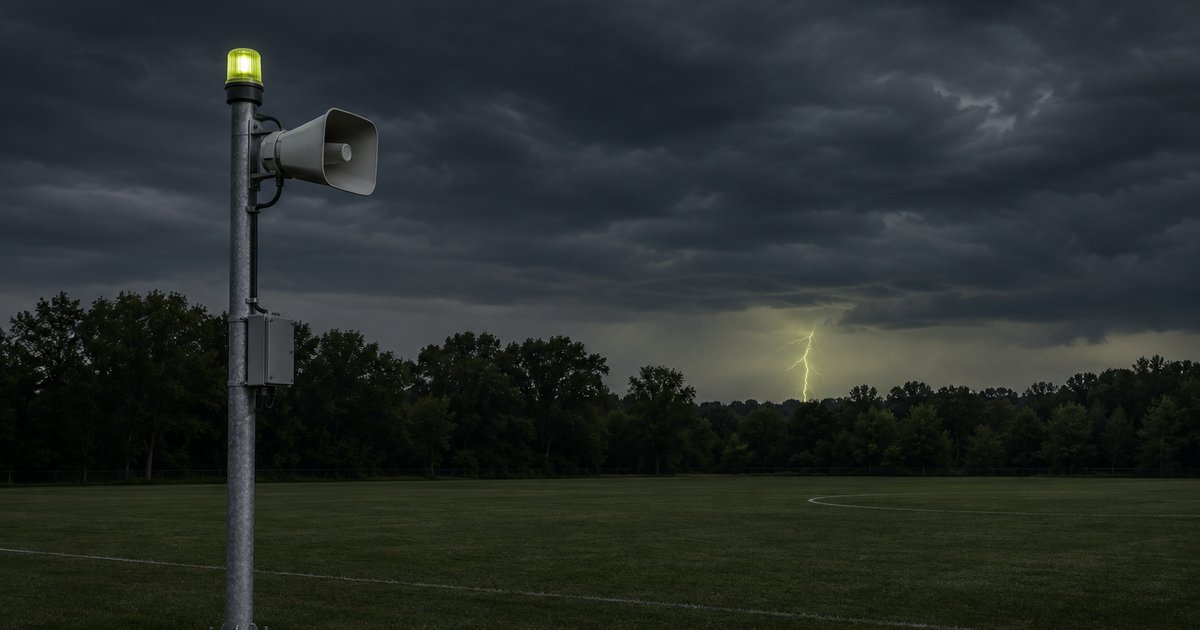
A fixed lightning warning system is a lightning sensor or data feed wired to a horn and a strobe light. The horn usually means the system detected lightning inside the radius its operator chose; some on-site sensor systems instead sound when they judge a strike is likely. Leave the field when it sounds and return after the all-clear, which on the park pages read for this article comes after a countdown, often 30 minutes without further detection (three of the six operator pages in the table below state that figure). As of November 2026 the signals, radius and technology differ from town to town, Wilton and Bartlett warn that the systems can fail, and thunder you hear still means you stop, as the NFHS text and Naperville's page direct.
What the horn and strobe tell you
Park operators that publish the rules for their warning systems use a short list of signals, but the details differ enough that one sound can mean different things in two towns. The table sets out six systems as their operators describe them on town and park-district pages read in November 2026. It is not a ranking, and every figure in it is the operator's own.
| Operator | System as described | What triggers it | Warning | All-clear |
|---|---|---|---|---|
| Wilton, Connecticut (July 2022 press release) | Earth Networks lightning detection | Lightning detected within 10 miles | Strobe on, 15-second horn, 30-minute countdown clock | Strobe off and three 5-second horn blasts |
| Alabaster, Alabama | Alert devices at youth sports venues; data source not named | Lightning detected within 8 miles of a device | Flashing light, 15-second siren, spoken message | After a 30-minute countdown |
| Trumbull, Connecticut | Detection systems at recreation areas; data source not named | Lightning detected within 5 miles | Siren sounded three times, strobes flashing | Two air horns once 30 minutes pass with no lightning |
| Naperville Park District, Illinois | Strike Guard sensors at the park sites | Strikes measured in an 8 to 10 mile radius | 15-second horn and strobe | Three short horn blasts, strobe stops |
| Bartlett Park District, Illinois | “Lightning prediction” sensors measuring electrostatic charge | Conditions indicate lightning is probable; no distance given | One 15-second horn blast, strobes on | Three short horn blasts two seconds apart, strobes off |
| Campbell County, Wyoming | Thor Guard electric-field sensors | Strike predicted within 2.5 miles in the next 10 to 15 minutes | 15-second horn, strobe until the all-clear | Three 5-second blasts after a 10-minute countdown |
Two points stand out. First, the sources used for this page did not turn up a national standard for horn patterns, so a signal learned at one complex proves little at another; the rule that applies is the one posted at the site or on the operator's website. Second, the all-clear is not always 30 minutes: Campbell County's page counts down from 10 minutes. Three of the six pages (Wilton, Alabaster and Trumbull) state a 30-minute countdown, the same wait the National Weather Service gives for returning outdoors, as why the wait is 30 minutes explains.
When a horn sounds, staff should stop play or swimming, direct everyone to the shelter locations in the facility’s written plan, and have the assigned weather watcher keep monitoring. The National Weather Service’s outdoor-venue toolkit puts event suspension, staff direction of patrons, and evacuation into its sample response to a warning signal. The NFHS October 2024 guidance says the designated staff member decides when activity resumes; its 30-minute count restarts after later thunder or lightning. At a pool, the swim meet delay decision also needs a named official.
Sensor-based and network-fed systems
A network-fed warning system receives its lightning data over an internet or cellular link from a detection network, while a sensor-based system measures the sky at the field itself. A network locates a strike by comparing when the same radio pulse reaches several sensors, a method described in how lightning is detected. Perry Weather, a company that sells warning systems to sports facilities, describes the network-based type in an August 5, 2026 page as a grid of ground sensors that detect the same discharge from several points and work out its position, and says its own field hardware is solar powered and cellular connected. That page is vendor marketing, and its figures are the vendor's.
On-site systems differ in what they measure. Naperville Park District says its Strike Guard sensors measure lightning strikes in an 8 to 10 mile radius and that the system warns after lightning has been detected. Bartlett Park District and Campbell County describe a second kind, which they call prediction systems: sensors that read the electric charge in the air and sound the horn before a strike, not after one. Some pages read for this page, including those of Wilton, Alabaster and Trumbull, name a supplier or none and do not say which kind of system they run. That is a fair question for the facility manager.
Network-fed systems inherit the strengths and gaps of the network. In its 2013 position statement the National Athletic Trainers' Association (NATA) gave, for the U.S. National Lightning Detection Network, a median location error of 250 meters and a flash-detection efficiency above 90% for cloud-to-ground lightning. It also said that the performance of the WeatherBug Total Lightning Network for lightning aloft had not been well verified at the time. Those 2013 figures describe one network then, not the performance of any park horn today.
Whether a field sensor can warn before the first strike
An electric-field sensor, also called a field mill, measures the electric field at ground level, and the idea behind a prediction horn is that the field changes before a storm produces its first flash. NASA's Kennedy Space Center fact sheet (revised 2006) describes 31 field mills spread across the center and Cape Canaveral as an early warning system for electrical charges building aloft or approaching in a storm. Campbell County's page claims that its sensors monitor charge within 15 miles and warn when a strike is predicted within 2.5 miles in the next 10 to 15 minutes.
A 2022 study at the Kennedy range, published in the Journal of Geophysical Research: Atmospheres. It reports that a large-area field mill network detected the onset of cloud electrification 3.7 to 14.6 minutes before the first lightning discharge, depending on how near the storm was, and that measurements at a single field mill site would not have provided adequate warning. The study concerns a launch-range network with its own thresholds, not a park unit, so it neither confirms nor refutes the lead times operators quote. The Perry Weather page takes the opposing view, saying electric-field systems routinely produce false alarms when static electricity is in the air; that, too, is a claim from a company that sells the other kind of system. Neither side's figures came from an independent field test of park-scale units in the sources used here.
Trigger radius and the all-clear countdown
The trigger radius of a warning system is a policy choice, and the published documents do not agree on one number. The six operators above use radii of 2.5, 5, 8 and 10 miles, and Bartlett's charge-based prediction has no distance. A National Weather Service lightning toolkit for large outdoor venues, which is undated, gives a sample plan that raises its first alert at 15 miles, warns of an impending delay at 12 and suspends the event at 8, and says radii vary with venue size, capacity and the time patrons need to reach shelter. NATA's 2013 table of common notification alerts lists 15, 10 and 6 miles.
The all-clear follows a similar pattern. The same toolkit lets an event resume with a professional meteorologist's real-time lightning data only once lightning has moved beyond 8 miles, the storm motion carries activity away and the threat of new strikes within 8 miles has ended. Without that service, the venue waits 30 minutes after no observed thunder or lightning by day, or after no thunder at night. The countdown clock on a pole automates the second option, and Wilton says its clock resets automatically if more lightning is detected.
What the clock counts matters. The NFHS rule counts 30 minutes from the last thunder heard or lightning witnessed, and Bartlett's page tells users that if lightning is seen or thunder heard when the system has not sounded, activity stops and a 30-minute lightning-free and thunder-free period must pass before play resumes. None of the operator pages read for this page makes thunder an input to the horn. A person who hears thunder during a countdown should therefore restart their own count, whatever the clock shows.
What the NFHS 2024 wording says about networks
The National Federation of State High School Associations (NFHS) guidance dated October 2024 is a default policy for suspending and restarting practices and contests. It says that, if available, data from a nationally connected lightning detection network should be monitored closely when storms are possible or during lightning delays. It also says play shall be suspended when lightning is within a 10-mile radius of the event and not resumed until at least 30 minutes after the last lightning within that radius. The same paragraph warns never to depend on the reliability of any detection device if the sky looks threatening, thunder is heard or lightning is seen, and says what people see and hear takes precedence over a mobile app or lightning-detection device.
The text has limits worth knowing. It names no network or product, does not call for a horn or siren, and does not say whether a given system counts as nationally connected. It names a state association and the nearest National Weather Service office as the preferred sources for a facility's own policy. School staff can check the decision roles in lightning at school. One consequence is an interpretation, not a quotation: a horn set to 5 miles sounds later than a 10-mile policy asks for, while a 10-mile horn matches it, so the trigger distance in a local system is worth comparing with the policy it is meant to serve.
Where fixed systems fall short
Operators and professional bodies list the limits of fixed systems plainly, and they cluster around five points.
- The first strike of a new storm. NATA's 2013 statement says notification services work best for active storms already formed and moving into an area, and are not effective for the first strike of a new, nearby storm.
- Lightning inside clouds. The same statement says a source that detects only cloud-to-ground lightning misses the roughly 70% of lightning that stays in the cloud, and that a system used by people who do not know how to read it may be worse than none.
- Failure. Wilton's notice says no system is infallible and tells people not to wait for the signal because it can malfunction. Bartlett's page calls its system an aid for assessing conditions, not a guarantee of them.
- Hours. Bartlett's system runs from late March to mid-November, 6 a.m. to 11 p.m.; Naperville silences its sirens from 11 p.m. to 7 a.m., though strobes continue; Alabaster's devices are active only during park hours.
- Hearing the horn. River Forest's page says the signal horn may be at a site within earshot, not at the field you are standing on.
Questions to ask before relying on a horn
A coach, lifeguard or course manager can settle most of these from the facility's posted rules, and the answers say how far the horn can be trusted at that site. Course operators can compare the horn with stop procedures in lightning on the golf course.
- What triggers the horn, from how far, and does the system use on-site sensors or a detection network? Ask how the supplier distinguishes a forecast from a detected strike.
- Does it run at all hours and all season, or only during set hours?
- How will staff learn that the system is working before an event, and what independent weather and warning channels remain available? The National Weather Service outdoor-venue toolkit calls for testing the detection display and communication methods before an event, and for continuous access to NWS warnings during public events.
- Who decides to resume after the all-clear? The NFHS text asks schools to assign a specific staff member to monitor the weather and to suspend and resume activities.
- Where does everyone go, and how long does the walk take? The NFHS text asks schools to work out the time needed to reach the designated place, and where to shelter from lightning covers what counts as shelter.
- How will the warning reach everyone, including people who cannot hear the horn? The National Weather Service toolkit calls for several ways to notify patrons, such as a siren, public address system, messages and staff announcements; record the chosen channels in a written lightning action plan.
- What happens when thunder is heard and the horn is silent? Bartlett and Naperville both say to stop and not wait for the horn.
Using a phone app alongside a horn
Lightning Tracker, an iPhone app, is a personal layer for one person's phone, not a field system with a horn. It shows detected strikes on a live map, with the distance and direction to the nearest one and how many minutes ago it was detected. It alerts you when a strike is detected inside a radius you set for each place, 10 miles (16 km) by default, and starts a 30-minute wait after the last detected strike inside that radius that begins again with each new one. When the wait ends, the app reports what it observed and asks you to judge conditions yourself; it does not announce that the storm is over. How to choose an alert radius explains how to pick the distance.
The app shares the gaps described above. Detection networks miss some strikes, especially weak ones; data can arrive late, which the app marks as a delay or gap and does not treat as quiet; and iOS decides when a closed app may check for data, so a closed app may show strike data only when it is opened. It does not replace official warnings or local procedures, which at a school or pool means the facility's own plan. The NFHS text does not say which apps or networks qualify, and this page does not claim that Lightning Tracker is one. Pool operators can compare horn and reopening rules in lightning at pools and water parks.
Not a substitute for official weather warnings.
If you hear thunder, seek shelter even if the app shows no nearby strike.
Sources
- National Federation of State High School Associations, Sports Medicine Advisory Committee, Guidelines on Handling Practices and Contests During Lightning or Thunder Disturbances, October 2024 (PDF)
- National Weather Service, Lightning Safety Toolkit: Outdoor Venues (PDF, undated)
- National Weather Service, Lightning Safety and Outdoor Sports Activities
- National Athletic Trainers' Association, Walsh et al., Position Statement: Lightning Safety for Athletics and Recreation, Journal of Athletic Training, March-April 2013
- Handel, Cummins and Krider, Surface Potential Gradients and NEXRAD Radar Reflectivities Before the Onset of Lightning at the KSC-ER, Journal of Geophysical Research: Atmospheres 127(18), September 27, 2022 (University of Arizona research record)
- NASA Kennedy Space Center, Lightning and the Space Program, NASA Facts FS-2005-10-031-KSC, revised 2006 (PDF)
- Town of Wilton, Connecticut, Lightning Detection System to be Rolled Out for Wilton Parks and Fields, press release, July 20, 2022 (PDF)
- City of Alabaster, Alabama, Weather System, notice on youth sports venues (PDF, undated)
- Town of Trumbull, Connecticut, Lightning Detection System, read November 7, 2026
- Naperville Park District, Illinois, Strike Guard: Lightning Detection System, read November 7, 2026
- Bartlett Park District, Illinois, Lightning Prediction Systems, read November 7, 2026
- Campbell County, Wyoming, Lightning Prediction System, read November 7, 2026
- River Forest Park District, Illinois, Lightning Detection System, read November 7, 2026
- Perry Weather, Lightning Detection System for Sports Fields: What to Look For, vendor blog post, August 5, 2026