 Lightning Tracker
App Store
Lightning safety
Lightning at school: recess, dismissal and after-school practice
November 10, 2026 · 11 min read
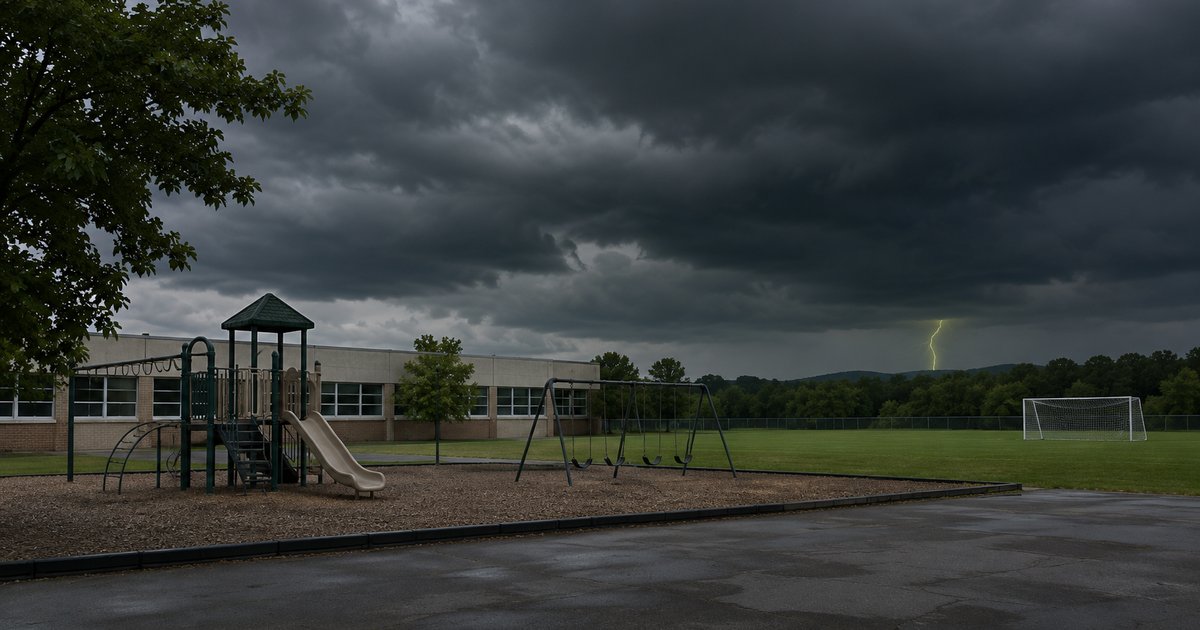
Schools are asked to do four things before a storm: have a documented lightning plan, name a person who watches the weather and can stop outdoor activity, move everyone into a substantial building when thunder is heard or lightning is seen, and wait 30 minutes after the last thunder before going back out. That is the shared message of National Weather Service, NFHS and NATA guidance, which is written mostly for school sports. For recess, dismissal and buses the sources say little, so each school fills in the details, and this page is not legal advice or a statement of what any district or state requires.
Most school lightning guidance is written for sports
Two documents relevant to schools are the guidelines of the National Federation of State High School Associations (NFHS), whose newest revision is dated October 2024, and the National Athletic Trainers' Association (NATA) position statement published in the Journal of Athletic Training in 2013. Both are written for athletics. NFHS calls its text a default policy for suspending and restarting practices and contests, and NATA states its aim as recommendations for people involved in athletics or recreation. The National Weather Service (NWS) page on outdoor sports is aimed at organized outdoor activities. None of the three uses the words recess or dismissal.
NFHS also says where a school should look for its own policy: the preferred sources are the state association and the nearest NWS office. The sections below borrow from these documents and from pages that schools publish themselves, and they mark the points where a school has to decide for itself.
A school lightning plan answers five questions
The National Weather Service recommends that organizers of outdoor activities have a lightning safety plan and follow it without exception. Its list of what the plan should settle runs: when to stop, where people go, when to resume, who monitors the weather and decides, and what to do if someone is struck. The last of those is covered in If someone is struck by lightning; the other four are what the rest of this page works through. The Kansas State High School Activities Association (KSHSAA), in guidelines approved in September 2026, puts the first step in one line: a documented plan for situations such as lightning should be in place. Teachers explaining the stop rule to students can use teaching kids about lightning for words children can remember.
The person who watches the weather should not be the coach
The NWS says the lightning monitor should not be the coach, umpire or referee, because those people are busy and cannot watch conditions adequately, and that the monitor must know the plan and be empowered to see it followed. KSHSAA's September 2026 school considerations say the people who monitor the weather and decide when to suspend should ideally not be a coach or an official in the game or practice. NFHS's October 2024 revision goes further: it asks schools to assign a specific staff member who is charged with suspending outdoor activities and deciding when to resume, and it says that anyone following the guidelines shall not be challenged. NATA's 2013 statement asks for a chain of command that names a person or role with unchallengeable authority to suspend activity, and adds that anyone, whatever their role, should feel free to raise the question of evacuating.
Who holds that authority is a local choice, and the association documents show it. The Missouri State High School Activities Association (MSHSAA), in guidelines revised in July 2025, gives the host school's principal or designee and the head official shared authority to delay a game when weather is hazardous to life or limb. None of these sources says who holds the role at recess or dismissal, when no officials are present. Applying their reasoning, it would be a named staff member who can stop an activity and is not also supervising it. That is an interpretation, not a rule taken from any one of them.
Recess and PE depend on how long the walk indoors takes
A paper presented at the American Meteorological Society's annual meeting in January 2005, by authors from the National Weather Service, the Air Force's 45th Weather Squadron and a middle school, says most lightning casualties in schools are associated with outdoor activities such as sports on athletic fields, recess on playgrounds, marching band and other extracurricular activities. It gives no recess-specific rule, but its general advice applies: avoid open areas including playgrounds, avoid elevated spots such as some playground equipment, and stay away from unprotected open structures such as rain shelters and bus stops. The paper also describes the old 30-30 rule: go inside if the count from flash to thunder is 30 seconds or less, and stay in until 30 minutes after the last thunder. Flash to bang explains why hearing thunder is the better trigger.
The sources return to one practical point: time the walk. NATA says the plan should tell people how long it takes to reach the designated place from each field, and NFHS asks schools to work out the time needed to get everyone there. The 2005 paper shows why minutes matter: if reaching shelter takes 5 minutes, a storm moving 30 mph covers 2.5 miles in that time. As an illustration of the same arithmetic, a class that needs 10 minutes to line up and reach the door would meet a storm 5 miles closer at that speed. Storm speeds vary, so that figure is an example, not a forecast.
Dismissal is where shelter rules meet buses and car lines
The 2005 school paper counts the trips around school among the risky school-related activities: waiting outside for school buses, walking or biking home, and walking home after leaving the bus. It adds that after-school outdoor activities coincide with the afternoon peak of thunderstorm activity.
On buses, the sources answer two different questions. As a place to shelter, a fully enclosed metal school bus counts: NFHS lists a fully enclosed metal car or school bus as an alternate place, NATA names school buses among enclosed metal vehicles, and KSHSAA says enclosed automobiles with metal roofs, including school buses, give adequate shelter. As a place to wait, a bus shelter does not: NATA lists bus shelters among structures that do not protect against lightning, and the 2005 paper says to avoid bus stops. A bus is therefore a fallback, and loading one means standing outside first. Where to shelter from lightning covers what counts as a building.
Three schools publish how they handle dismissal during lightning. Each is a single undated page, and none is a template or a standard. They show the decisions a plan has to make.
- Gulf Middle School (Cape Coral, Florida) starts its inclement-weather dismissal when lightning is less than 10 miles away. No student may be outside without cover until the lightning is 10 miles or farther, with no exceptions, and walkers and bike riders are held inside until an all-clear.
- Oakridge Middle School (Naples, Florida) says that when its lightning warning system is activated, the car line, walking or biking home, and bus departures all stop. Bus riders wait in the cafeteria, walkers and bike riders gather together, and car riders meet in the gym.
- Bette Perot Elementary (Keller ISD, Texas) activates its severe-weather dismissal when lightning is within 10 miles. It texts parents, keeps staff indoors, does not dismiss students to buses or out of the building, and tells parents who have arrived that they may wait in their cars.
The triggers differ, two by distance and one by a warning system, but all three hold students instead of rushing them out. Whether a particular school's procedure meets any rule is outside what these pages say, and this article does not judge it.
The documents that cover practice disagree on the distance that triggers a stop
For after-school practice, the guidance sets different triggers, as the table shows. Dates are those of each document, and the Pearland ISD page covers interscholastic athletics only.
| Document | Stop when | Resume when |
|---|---|---|
| NWS, outdoor sports page (undated) | Lightning is seen, thunder is heard or the sky looks threatening; the threat reaches about 6 to 10 miles from the storm base | At least 30 minutes after the last thunder |
| NATA position statement (2013) | Everyone is fully inside by the time the storm edge is 5 nautical miles (about 6 statute miles) away | 30 minutes after the last lightning seen or thunder heard; restarts for each flash within 5 nautical miles and each thunder |
| NFHS guidelines (October 2024) | Thunder is heard or lightning is seen; and play shall be suspended when detection data show lightning within a 10-mile radius | 30 minutes after the last thunder or lightning, and 30 minutes since the last lightning within 10 miles; any new one resets the clock |
| KSHSAA guidelines (September 2026) | Thunder is heard or lightning is seen; validated detection data showing a strike within 10 miles could also be used | 30 minutes after the last thunder or lightning; any new one resets the clock |
| Pearland ISD athletics policy (2022) | A strike within 8 miles on its monitoring system, or a flash-to-bang count of 40 seconds or less | No strike within 8 miles for 30 consecutive minutes |
| School paper, American Meteorological Society (2005) | Thunderstorms within six miles; 30 seconds or less from flash to thunder | 30 minutes after the last thunder |
Three points follow from the table. First, the numbers are not interchangeable. Pearland's policy converts a count to miles by dividing the seconds by five, so its 40 seconds is 8 miles, while the 30 seconds in the 2005 paper is 6 miles. Second, documents of different ages sit side by side. NFHS's October 2024 revision says play shall be suspended when lightning is within a 10-mile radius, where its January 2021 text said detection technology could be used to help decide, and the KSHSAA (September 2026) and MSHSAA (July 2025) documents still carry the earlier could-be-used wording. A policy copied from one of them may therefore differ from the newest NFHS text, so check the date on any policy you are handed. Third, NFHS and KSHSAA both say that sight and sound take precedence over information from a phone app or detection device. None of the sources reconciles its figures with the others, which is why NFHS points schools to their state association and local NWS office. Why the 30-minute wait restarts explains the right-hand column.
Parents and teachers can ask six questions
Anyone who wants to check a school's plan can ask the six questions below. Each comes from the guidance above, and the list is a recommendation, not a legal test.
- Is the plan written down, and who may stop an activity? KSHSAA calls for a documented plan, and NATA for a chain of command with a named authority.
- Who watches the weather, and is that person free of other duties? The NWS says it should not be the coach or referee.
- What triggers a stop? Thunder, lightning seen or detection data, and at what distance. The table shows how much documents differ.
- Where does each group go, and how many minutes is the walk? NATA and NFHS both ask for this to be worked out in advance.
- What happens at dismissal? Buses, car line, walkers and bike riders each need an answer.
- When is the plan reviewed and practiced, and are families told? NFHS wants a school's plan to be current, practiced and executed, asks for an annual review, and asks that athletes and parents be told at the start of the season. NATA asks for annual rehearsal.
The NWS runs a toolkit program, founded in 2011 for outdoor venues, in which an organization drafts a lightning safety plan and emails it to its local NWS office for review. After approval, the organization can be recognized for having a written plan. The toolkit forms on the NWS page are for outdoor venues, golf facilities, wilderness areas, communities, lifeguards and beach patrols, and boating; none is labeled for schools. For local lightning information the NWS says to contact the nearest NWS office. Employers write down a similar plan for outdoor workers, and A lightning plan for outdoor work covers what OSHA and NOAA ask them to include. Nothing on this page says what the law or a district's rules require, and following it does not make a school compliant with anything.
A lightning app can support the person watching, not replace them
Lightning Tracker is an iPhone app that shows recently detected lightning strikes on a live map, with the distance and direction to the nearest one and how many minutes ago it happened. It alerts when a strike is detected inside a radius you set for each place, 10 miles (16 km) by default. Its return wait starts after the last detected strike inside that radius and starts over with each new one. When the wait ends, the app reports what it observed and asks you to judge conditions yourself; it does not announce that a storm is over.
Detection has limits a school should weigh. Detection networks miss some strikes, especially weak ones, and data can arrive late, so the app marks a delay or a gap instead of counting it as quiet. In the background, iOS decides when the app may check for data, which means a closed app may show the latest strikes only once it is opened. NFHS has changed its own wording twice. Its March 2018 guidelines said detection devices or phone apps could assist a decision to suspend play, its January 2021 revision limited that to independently validated ones, and its October 2024 revision asks for data from a nationally connected lightning detection network to be monitored closely. All three put sight and sound ahead of an app or device. NATA, in 2013, said notification systems should supplement a designated weather watcher and NWS monitoring and never replace them. The NFHS text does not say which apps or networks qualify, this page does not claim that Lightning Tracker is one, and the app does not replace official warnings or local procedures, which at a school means the school's plan. How lightning is detected explains the gaps, and How to choose an alert radius shows how to match a radius to the time a group needs to reach a building.
Not a substitute for official weather warnings.
If you hear thunder, seek shelter even if the app shows no nearby strike.
Sources
- National Weather Service, Lightning Safety and Outdoor Sports Activities
- National Weather Service, Lightning Safety Toolkits
- NFHS Sports Medicine Advisory Committee, Guidelines on Handling Practices and Contests During Lightning or Thunder Disturbances (October 2024)
- NFHS Sports Medicine Advisory Committee, Guidelines on Handling Practices and Contests During Lightning or Thunder Disturbances (January 2021)
- NFHS Sports Medicine Advisory Committee, Guidelines on Handling Practices and Contests During Lightning or Thunder Disturbances (March 2018)
- National Athletic Trainers' Association, Lightning Safety for Athletics and Recreation (Journal of Athletic Training, 2013)
- Kansas State High School Activities Association, Guidelines for Lightning Safety (September 2026)
- Missouri State High School Activities Association, Hazardous Weather Conditions and Guidelines for Lightning/Thunder Disturbances (July 2025)
- Pearland ISD, Lightning Safety Policy (2022)
- American Meteorological Society, Lushine, Roeder and Vavrek, Lightning Safety for Schools: An Update (85th Annual Meeting, 2005)
- American Meteorological Society, Lightning safety for schools: An update, program entry for the 85th Annual Meeting (January 2005)
- Gulf Middle School, Lee County, Dismissal Procedures (Lightning Dismissal)
- Oakridge Middle School, Collier County, Students and Families: Inclement Weather Dismissals
- Bette Perot Elementary, Keller ISD, Severe Weather Arrival and Dismissal