 Lightning Tracker
App Store
Storm basics
How long thunderstorms last, and why the end drags on
November 19, 2026 · 6 min read
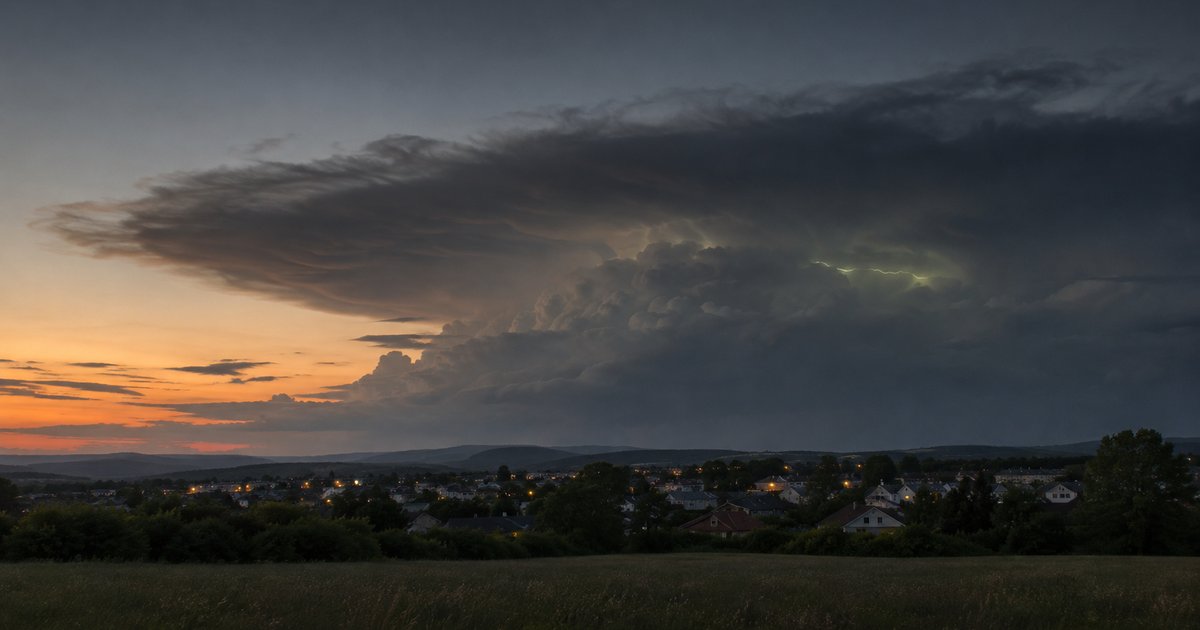
A single thunderstorm cell runs through its whole life in roughly 30 minutes to an hour, according to NOAA and National Weather Service material. Most storms are several cells in a row, though, and lightning can continue after the heavy rain has moved on. How long you stay inside is set by the last thunder you hear, not by how long a storm is supposed to last.
A single storm cell lives for about 30 to 60 minutes
NOAA's JetStream weather school calls the thunderstorm cell the building block of all thunderstorms and says a cell's life cycle lasts about 30 minutes. A cell is one updraft-and-downdraft unit, and it passes through three stages. In the towering cumulus stage, warm, moist updrafts push the cloud upward. In the mature stage, strong updrafts and downdrafts coexist. In the dissipating stage, the downdraft cuts off the updraft, so the storm loses its supply of warm, moist air. The same JetStream page (last updated May 23, 2023) adds that light rain and weak outflow winds may remain for a while in that last stage.
Published numbers for the same kind of storm are not identical. The National Weather Service Spotter's Field Guide gives a short life of generally 30 to 45 minutes for a single-cell storm. The NOAA National Severe Storms Laboratory (NSSL) says single-cell storms grow and die within an hour or so. The University Corporation for Atmospheric Research (UCAR) Center for Science Education describes them as lasting about an hour, and Australia's Bureau of Meteorology says they usually last no more than an hour. None of these pages explains the gap between 30, 45 and 60 minutes, so this article uses the range of 30 to 60 minutes instead of a single figure.
Most thunderstorms are several cells, and that is why they last longer
The Australian Bureau of Meteorology says multi-cell thunderstorms are the most common kind, and that a pure single-cell storm is rare because almost all of them show some multi-cell traits. The National Weather Service Spotter's Field Guide likewise calls the multicellular cluster the most common type of thunderstorm. In a cluster, each cell is at a different stage of its life at the same moment.
NSSL explains how the system outlives its parts. In a multicell storm, new updrafts keep forming along the leading edge of rain-cooled air, which meteorologists call the gust front. Individual cells usually last 30 to 60 minutes, while the system as a whole may last for many hours. The Spotter's Field Guide describes the cluster as moving along as a single unit while its individual cells live only about 30 minutes each.
The storm type decides whether the wait is about an hour or many hours
The table below collects what NSSL and the Bureau of Meteorology publish for each storm type. A mesoscale convective system, in NSSL's wording, is a collection of thunderstorms that act as a system.
| Storm type | What the source says about duration | Source |
|---|---|---|
| Single cell | Grows and dies within an hour or so | NSSL |
| Multicell storm | Individual cells usually last 30 to 60 minutes; the system may last for many hours | NSSL |
| Squall line | No duration given; tends to pass quickly over any one place | NSSL |
| Supercell | Long-lived, more than 1 hour; the Bureau says it can hold a nearly steady state for many hours | NSSL, Bureau of Meteorology |
| Mesoscale convective system | Can spread across an entire state and last more than 12 hours | NSSL |
How long a storm lives and how long it stays over you are two separate questions. A squall line, which is a group of storms arranged in a line, can be hundreds of miles long yet only 10 or 20 miles wide, and NSSL says such lines tend to pass quickly. Texas Ready, the state's emergency preparedness site, notes the opposite case: some of the most severe storms occur when a single thunderstorm affects one location for an extended period.
Lightning can keep going after the heavy rain ends
NOAA's JetStream lightning page calls lightning the first thunderstorm hazard to arrive and the last to leave. The National Weather Service lightning safety overview shows the same pattern as a curve: the threat increases as a thunderstorm approaches, peaks when the storm is overhead, and then gradually diminishes as the storm moves away. A slope like that has no moment when the risk switches off.
The fading stage has a specific lightning type. JetStream's page on positive lightning (last updated April 5, 2023) says positive cloud-to-ground lightning can be the dominant type in the dissipating stage of a thunderstorm. Positive strikes make up less than 5% of all strikes, according to the same page, but it says many of them come from the edge of the cloud or from the anvil and can occur more than 25 miles away from precipitation. The National Weather Service Lightning Myths page uses a smaller distance, saying bolts from the blue can strike 10 to 15 miles from the thunderstorm. The two pages do not reconcile those figures, and both lead to the same advice: hearing thunder means you are within reach, wherever the radar shows the rain.
The National Weather Service lightning safety overview also names the habit that follows from this. Many people go outside too soon after the storm has seemingly passed, it says, often only waiting for the rain to become lighter or end. Rain is a poor clock for a storm whose lightning can outlast it.
The last thunder, not the typical duration, sets the end of the wait
- Count from the last thunder. The National Weather Service says to wait 30 minutes after the last lightning or thunder before going back outside. Why the 30 minutes restart has the reasoning.
- Use your ears as the trigger. The National Weather Service says you can normally hear thunder about 10 miles from a lightning strike, so thunder puts you inside the range of the storm. Flash to bang shows how to turn the delay into a distance.
- Expect restarts from a cluster or a line. A multicell system keeps forming new cells, so a quiet spell can end with another cell and another 30 minutes. That is an interpretation of the NSSL description, not a measured rule, and no source gives the number of restarts to expect.
- Treat a typical duration as an average, not a promise. A cell that lasts 30 to 60 minutes tells you little about the storm system it belongs to. Where you wait matters more than guessing the end time.
How long does thunder last?
One flash can keep thunder going for several tens of seconds. The NOAA National Severe Storms Laboratory says the first thunder you hear comes from the closest channels, a few seconds later come a sharp click or loud crack from channels a little farther away, and several tens of seconds later the thunder from the most distant part of the flash has quieted to a low rumble. The National Weather Service explains why it rolls: a flash strikes one spot on the ground but travels many miles through the air, so you hear the nearest part of the channel first and then the portions farther and farther away.
Lightning Tracker follows the last strike, not the expected length of a storm
Lightning Tracker is an iPhone app that shows recently detected strikes on a live map, with the distance and direction to the nearest one and how many minutes ago it happened. For a fading storm, that last number matters most: a long gap since the last strike is a better clue than the sky overhead.
The app's return wait starts after the last detected strike inside the alert radius you set for each place, which is 10 miles (16 km) by default, and it starts over with every new strike inside that radius. When the wait ends, the app reports what it observed and asks you to judge conditions yourself. It does not announce that the storm is over. Detection networks miss some strikes, especially weak ones, and data can arrive late, so the app labels delayed or missing data instead of counting it as quiet. How lightning is detected explains those gaps, and choosing an alert radius explains how to fit the radius to your place.
Not a substitute for official weather warnings.
If you hear thunder, seek shelter even if the app shows no nearby strike.
Sources
- NOAA JetStream, Life Cycle of a Thunderstorm
- NOAA National Severe Storms Laboratory, Severe Weather 101: Thunderstorm Types
- National Weather Service, Spotter's Field Guide: Types of Thunderstorms
- UCAR Center for Science Education, Thunderstorms
- Australian Bureau of Meteorology, Thunderstorms
- Texas Ready, Thunderstorms
- NOAA JetStream, Lightning Safety
- NOAA JetStream, The Positive and Negative Side of Lightning
- National Weather Service, Lightning Safety Overview
- National Weather Service, Lightning Myths
- National Weather Service, Understanding Lightning Science
- National Weather Service, Understanding Lightning: Thunder
- NOAA National Severe Storms Laboratory, Severe Weather 101: Lightning Basics