 Lightning Tracker
App Store
Places and activities
Lightning delays in youth and school sports: who decides and when play resumes
November 16, 2026 · 10 min read
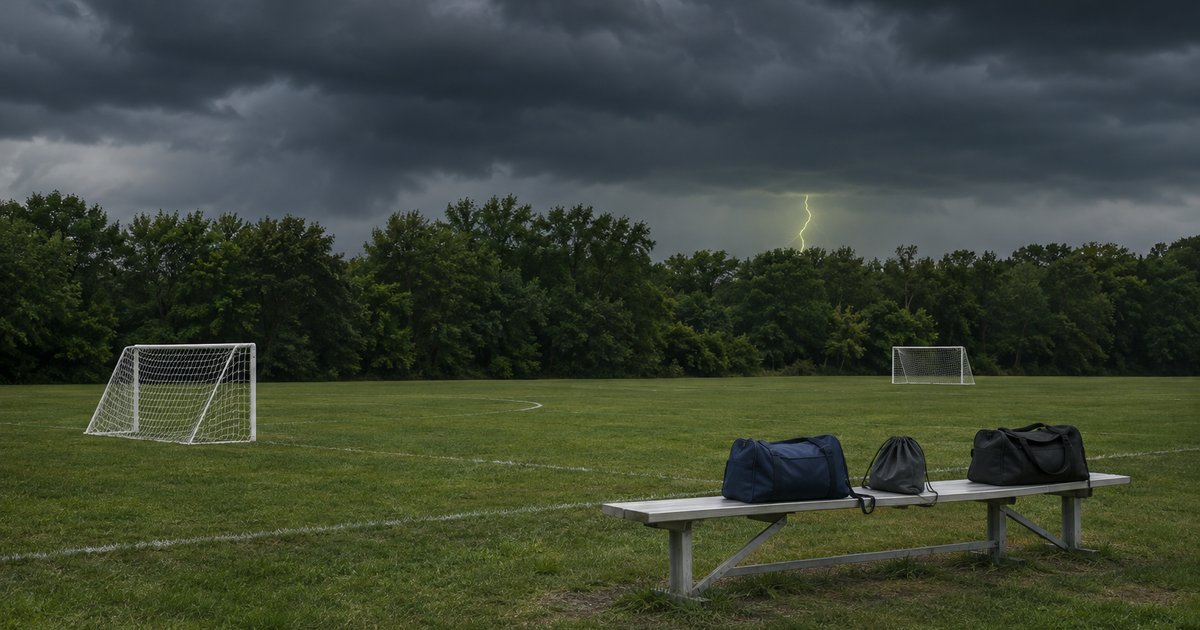
Most U.S. youth and school sports guidance says the same thing: when thunder is heard or lightning is seen, stop play, move everyone to a substantial building or an enclosed metal vehicle, and wait at least 30 minutes after the last thunder or lightning before resuming. The details differ. In October 2024 the National Federation of State High School Associations turned its optional 10-mile lightning-detection trigger into a firm one in its default guidelines, and state associations, school districts and leagues set their own distances and limits on delays, so the binding rule is the one your league or state association has adopted.
What the national guidelines agree on
The National Federation of State High School Associations (NFHS) sets the default for high school sports, and its Sports Medicine Advisory Committee revised its lightning guidelines in October 2024. The guidelines treat thunder heard or lightning seen as a sign that the leading edge of a storm is close enough to strike your location. Staff are to suspend play for at least 30 minutes and move everyone at once to a previously designated safer place. The count runs from the last thunder heard or lightning witnessed, and any new thunder or lightning restarts it. The NFHS calls its text a default policy and names a state association and the nearest National Weather Service office as the preferred sources for a facility's own policy.
The National Weather Service (NWS) lists three signals for stopping outdoor sports: seeing lightning, hearing thunder and threatening skies. It advises waiting at least 30 minutes after the last thunder before resuming, and it describes the significant lightning threat as reaching about 6 to 10 miles out from the base of a thunderstorm cloud. Little League's Appendix A, which cites NWS recommendations, also lists a flash-to-bang count of 30 seconds or less as a stop criterion and equates it with a storm 6 miles away or less. The arithmetic behind that count is in Flash to bang.
Six published rules side by side
The table lines up the stop and resume rules in six documents, from national guidance to one school district's 2023 procedures. The documents agree on the 30 minutes and disagree on the distance.
| Document | Stop when | Resume when |
|---|---|---|
| NFHS guidelines, October 2024 (high school default) | Thunder is heard or lightning is seen; with a nationally connected detection network, lightning is within a 10-mile radius of the event | 30 minutes after the last thunder or lightning, counted from the last lightning inside 10 miles when detection is used; new activity restarts the count |
| NWS, Lightning Safety and Outdoor Sports Activities | Lightning is seen, thunder is heard or the skies look threatening | At least 30 minutes after the last thunder |
| Little League, Appendix A | Lightning is seen, thunder is heard, or the flash-to-bang count is 30 seconds or less | At least 30 minutes after the storm |
| National Athletic Trainers' Association (NATA), 2013 position statement | Everyone is inside by the time the edge of the lightning storm is 5 nautical miles (about 6 miles) away; thunder heard means go in | 30 minutes after the last lightning seen (or at least 5 nautical miles away) and the last thunder heard; each new flash within 5 nautical miles or thunder restarts the clock |
| Texas UIL, school sports | Recommended for schools that use detection technology: lightning detected within 10 miles of the venue; without technology, NFHS sight and sound cues or a 30-second count | No lightning detected within 10 miles and at least 30 minutes since the last strike in that radius |
| Anne Arundel County Public Schools, Maryland, 2023 | The detection system finds lightning within an 8-mile radius of the school, and a horn sounds | Thirty minutes with no detection, then a horn signal |
The distances come from different reasoning and none of them is a measured boundary. The NWS speaks of a 6 to 10 mile threat zone, NATA of 5 nautical miles, the NFHS and UIL of 10 miles, and the Maryland district of 8. NATA adds that any alert threshold should be adjusted for the time a particular venue needs to communicate the decision and evacuate. How to choose an alert radius shows how to turn that evacuation time into a distance.
What the October 2024 NFHS revision changed
The January 2021 NFHS text said that independently validated detection devices or phone apps "could be used" to help decide to suspend play when a strike was noted within 10 miles of the event. The October 2024 text is firmer. It says that data from a nationally connected lightning detection network should be monitored closely when storms are possible or during lightning delays, and that play shall be suspended when lightning is within a 10-mile radius of the event and not resumed until at least 30 minutes have passed since the last lightning inside that radius.
Both versions keep one limit on technology: sight and hearing win. The 2024 text says never to depend on a detection device if the sky looks threatening, you hear thunder or you see lightning. A league handbook or web page that still quotes the 2021 wording predates the revision, so check the date on whatever document your league cites. Whether the NFHS text binds a particular school depends on the state association. The Texas University Interscholastic League (UIL), for one, adopts the NFHS guidelines as the minimum required standard for all outdoor practices and contests.
Who has the authority to stop and restart play
The NFHS guidelines tell schools to assign a specific staff member to monitor the weather, charge that person with suspending outdoor activities and deciding when to resume, and state that anyone following the guidelines shall not be challenged. NATA's statement makes the same point as a chain of command, with one person or role holding recognized and unchallengeable authority to suspend activity. It also says that anyone has the right to leave an outdoor site they consider unsafe, without fear of repercussion or penalty. Camp leaders who must move groups from several activity areas can use a lightning plan for summer camps for shelter routes, monitoring and the all-clear.
The NWS and Little League go one step further on who the monitor should be: not the coach, umpire or referee, because those people are busy and cannot adequately watch conditions. Local rules fill in the rest. In Anne Arundel County, any coach, official or field staff member may evacuate a practice or warm-up area they declare unsafe, and once a game begins, officials have control and may delay or discontinue it for a health and safety hazard.
What detection data adds, and what it cannot do
NATA's 2013 statement calls real-time lightning notification services useful as supplements but says they should never replace the designated weather watcher and NWS monitoring. It adds that such services work best for storms that have already formed and are moving into the area, and will not be effective for the first strike of a new, nearby storm. The Maryland district's system is described as detecting both in-cloud and cloud-to-ground lightning. How lightning is detected explains why even good networks miss some strikes.
The NFHS makes one exception for night games. Distant flashes can be seen at night under certain atmospheric conditions, and if no thunder can be heard and the flashes sit low on the horizon, the storm may not pose a threat; independently verified detection information would help resolve the uncertainty.
Lightning Tracker, an iPhone app, can serve as one of those signals at a practice or game. Save the field as a place and set its alert radius; the app alerts you when a strike is detected inside it, and the default is 10 miles (16 km), the same distance the NFHS uses. Its return wait starts after the last strike detected inside the radius and restarts with each new one. When the 30 minutes pass, the app reports what it observed and asks you to judge conditions yourself; it does not announce that the storm is over. The app can miss strikes and receive data late, and it marks delayed or missing data rather than counting it as quiet. Alerts are local notifications, so iPhone settings such as Focus and Low Power Mode affect delivery; Five iPhone settings that decide when a storm alert arrives covers them. The app does not replace official warnings or your league's procedures, and the weather monitor still listens for thunder.
How long a delay lasts, and why the end of a storm counts
A lightning delay under the NFHS guidelines lasts at least 30 minutes, and each new thunder or lightning starts a fresh count, so a slow storm can hold up play for much longer. The national texts set that minimum. How long a game may be held before it is postponed or called off is left to local rules, which vary. The Anne Arundel County procedures say that if play resumes and is suspended a second time, staff may conclude or postpone the event instead of waiting another 30 minutes, that games should not start or restart if they cannot complete at least half of the game, and that no youth games start or restart after 8 pm.
NATA's statement explains why the wait follows the last thunder, not the last rain. It reports that waiting 30 minutes after any thunder or lightning gives 90 to 95 percent confidence that no more lightning will occur, and that deaths happen at about equal rates at the onset, the middle and toward the end of a thunderstorm. Once the flash rate starts to decline, people may stop seeing the storm as dangerous and return outdoors too early. The reasoning behind the restart is in Why wait 30 minutes after the last strike?
Where players, officials and spectators go during a delay
The NFHS names a substantial building with plumbing and wiring where people live or work, such as a school, gymnasium or library, as the designated safer place. Its alternate is a fully enclosed metal car or school bus, not a convertible or soft top. The guidelines also ask schools to work out how much time it takes to get everyone to that place. NATA lists tents, dugouts, refreshment stands, gazebos, screened porches, press boxes and open garages among the locations that do not protect against lightning. Where to shelter from lightning covers the reasons.
What the death records say about sports
The National Lightning Safety Council counted 492 lightning deaths in the United States from 2006 through 2024. Sports-related activities made up about 9 percent of them, and golf and soccer had the most, with 14 and 13 deaths. The author notes that in most sports cases a building or vehicle was nearby and many victims did not react quickly. That points to timing rather than missing shelter: a delay rule only helps if people leave when it says to. More of the data is in Who gets struck by lightning? Golf-course staff can compare stop and shelter procedures in lightning on the golf course.
A clock and message for the next practice or game
For a high school football game or a spring baseball or track practice, the NFHS October 2024 default works the same way: the assigned staff member stops outdoor activity when thunder is heard or lightning is seen, and the team goes to its designated shelter. For example, if the last thunder is heard at 3:10 pm, the earliest return under that rule is 3:40 pm; thunder at 3:25 pm moves it to 3:55 pm. If a nationally connected detection network is used, lightning inside the NFHS 10-mile radius also starts or restarts the 30-minute count. A resettable 30-minute lightning timer can help the assigned person track the last observation, but that person still decides when conditions and the governing policy permit a return.
The NFHS assigns one staff member the stop and restart decision and asks schools to inform athletes and parents of the policy at the start of the season. A league can turn that into one message to coaches and families: “Play is suspended; go to the designated building or enclosed vehicle. We will announce a new start time only after the last thunder, lightning or qualifying detection has cleared the policy’s wait.” The written lightning action plan should name who sends the message, how each field hears it and which local rule controls a postponed game.
Before the season: a short checklist for leagues and coaches
- Ask for the governing rule. The NFHS names the state association and the nearest NWS office as the preferred sources for a facility's policy. Get the written rule that applies to your league, and note its date.
- Name the monitor. Decide who watches the weather and who may suspend play before anyone is on the field.
- Pick the shelter and time the walk. Write down the building or vehicle, and how long it takes everyone to reach it from each field.
- Write the restart rule. State whether the 30 minutes count from the last thunder, the last lightning, or the last detection inside a set radius, and what happens after a second delay.
- Tell the families. The NFHS asks schools to review the policy each year with administrators, coaches and game personnel, and to inform student-athletes and their parents at the start of the season.
This page summarizes published guidance. It does not say what any league, school or state requires, and a policy that resembles the documents above is not thereby shown to meet any requirement.
Not a substitute for official weather warnings.
If you hear thunder, seek shelter even if the app shows no nearby strike.
Sources
- National Federation of State High School Associations, Sports Medicine Advisory Committee, Guidelines on Handling Practices and Contests During Lightning or Thunder Disturbances (PDF, October 2024)
- National Federation of State High School Associations, Sports Medicine Advisory Committee, Guidelines on Handling Practices and Contests During Lightning or Thunder Disturbances (PDF, January 2021 version)
- National Weather Service, Lightning Safety and Outdoor Sports Activities
- Little League International, Appendix A - Lightning Safety Guidelines
- National Athletic Trainers' Association, Lightning Safety for Athletics and Recreation (position statement, Journal of Athletic Training, April 2013)
- University Interscholastic League (Texas), Lightning Safety
- Anne Arundel County Public Schools, AACPS Athletics Updated Lightning Procedures (PDF, implemented March 1, 2023)
- National Lightning Safety Council, J. Jensenius, A Detailed Analysis of Lightning Deaths in the United States from 2006 through 2024 (PDF, January 2025)