 Lightning Tracker
App Store
Places and activities
High school football lightning delay: game, halftime and restart
November 18, 2026 · 5 min read
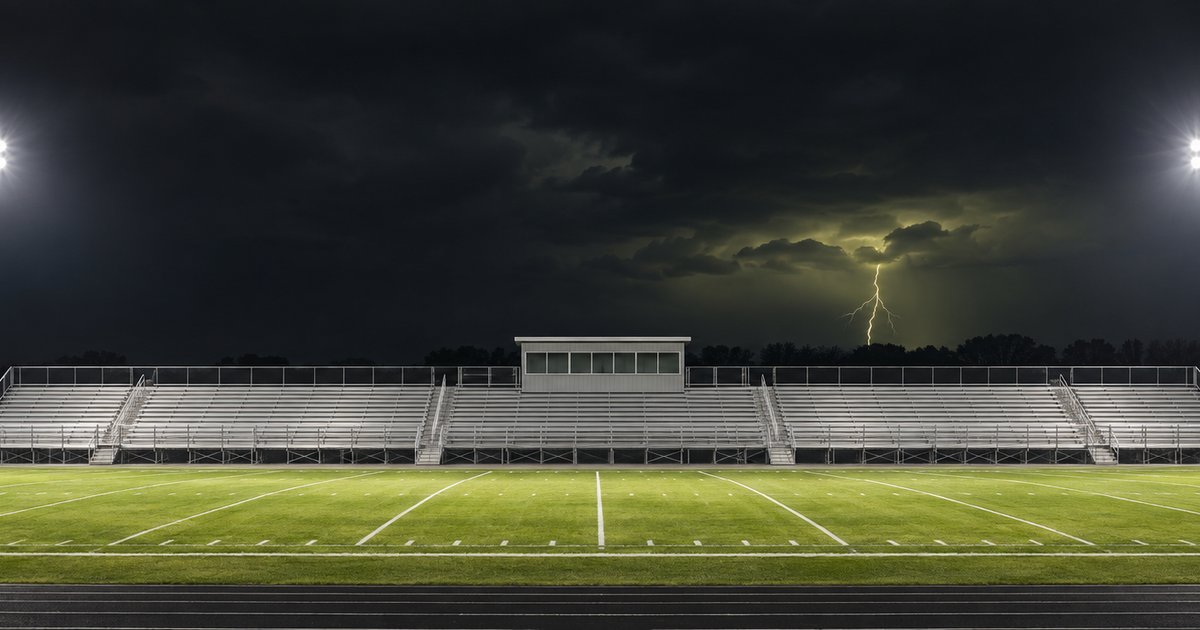
A high school football game stops for thunder or nearby lightning, and NFHS guidance calls for at least 30 minutes after the last thunder or flash before anyone returns to play. Its October 2024 guideline also says each new event resets that wait. A late-second-quarter delay can affect halftime under NFHS football rules, while state associations decide how an unfinished game is handled.
The stop starts with thunder, a flash or a nearby detection
The NFHS Sports Medicine Advisory Committee’s October 2024 guideline says a high school contest should be suspended when thunder is heard or lightning is seen, with everyone moved immediately from the outdoor activity to a designated shelter. It also says that, when a nationally connected lightning detection network is available, play shall stop for lightning within 10 miles (16 km) of the event. A threatening sky, thunder or a visible flash takes precedence over an app or device reading. The school’s plan should assign one staff member to monitor the weather and to suspend and resume activities, and should work out the time needed to reach shelter.
The first stop is an evacuation, not a chance to wait under the stands. NFHS calls a substantial wired and plumbed building, such as a school or gymnasium, a designated shelter; a fully enclosed metal car or school bus is its alternate. The plan has to get athletes, game personnel and spectators to shelter, not only the teams. Where to shelter from lightning explains why an open dugout, tent or covered bleacher is inadequate.
The 30-minute clock follows the last event, not the first
The October 2024 NFHS guideline says to wait at least 30 minutes after the last heard thunder or witnessed lightning before going back outdoors and resuming play. Each new thunder or flash during that count starts another full 30 minutes. Where a detection network is used, its separate 10-mile (16 km) condition also has to clear: at least 30 minutes must pass since the last detection inside the radius. A scheduled restart announced after the first flash can therefore move repeatedly. The 30-minute waiting rule is a minimum, not a promised kickoff time; the people applying the local plan still decide whether the field and event are ready.
The NFHS guidance notes that at night, under certain atmospheric conditions, distant flashes low on the horizon with no thunder may not pose a threat, and that independently verified detection information helps resolve uncertainty. A spectator should not make that judgment for the whole stadium. A lightning map can help staff follow detections, but NFHS says observed thunder, lightning and a threatening sky outrank a device reading. That is why the evacuation announcement remains the instruction to follow even if a phone shows no nearby strike.
A delay near halftime can change the football clock
An NFHS football rule adopted in 2020, and left unchanged by the 2026 rule changes, permits opposing coaches to shorten the halftime intermission by mutual agreement when a weather delay occurs during the last three minutes of the second period. NFHS’s published rule explanation gives the fuller condition: the delay must last at least 30 minutes, and the shortened halftime must still include at least a one-minute intermission, plus a separate three-minute warm-up. A delay with four minutes left in the half does not meet that stated last-three-minutes exception. An ordinary lightning wait does not by itself shorten halftime; the NFHS exception needs both coaches to agree.
For spectators, “the 30 minutes are up” is therefore not the same as “the third quarter begins now.” Teams may still need to finish the second period, observe the applicable halftime interval and warm up. Texas differs: the University Interscholastic League says Texas high schools use NCAA football rules, and its regular-season manual gives a maximum 28-minute varsity halftime plus at least three to four minutes for warm-up. The NFHS football halftime exception above should not be treated as Texas’s rule.
The referee and schools handle different decisions
Ohio’s football inclement-weather procedure, updated in 2011, says that after officials assume authority, the referee suspends the game for lightning and does not resume until it leaves the area. The Ohio High School Athletic Association’s general lightning policy requires at least 30 minutes since the last flash or thunder, resetting for each later event. If play cannot continue that day, Ohio’s football procedure sends administrators and coaches of both schools to decide when it will be completed. It says the game resumes from the interruption point unless the schools agree to end it at the existing score. That distinction matters to anyone hearing that a Friday game has been “called”: the announcement may mean a later restart, not a final score.
Kentucky’s November 2025 football reminder gives a 2025 contest administration example. KHSAA says its lightning provisions apply in regular season and postseason. For the 2025 playoffs, the teams could mutually end with the present score or agree to resume from the stopping point on the Sunday of the playoff week; if they could not agree, KHSAA specified the following calendar day. Its reminder asks officials, coaches and school administrators to take part in the discussion. A local school’s posted update or state association notice is the place to confirm the actual game’s status.
Texas UIL adopts the NFHS sports-medicine lightning guidance as its minimum for outdoor contests, while giving schools that use detection technology a recommended 10-mile (16 km) suspension trigger. Unlike NFHS football, UIL’s football manual says Texas high schools play by NCAA rules. These Ohio, Kentucky and Texas examples show why the general youth sports delay cannot settle every football result.
Spectators should follow the venue’s evacuation and update route
NFHS tells schools to identify shelters in advance and review the lightning plan with administrators, coaches and game personnel each year. Ohio’s current association policy specifically directs evacuation of personnel, athletes and spectators to available shelter when lightning is imminent or a storm approaches, and calls for nearby structures to be announced and displayed at venues. Anyone leaving the stands should go to the named building or an enclosed metal vehicle, then follow the host’s announcement for return. Crowd shelter at outdoor events is useful when many people have to move at once; school lightning plans cover student supervision outside the game itself.
Lightning Tracker on iPhone can show recently detected strikes on a live map and alert for detections inside a chosen radius. The school’s weather monitor, referee and state contest rules govern the game’s stop and restart.
Not a substitute for official weather warnings.
If you hear thunder, seek shelter even if the app shows no nearby strike.
Sources
- National Federation of State High School Associations, Guidelines on Handling Practices and Contests During Lightning or Thunder Disturbances
- National Federation of State High School Associations, Football Rules Changes — 2020
- National Federation of State High School Associations, Football Rules Changes — 2026
- National Federation of State High School Associations, Additional Timing Changes on Play Clock Approved in High School Football Rules
- Ohio High School Athletic Association, OHSAA Lightning & Inclement Weather Policy
- Ohio High School Athletic Association, Inclement Weather Procedures: Football
- Kentucky High School Athletic Association, Additional Reminder about Weather Shortened and Interrupted Football Games
- University Interscholastic League, Lightning Safety
- University Interscholastic League, Football Manual Regular Season