 Lightning Tracker
App Store
Places and activities
Lightning at outdoor events, concerts and stadiums
November 17, 2026 · 12 min read
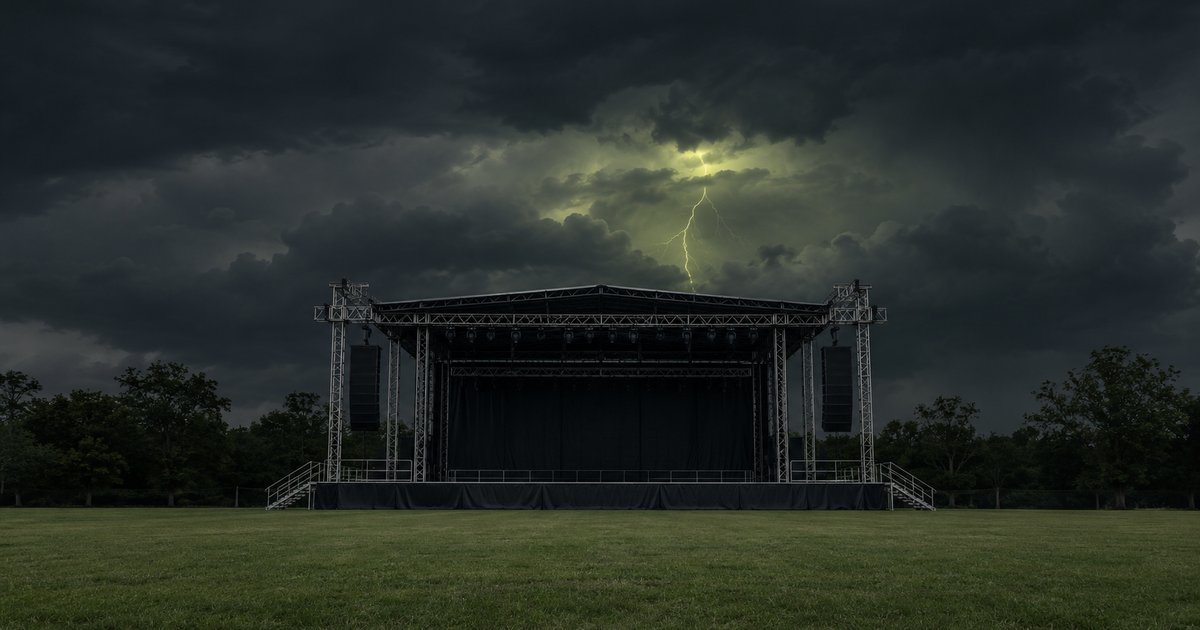
When lightning nears an outdoor stadium or concert, the guidance from the National Weather Service (NWS), the CDC and the Cybersecurity and Infrastructure Security Agency (CISA) is that the venue decides: a written plan, a named person watching for lightning, a trigger distance that starts the move to shelter, and a wait of about 30 minutes after the last thunder before the event resumes. The trigger distance is not settled, ranging from about 6 to 15 miles depending on the source, and none of these documents says how many people a venue's shelters hold. For a ticket holder, the useful question is what to do while those decisions are made.
A full stadium turns a shelter problem into a crowd problem
The Centers for Disease Control and Prevention (CDC) says lightning can strike and injure players and spectators in outdoor stadiums during a sporting event (page dated April 15, 2024). A 2006 article in the Bulletin of the American Meteorological Society, “Lightning Safety and Large Stadiums” by Joel Gratz and Erik Noble, argues that crowd density rather than crowd size is the overwhelming concern in lightning policy: when a stadium is relatively empty, spectators can reach shelter quickly, and when it is full, they cannot. Its abstract says events that fill stadiums to capacity carry the highest risk because there is little room to move and crowd panic becomes a real possibility.
The same paper points to cues that fail in a crowd. The sounds and sights most people use to judge a storm may be hidden by crowd noise, the stadium structure and the stadium lights. Its examples are specific. At a 2003 football game at Denver's Invesco Field, with 76,219 people attending, play stopped for lightning, and during a delay of 30 to 45 minutes management gave spectators no instructions. At a 1998 concert at Robert F. Kennedy Stadium in Washington, D.C., a woman in the audience was struck, and officials evacuated more than 50,000 spectators soon after. The authors also note that up to 2006 there had been few U.S. casualties from direct strikes on a stadium or from the mass movement of people when lightning threatened, and they argue that venues without an action plan are overlooking a chance to prevent a disaster.
Who decides, and what the plans ask for
The National Weather Service (NWS) recommends that organizers of outdoor activities have a lightning safety plan and follow it without exception. Its sports page, which is undated, lists what the plan must settle: when to stop, where people go, when to resume, who monitors the weather, and what to do if someone is struck. It adds that the lightning monitor should not be the coach, umpire or referee, because those people are too busy to watch conditions. Coaches managing smaller games can compare stop and restart rules in lightning delays in youth sports.
The May 2026 Lightning Safety Guide for Sports and Special Events, published by the Cybersecurity and Infrastructure Security Agency (CISA) with the National Center for Spectator Sports Safety and Security (NCS4), splits the work in two. A Weather Safety Official watches conditions, and an Authorized Decision-Maker decides when and how the plan starts, including delays, cancellations, and orders either to shelter in place (stay inside a protective structure) or to evacuate. The NWS runs a voluntary recognition program built on a venue toolkit, and its eligible sites include concert venues. Venues that complete a plan with their local NWS office are listed on the NWS website.
Having a plan is common; trusting it is less so. In an NCS4 survey of 182 people from the sports and entertainment sector, run from July to September 2023, 95 percent had a lightning safety plan, but only 77 percent felt it covered their event appropriately, and 25 percent reported no lightning mitigation measures. The challenges respondents named included conflicting information about trigger points, inadequate shelter space and getting the crowd to follow directions.
How close is too close? The numbers differ by source
The guidance gives the venue a trigger distance, the point at which lightning detected or observed near the venue starts the move to shelter. The documents do not agree on one number, as the comparison below shows.
| Source | Distance | What it means |
|---|---|---|
| NWS, outdoor sports page (undated) | About 6 to 10 miles | How far a significant lightning threat extends from the base of a storm cloud; the page asks organizers to allow for the time everyone needs to reach shelter |
| NCAA guideline, as quoted in an NWS conference paper (2012) | 30 seconds flash to bang, about 6 miles | By then, everyone should already have left the site and reached a more protective structure |
| NWS venue toolkit (undated) | 15, 12 and 8 miles | Three steps: raise the monitoring level and prepare staff at 15, begin or continue evacuating at 12, suspend the event and send everyone to shelter at 8 |
| CISA guide (May 2026) | 15, 12 and 8 miles, adjustable | Eight miles is the minimum, because 20 percent of strikes fall beyond that radius |
The spread reflects how long the crowd needs, not a disagreement about lightning. The NWS toolkit says radii vary with venue size, capacity and the time patrons need to reach shelter, and CISA lists distance to shelter and time to leave the seating areas among the factors. One example is in the NWS conference paper: officials at Neyland Stadium in Knoxville, Tennessee, called an evacuation when a storm came within six miles during a September 2010 game with 102,035 fans. The university's emergency management director judged that was not enough time to evacuate spectators safely, and the university moved to an eight-mile minimum. For turning a flash-to-bang count into miles, Flash to bang has the arithmetic.
Moving tens of thousands of people takes longer than a warning gives
The toolkit tells venues to plan for the slow case. If an organized thunderstorm system (supercells, squall lines or bow echoes) is heading for the venue, it says a lead time of 30 minutes or more should be considered before the storm reaches the eight-mile radius. Gratz and Noble go further: their abstract says complete evacuation is often counterproductive, and they suggest designating shelter areas inside the stadium, estimating how many people fit, and treating about 3 square feet (0.3 square meters) per person as the point where people begin pressing against each other.
The NWS conference paper documents what slow looks like. At West Virginia University in September 2011, spectators were slow to leave, some refused to leave their seats, and a cloud-to-ground strike was filmed directly behind the stadium while people remained in the upper deck. The post-event review found that elderly and disabled spectators did not have enough time to leave before the storms arrived, and that people in the concourse could not hear announcements or see radar on the closed-circuit screens. The day before, when Michigan Stadium called a delay with 110,506 spectators in the stands, radar imagery went up on the video boards; the paper calls that effective because most people look for a second source of information before acting.
Delays are routine at this scale. The paper counts lightning delays in 2010 and 2011 at four NFL games, 39 college games and high school games in 34 states. At Notre Dame Stadium on the same day as the Michigan delay, the game resumed after two delays that together lasted 2 hours and 33 minutes.
Count shelter space and the time to reach it before doors open
The NWS outdoor-venue toolkit asks organizers to list specific enclosed buildings for patrons, mark primary and secondary shelter locations, and account for venue size, capacity and the time people need to reach those structures. Before opening doors to a crowd, a venue can put those inputs in its written lightning action plan: expected attendance, how many people each designated building or enclosed vehicle can hold, which seating sections use each route, and the slowest observed trip from seat to shelter. If the assigned places cannot hold the expected crowd, the plan needs more protective space or fewer people; calling a concourse, tent or open shelter a shelter does not solve that gap.
The toolkit's 15-, 12- and 8-mile steps are examples, not a universal margin. It says the radii vary with venue capacity and evacuation time, and that a large organized storm may justify considering 30 minutes or more of lead time before it reaches the eight-mile radius. A venue can record its measured clearance time in an alert-radius worksheet, then have its weather watcher and decision maker choose the trigger in the local plan. The calculation is a planning input, not a promise of warning before a first nearby strike.
Postpone before arrivals or delay after the event starts
The NWS advises organizers to consider canceling or postponing an outdoor event if thunderstorms are forecast before it begins; in some cases it can move indoors. Once people start arriving, it says to follow the lightning plan. The toolkit’s pre-event stage calls for a forecast review, a weather watcher and a notice to patrons when storms are forecast. During the event, its sample stages move from staff preparation to crowd evacuation and suspension. The authorized decision maker therefore has two different calls to make: whether to open at all when the forecast gives advance notice, and when to pause and move an admitted crowd as a storm approaches. Ticket refunds and insurance terms come from the event’s own arrangements, not from the NWS lightning guidance.
What counts as shelter at a venue
The NWS sports page says a substantial building with wiring and plumbing gives the greatest protection, and that small outdoor buildings, including dugouts, rain shelters and sheds, do not. When no building is available, it says a hard-topped metal vehicle with the windows closed provides good protection. CISA adds that pavilions, dugouts, gazebos and open-cab vehicles such as convertibles and golf carts give no protection, and that metal bleachers can be deadly. Where to shelter from lightning explains each of these in more detail.
The NWS toolkit tells venues to name their shelters in advance and mark them with signs. It treats enclosed vehicles as shelter if a building is not available, with the extra condition that patrons not touch the metal framework, and it calls partially enclosed vending areas and picnic shelters unprotected. For people still on their way in, it says to encourage them to stay in their vehicles until the threat has ended. Its sample announcement also lets ticket holders leave for a building or a vehicle and come back in with their ticket stub. Whether a given venue offers that is a matter for its own plan.
Resuming the show
The NWS and the CDC both put the wait at about 30 minutes after the last thunder. The CDC says attendees should wait for an all-clear signal, which should come roughly 30 minutes after the last clap of thunder. Gratz and Noble add that the all-clear should sound clearly different from the warning. Why wait 30 minutes covers why each new strike restarts the clock.
The toolkit and the CISA guide describe two routes. A venue working with a professional meteorologist who uses real-time lightning data may resume once lightning has moved beyond eight miles, the storm is moving away and the threat of new strikes within eight miles has ended; those conditions name no number of minutes. A venue without that help waits 30 minutes after the last observed thunder or lightning during the day, or the last thunder at night. CISA calls the 30/30 rule no longer the most accurate method given modern detection, and a last resort. The sources therefore agree on 30 minutes, but they differ on whether it is the main rule or the fallback.
What a ticket holder can do
Most of the guidance is written for organizers, and the CDC's attendee advice is short. At an organized event in an outdoor stadium during a thunderstorm, it tells people to remain calm, listen for instructions from stadium personnel, move to the designated shelters away from metal poles and the open field, and wait for the all-clear. It says these shelters should be determined before the event if storms are possible. Some of that can be done in advance:
- Look for the plan. The toolkit says lightning guidelines and evacuation procedures should be printed in event programs and announced over the public address system when thunderstorms are in the forecast. Gratz and Noble add tickets, flyers, large screens and placards.
- Find the shelter and the vehicle option before you need them. The route from your seat matters because the National Lightning Safety Council's January 2025 analysis of U.S. lightning deaths from 2006 through 2024 says, based on media reports, that many victims were headed to shelter or just steps from it when they were struck.
- Do not count on hearing a warning. Crowd noise and stadium structure can hide the usual clues, and in one documented case people in a concourse could not hear the announcements. A second source, such as radar or a lightning map on your phone, gives you another look.
- If someone near you is struck, the NWS says to call 911 for medical help; most victims survive, but need immediate care. If someone is struck by lightning covers the first minutes.
What the sources leave unknown
Four questions stay open after reading the NWS, CDC, CISA and National Lightning Safety Council documents.
- How many spectators have been killed. The National Lightning Safety Council counted 492 U.S. lightning deaths from 2006 through 2024 and published no separate figure for spectators. Its catch-all list of leisure activities includes attending a rock festival and watching a car race, so these settings appear in the record, but the study gives no count.
- A distance for concerts. The CISA guide covers music festivals as well as sports, and the toolkit lists concert venues as eligible, but neither gives a trigger distance specific to concerts.
- How many people the shelters hold. CISA's survey lists inadequate shelter space as a challenge, and no source states how many fans a typical stadium can shelter.
- What to do before an announcement. The sources tell organizers when to act. None of the pages read for this article says whether a ticket holder should leave a seat ahead of the venue's call. The NWS toolkit's general reminder is “When Thunder Roars, Go Indoors!”
Where Lightning Tracker fits
A venue's trigger distances belong to its weather watcher and its plan, which an attendee cannot change. What a phone adds is a second source. Lightning Tracker, an iPhone app, shows recently detected strikes on a live map, with the distance and direction to the nearest one and how many minutes ago it was detected. CISA's guide itself lists mobile software applications among the ways to get lightning data. You can save the venue as a place and set the alert radius for it; the app alerts you when a strike is detected inside that radius, and the default is 10 miles (16 km). How to choose an alert radius shows how to match the distance to the time you need.
Detection networks miss some strikes, especially weak ones, and data can arrive late, so a quiet map does not mean a quiet sky. The app's 30-minute wait starts after the last strike detected inside your radius and restarts with each new one; when it ends, the app tells you what it observed and asks you to judge conditions yourself. At an event, the venue's all-clear is the one to follow. The app does not replace official warnings or local procedures. How lightning is detected explains what a map can miss.
Not a substitute for official weather warnings.
If you hear thunder, seek shelter even if the app shows no nearby strike.
Sources
- National Weather Service, Lightning Safety and Outdoor Sports Activities
- National Weather Service, Toolkits for County, Communities, Organizations and Large Venues
- National Weather Service, Lightning Safety Toolkit: Outdoor Venues (PDF)
- C. Woodrum and D. Franklin, National Weather Service, Using a Lightning Safety Toolkit for Outdoor Venues (conference paper, PDF, 2012)
- Centers for Disease Control and Prevention, Lightning and Organized Sporting Event Recommendations (April 15, 2024)
- Cybersecurity and Infrastructure Security Agency with the National Center for Spectator Sports Safety and Security, Lightning Safety Guide for Sports and Special Events (PDF, May 2026)
- J. Gratz and E. Noble, Bulletin of the American Meteorological Society, Lightning Safety and Large Stadiums (September 2006, abstract)
- J. Gratz and E. Noble, Lightning Safety and Large Stadiums (full text, PDF copy hosted by the Lightning Protection Institute)
- National Lightning Safety Council, J. Jensenius, A Detailed Analysis of Lightning Deaths in the United States from 2006 through 2024 (PDF, January 2025)