 Lightning Tracker
App Store
Places and activities
Who should watch weather during a game?
November 16, 2026 · 5 min read
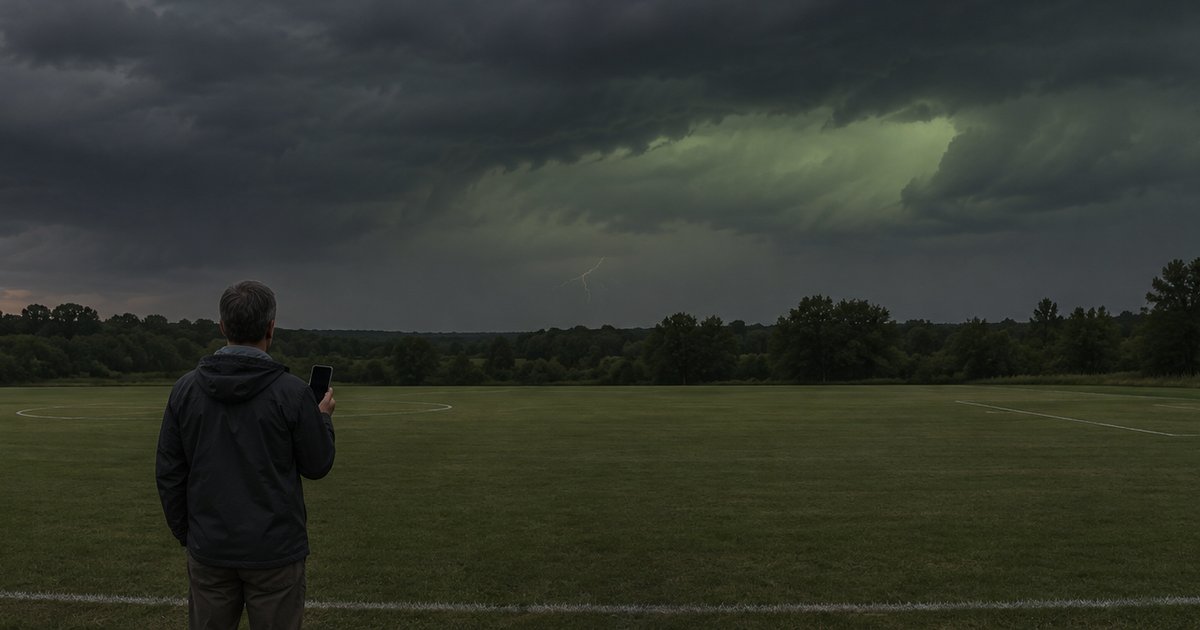
A designated weather watcher should monitor conditions during a game, and the National Weather Service advises that the role go to someone other than a busy coach, umpire or referee. Its undated sports guidance says the monitor must know the lightning plan and be empowered to see it followed. NATA’s April 2013 guidance separates the watcher who reports a threat from the person with authority to stop play; an applicable school or league policy determines exactly who holds that authority.
The watcher needs a job that leaves time to watch
The National Weather Service, in its undated guidance for organized outdoor sports, says the lightning monitor should not be a coach, umpire or referee. Those people are occupied with the game and cannot adequately monitor conditions. The monitor needs to know the venue's lightning guidelines and have enough authority to see that they are followed. Naming someone only after thunder begins misses the point of the role: the person needs to be watching while the game is still underway.
The National Athletic Trainers’ Association (NATA) recommended in its April 2013 position statement that organizers identify a specific weather watcher before an event. The statement describes that person's task as actively looking for threatening weather and notifying the chain of command. It separately calls for a person or role with recognized, unchallengeable authority to suspend activity. One person may have both jobs under an applicable policy, but the observer and the decision maker need not be the same person. The handoff between them must be clear before play starts.
The October 2024 National Federation of State High School Associations (NFHS) guidance takes a more combined approach for school sports. It tells schools to assign a specific staff member to monitor local conditions before and during practices and contests, and charges that staff member with suspending outdoor activity and deciding when to resume. The NFHS calls its document a default policy and points facilities to their state association and nearest NWS office for their own policy. A school should therefore identify the staff member under its governing rules, not assume every sport or state assigns identical authority.
The assignment should name an observer and a decision path
NATA's 2013 statement provides a useful distinction for a pregame conversation: who is watching, and who has the authority to remove people from the field? The weather watcher alerts the chain of command; the person with the decision role can put the venue's procedure into motion. The statement says this authority should be widely recognized and unquestioned. It also says anyone who perceives a lightning threat should feel free to raise postponement or evacuation, regardless of role. A watcher is the assigned observer, not the only person allowed to notice thunder.
For an organizer, a practical handoff is to state the watcher's name, the person who can suspend activity, and the way an observation reaches that person immediately. The message can identify the field, the observed thunder, flash or threatening sky, and the time. This is an implementation of NATA's watch-and-notify recommendation, not a quotation from an agency or a required national form. If the watcher leaves the venue, the organizer should transfer the assignment explicitly so monitoring continues through the event; NATA says awareness begins before and continues throughout it.
The University Interscholastic League's Texas page shows why local wording matters. For its member schools, it says a designated person should monitor before and during practices and contests and has authority to initiate suspension and evacuation. The page also calls for a clearly defined chain of command, including the person with final authority to suspend and resume activity. Those statements describe UIL guidance for Texas member schools; they do not establish one staffing rule for every youth league.
The watcher monitors more than a phone alert
The NWS sports guidance, undated, tells officials to monitor weather conditions, weather radar and lightning detection for developing or approaching storms. NATA's 2013 statement adds continual visual attention to high winds, darkening clouds, lightning and thunder. A forecast helps prepare; observation covers a storm that develops near the venue during play. NATA notes that weather radios can supply updates but may be less useful for localized storms, so the watcher must remain alert to conditions at the event itself.
NATA also points out that a single vantage point may be inadequate. Depending on the venue and its geography, NATA says, the watcher may need to be more than one person who can see a distance or has the weather and lightning information. This is a recommendation based on visibility, not a fixed ratio of watchers to fields. For a spread-out tournament, the organizer can decide how observations from different fields reach the person with stop authority without delay.
The October 2024 NFHS guidance says visual and audio indications of a storm take precedence over information from a mobile app or lightning detector. A quiet phone does not overrule thunder, visible lightning or a threatening sky. Lightning Tracker on iPhone can show recent detected strikes and alert for strikes inside a radius set for a saved field, but the assigned watcher still follows the venue's procedure and observes conditions directly.
The watcher reports the threat; the venue carries out the response
The NWS says the lightning monitor must know the plan's guidelines and be empowered to assure they are followed. Under the NFHS October 2024 default, the designated staff member suspends play when thunder is heard or lightning is seen and moves people toward the designated shelter. The exact lightning delay and restart rules belong to the governing policy. The watcher's role is to make a developing threat visible to those who must act, before a busy official has to infer it from the game field.
The CDC's April 2024 guidance for large outdoor stadiums calls for a person monitoring forecasts and reports, an evacuation plan for players and spectators, and a shelter. It says venue personnel should communicate specific directions to fans to reduce confusion. The watcher does not single-handedly move a crowd: the designated decision maker, announcer and venue staff need an agreed communication path. For a school practice, the same principle is smaller in scale: make sure the person receiving the report can reach coaches and the people responsible for students. School lightning procedures address those broader school responsibilities.
Before the activity, the watcher should be told where people are expected to go. NATA's 2013 statement calls for venue-specific shelter locations to be identified in advance and for the travel time from each activity area to be known. The watcher's observation is more useful when the decision maker understands how long it takes to move the group. Where to shelter from lightning explains which structures protect people during that move. The written lightning action plan can record the role, contact route and replacement, but the assignment still has to work during play.
Not a substitute for official weather warnings.
If you hear thunder, seek shelter even if the app shows no nearby strike.
Sources
- National Weather Service, Lightning Safety and Outdoor Sports Activities
- National Athletic Trainers’ Association, Position Statement: Lightning Safety for Athletics and Recreation
- National Federation of State High School Associations, Guidelines on Handling Practices and Contests During Lightning or Thunder Disturbances
- University Interscholastic League, Lightning Safety
- Centers for Disease Control and Prevention, Lightning and Organized Sporting Event Recommendations