 Lightning Tracker
App Store
Places and activities
USA Swimming lightning rules: who pauses a meet and when it restarts
November 19, 2026 · 10 min read
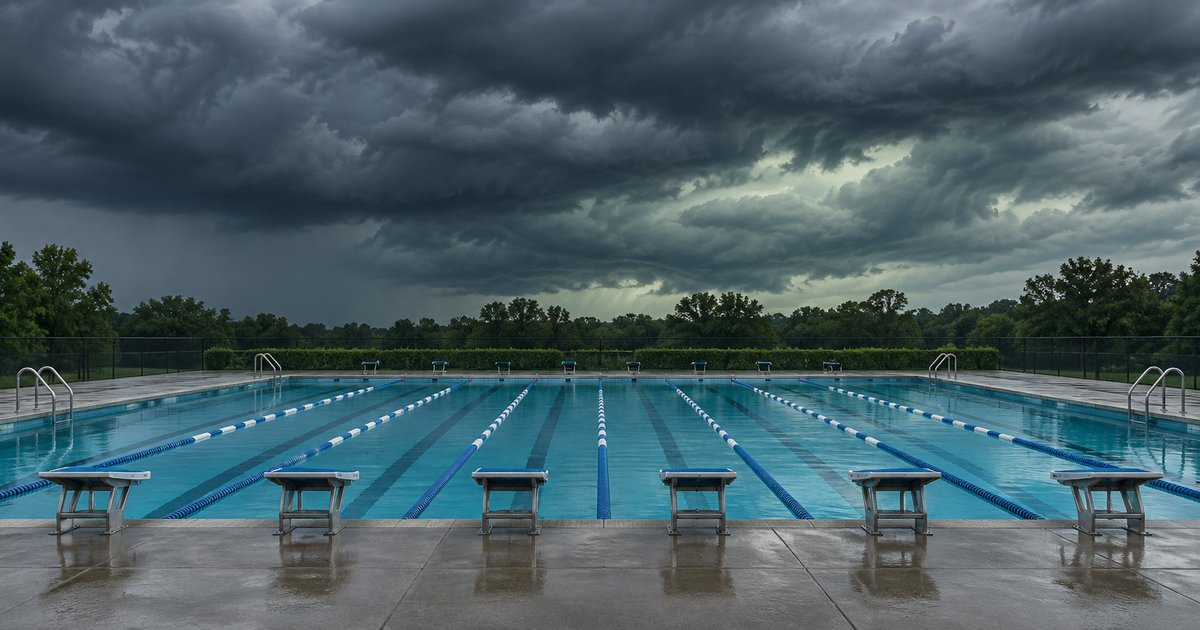
At a USA Swimming meet the referee decides: the 2026 rulebook lets the referee suspend a meet in progress that cannot continue because of weather, in the referee’s sole discretion, but it names no lightning distance and no wait. Those come from the meet’s own plan, the pool owner’s rules or the league’s handbook, and the wait that the written rules below use is 30 minutes after the last thunder or lightning, restarted by each new one.
The 2026 USA Swimming rulebook lets the referee suspend a meet and the committee cancel it
The USA Swimming Rules and Regulations for 2026 give the weather decision to two bodies. Before a meet starts, the meet committee may cancel or postpone it if unusual or severe weather or other conditions rule out conducting it; after it starts, the committee keeps that power (Article 102.7.4). Unless the meet announcement says otherwise, the rulebook defines the committee as the Meet Director, the Meet Referee, and coach and athlete members as appropriate. Once a meet or event has begun and, in the Referee’s judgment, cannot continue because of weather, the Referee may suspend it “in their sole discretion” until conditions warrant continuance. If conditions never do, the Referee may cancel the meet or event, or postpone it, with the committee’s approval, and a decision to cancel or postpone is final.
The rulebook is just as plain about what it leaves out. Its preface says the rules are not meant to set standards of care for the swimmer’s safety, and that the swimmer, the coach, the club and the local public entity or pool owner should address safety where events are held. A text search of the 2026 rulebook PDF found no use of the word lightning, so as of November 2026 the lightning trigger and the wait are not in the rulebook. USA Swimming’s list of amendments to the 2026 rulebook, posted on its rules page, covers Articles 101.1 through 101.6, 102.6 and 102.8, not the weather article.
Open-water events sanctioned by USA Swimming fall under Article 701 of the 2026 rulebook. It gives the Meet Director, and an Independent Safety Monitor who must be independent of the organizing committee, the authority to stop a race at any time if conditions change and safety becomes a concern.
The referee holds the authority, while the NWS wants someone else watching the sky
The National Weather Service tells organizers of outdoor activities to designate a lightning monitor, and says that person should not be the coach, umpire or referee, because those people will be busy and cannot adequately monitor conditions. It adds that the monitor must know the plan’s guidelines and be empowered to see that they are followed. The NFHS guideline for high schools likewise has a staff member assigned to monitor the weather, charged with suspending outdoor activities and deciding when to resume, and says no one following the guideline shall be challenged.
Neither source describes how that fits with a rulebook that gives a swim meet’s suspension to the referee. Our reading is that the referee’s authority covers the order to stop, while the NWS advice points to a different person doing the watching. League handbooks put the signal in the referee’s hands: the Maverick Summer Swim League’s 2026 handbook says the Referee or lifeguard will signal all swimmers to leave the water when lightning or thunder is seen or heard, and it asks teams to check whether the pool has an inclement-weather policy, to write one if it does not, and to review it with the Meet Referee before the meet. Pacific Swimming’s safety page for meet operations, which speaks of Northern California, tells coaches, officials and meet directors to act on the NWS advice and says pool operators should consider building lightning practices into pool procedures.
Each body’s written rule governs its own meets, and the six below differ
The table sets six written rules side by side as of November 2026, and each row applies only to that body’s own meets: a rule from one is not a rule at another.
| Document and edition | Who decides | Lightning trigger and wait |
|---|---|---|
| USA Swimming Rules and Regulations, 2026 | Referee suspends; meet committee cancels or postpones | None in the rulebook; safety is left to the club, coach and pool owner |
| NFHS lightning guidelines, October 2024 (high school default) | A staff member assigned to monitor the weather, charged with suspending and resuming | Thunder heard or lightning seen: suspend at least 30 minutes; new thunder or lightning restarts the count; with a detection network, a 10-mile radius |
| NCAA swimming and diving rules, 2025-26 and 2026-27 | Diving referee may declare a short break or postpone for adverse weather; no weather rule for the swimming referee found | Appendix F points to the NCAA Sports Medicine Handbook; no trigger or wait in the rules book |
| YMCA of the USA national championship policy, 2022 memo | A Y-USA representative and the host facility set a chain of command; the Y-USA policy prevails over the facility’s | Lightning seen, thunder heard, a severe thunderstorm or tornado warning, or detection within a few miles or approaching: clear the pools; return 30 minutes after the last evidence |
| Maverick Summer Swim League handbook, 2026 | Meet Referee postpones or suspends at their discretion; Referee or lifeguard signals swimmers out | Thunder or lightning: swimmers exit; the meet may resume 30 minutes after both cease |
| Greater Annapolis Swim League standing rules, 2026 | Majority agreement of the teams’ League Representatives and the Lead Official | No lightning number; teams follow county regulations and the home pool’s rules |
The NCAA’s swimming and diving rules book says it provides detailed lightning guidance in its Sports Medicine Handbook, and the weather provision it does contain sits in the diving officials’ duties. The YMCA’s 2026 national short course championships handbook says the YMCA national championship lightning policy and local and facility procedures will be followed, so the 2022 memo still governs that meet. The NFHS text is a default for high school sports, and its own wording names the state association and the nearest NWS office as the preferred sources for a facility’s policy; the same default governs delays in youth and school sports generally.
Thunder or lightning starts the stop, and each new one restarts the 30 minutes
The NWS lists three signals that could be used to stop outdoor sports: seeing lightning, hearing thunder and threatening skies. It puts the significant lightning threat about 6 to 10 miles (10 to 16 km) out from the base of a thunderstorm cloud, and says thunder can usually be heard about 10 miles (16 km) away if there is no background noise, with traffic, wind and precipitation cutting that distance. Pacific Swimming’s safety page repeats the 30/30 rule: if the interval between seeing lightning and hearing thunder is 30 seconds or less, the storm is close enough to be dangerous, and the page tells people to seek shelter at once. Because the NWS says thunder takes about 5 seconds to travel a mile, a flash-to-bang count of 30 seconds works out to about 6 miles. Under the NWS signals above, any thunder you can hear is a reason to stop, so a count longer than 30 seconds is not a reason to keep swimming (our reading).
The wait before swimming resumes is 30 minutes in every written rule above that gives one. The NWS says electrical charges can linger in clouds after a storm has seemingly passed, so experts agree people should wait at least 30 minutes after the last thunder before resuming outdoor activities. The NFHS guideline counts from the last thunder heard or lightning witnessed and says any subsequent thunder or lightning restarts the clock. The YMCA memo counts from the last flash or sound of thunder. The Maverick handbook also suggests announcing a specific time when the meet may resume, if possible; since each new strike restarts the wait, our reading is that such a time can only be an estimate.
Detection data can change when the count begins. The NFHS guideline says that, when a nationally connected lightning detection network is available, play shall be suspended when lightning is within a 10-mile (16 km) radius of the event and not resumed until at least 30 minutes after the last lightning inside that radius, but that no one should depend on a detection device if the sky looks threatening, thunder is heard or lightning is seen. The Maverick handbook names a smartphone lightning app with a 10-mile radius and says that without it, the meet should be suspended as soon as thunder is heard or lightning observed.
Where people wait matters too. The NFHS names a substantial building with plumbing and wiring, such as a school, gymnasium or library, as the designated safer place, with a fully enclosed metal car or school bus as the alternate. The NWS says small outdoor buildings such as dugouts, rain shelters and sheds do not qualify.
A suspended meet can resume, move to another day or end, and the rulebook says what then counts
The USA Swimming rulebook puts no time limit on a weather delay: the Referee may suspend until conditions warrant continuance. What it does set is the consequences of postponing. A meet postponed before it starts to a date within 14 days of the original start keeps the swimmers’ ages as of the first day of the original meet. A meet postponed after it starts to continue within 14 days keeps ages unchanged; beyond 14 days, ages change to the first day of the rescheduled events. An event stopped before an official finish and postponed is later swum by the swimmers who were officially competing when it stopped. Incomplete events are not awarded or scored, though times achieved up to the point of cancellation count as official, and the meet committee may refund entry fees in whole or part.
Events postponed to a later day because of conditions beyond the officials’ control, with a thunderstorm as the rulebook’s example, do not count toward a swimmer’s events-per-day limits. Dual-meet leagues write their own scoring rules. The Maverick handbook says the meet score stands if event 38 was completed, and that a meet delayed more than an hour before event 38 is finished is postponed. The Greater Annapolis Swim League says a meet that has completed Event 36 may be declared completed by either team.
Indoor pools: the sources disagree, and no study settles it
Indoor pools are where the written sources part ways. The NWS says lightning can enter a structure through a direct strike, wires or pipes, or the ground, and then travel through electrical, phone and plumbing systems, so it tells people indoors to avoid plumbing. The NFHS October 2024 guideline tells state associations to keep educating member schools on having a lightning policy or plan for all outdoor sports and activities and for indoor swimming pools. A page of the Wisconsin Interscholastic Athletic Association reproduces NFHS swimming text that it attributes to page 97 of the 2018-19 NFHS Swimming and Diving Rules Book, which calls indoor pools just as dangerous as outdoor pools because their lighting, heating, plumbing and drains connect to materials outside the building; the page does not say whether a later edition repeats the passage. The YMCA memo has indoor pools vacated along with outdoor ones, whirlpools, steam rooms, saunas and showers.
The evidence behind these positions is thin. In May 2010 the Red Cross’s Advisory Council on First Aid, Aquatics, Safety, and Prevention found no studies behind several agency policies beyond logic and risk management, and said that lack of research makes the question difficult to impossible to resolve. It added that opponents of closing indoor pools point out that no deaths have been reported in them. The USA Swimming rulebook is silent on lightning, so at an indoor meet the pool owner’s policy and the referee’s judgment of whether the meet can continue are what remain. Lifeguards and pool managers who decide when to clear a deck will find operators’ triggers compared in lightning at pools and water parks.
Where a lightning map fits at a meet
Lightning Tracker is an iPhone app that shows recently detected strikes on a live map, with the distance and direction to the nearest one and how many minutes ago it was detected. The free version follows the current location only; Premium adds up to 5 saved places, so the pool can be one of them. The app alerts you when a strike is detected inside the radius you set for that place, 10 miles (16 km) by default. Its 30-minute wait starts after the last strike detected inside the radius and restarts with each new one; when it ends, the app reports what it observed and asks you to judge conditions yourself, and it does not announce that the storm is over. Detection networks miss some strikes, especially weak ones, and data can arrive late, so the app marks late or missing data instead of treating it as quiet. The app is free on the App Store, with Premium as a subscription. It does not replace the referee’s call, the meet’s lightning plan or the facility’s rules, and the NFHS guideline above puts sight and hearing ahead of any detection device.
Not a substitute for official weather warnings.
If you hear thunder, seek shelter even if the app shows no nearby strike.
Sources
- National Weather Service, Lightning Safety and Outdoor Sports Activities
- National Weather Service, Lightning Indoors
- National Weather Service, Lightning Science: Thunder
- USA Swimming, 2026 Rules & Regulations
- USA Swimming, Rules & Policies (amendments to the 2026 Rulebook)
- Pacific Swimming Association, Safety Considerations for Meet Operations
- National Federation of State High School Associations, Sports Medicine Advisory Committee, Guidelines on Handling Practices and Contests During Lightning or Thunder Disturbances, October 2024
- Wisconsin Interscholastic Athletic Association, Weather: Lightning (reproducing NFHS text)
- NCAA, Men’s and Women’s Swimming and Diving Rules, 2025-26 and 2026-27
- YMCA of the USA, Sports National Championship Lightning Policy Memo, 2022
- YMCA of the USA, 2026 YMCA National Short Course Championships Meet Handbook, Part 1
- Maverick Summer Swim League, Official’s Handbook, 2026
- Greater Annapolis Swim League, Standing Rules, 2026 Season (version 2, June 2026)
- American Red Cross Advisory Council on First Aid, Aquatics, Safety, and Prevention, ACFASP Scientific Report: Lightning Safety for Indoor Swimming Pools, May 2010