 Lightning Tracker
App Store
Places and activities
Why ski chairlifts close for lightning: what resorts say
November 17, 2026 · 7 min read
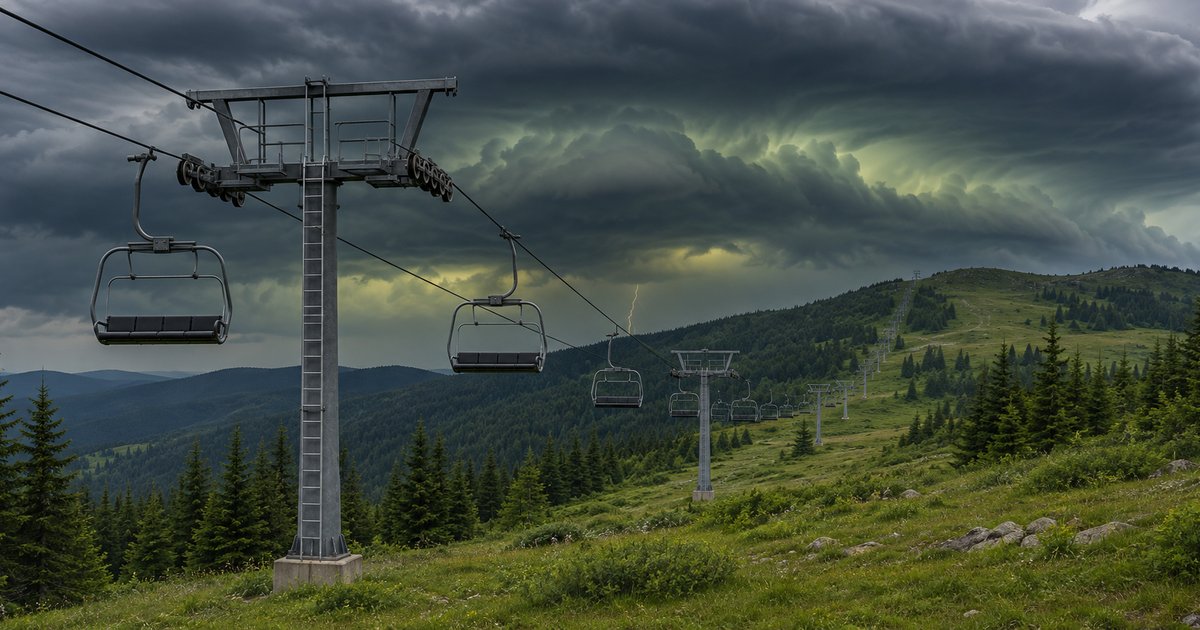
Resorts hold chairlifts when lightning is detected nearby, so that no one is left riding while it is close. Some publish a trigger distance and a quiet period before reopening; others, such as Cranmore and Mt. Bachelor, publish neither. Angel Fire Resort in New Mexico closes its summer chairlift to everyone for a strike within 10 miles, while Big Bear Mountain Resort in California pauses its lifts for a reported strike within 6 miles. Resorts do not share a single number.
Resorts hold lifts so that no one is riding while lightning is nearby
Purgatory Resort in Colorado states the reason plainly. In an operations post dated June 18, 2026, it says storms can delay its Lift 4, which carries bikes, so that guests are not on the lift with lightning in the vicinity. Whistler Blackcomb in British Columbia describes the aim of its last stage, which begins when lightning is 30 km (about 19 miles) away, as moving guests off exposed terrain and lift systems and into shelter. That comes from a June 2023 post on the resort's blog.
Vail Resorts' lift safety page says chairlifts may close temporarily for precautions related to maintenance or weather, and that weather is not always visible or obvious. It adds that the decision belongs to ski area management, which can include the managers of lift operations and lift maintenance and the director of mountain operations. The company's summer safety page tells guests that lifts may close on occasion, causing delays, and asks them to keep off ridge lines and stay clear of chairlift houses and towers. Palisades Tahoe's summer page gives a similar list: ridgetops, lift houses, lift towers and the tallest object nearby.
None of these pages says why towers and lift houses are on the list. The National Weather Service tells people outdoors to avoid ridge tops and to stay away from tall, isolated trees or other tall objects, and it says height, pointy shape and isolation are the dominant factors in where lightning strikes, while metal makes no difference.
Each resort sets its own trigger distance and restart clock
Published lift lightning policies differ in what starts a hold, how far away the lightning can be and how long the hold lasts. The table collects what six resorts' own pages say.
| Resort | What triggers a hold | Restart |
|---|---|---|
| Angel Fire Resort, New Mexico (summer scenic chairlift) | Radar watch at 30 miles; foot passengers stop loading at 20 miles; lift closed to everyone for a strike within 10 miles | After 30 minutes with no strikes |
| Big Bear Mountain Resort, California (lifts at three mountains) | A reported strike within 6 miles | May resume after 15 minutes with no further strikes within 6 miles, conditions permitting |
| Whistler Blackcomb, British Columbia | Three stages, at 100 km (62 miles), 60 km (37 miles) and 30 km (19 miles) | Not stated on the page |
| Cranmore, New Hampshire | Lightning detected nearby; a horn sounds and all lifts and attractions close | Not stated as a time; the page says operations resume once the resort judges conditions allow it |
| Mt. Bachelor, Oregon (summer) | Lightning in the area suspends all mountain operations | Not stated |
| Palisades Tahoe, California (tram) | Lightning in the area suspends all tram operations | Until the lightning clears |
The distances are the resorts' choices, and the pages do not say how each was picked. The National Weather Service's clock for people outdoors is to wait 30 minutes after the last lightning or thunder before going back out, and it says that if you hear thunder you are likely within striking distance of the storm. Angel Fire's 30 minutes after the last strike matches that number, while Big Bear's 15 minutes does not. The two clocks also start from different events: a strike detected within a radius around a mountain on one side, and the last lightning or thunder a person sees or hears on the other. At Cranmore the closure begins when a warning horn sounds, and the resort says its staff then direct guests to the nearest indoor facility.
ANSI's public summary of the lift standard names wind and ice, not lightning
The American National Standards Institute's blog, in a post dated January 13, 2016 that also shows a May 30, 2025 date, summarizes ANSI B77.1, the safety standard for chairlifts, gondolas and other passenger ropeways. It says the 2022 edition specifies that a lift should cease operations if wind or icing conditions are hazardous to passengers, their equipment or the lift's machinery. It adds that when passengers on a stopped lift cannot be unloaded in the normal way, the operator must use a predetermined evacuation system. The summary does not mention lightning. The standard itself is sold, so what it says about lightning is not covered here.
A rider already aloft depends on the resort's plan, which most pages leave out
Whistler Blackcomb's June 2023 post shows what a staged plan can do for people already on the mountain. At 100 km, its Peak Chair stops carrying people up but keeps carrying them down. At 60 km, the sightseeing lifts go on standby, while two gondolas stay available for guests going down. At 30 km those gondolas run only as required to clear guests heading down, and everyone is directed to seek shelter in an enclosed building until the lightning has passed. Angel Fire says that foot passengers already at the summit may have to wait up to two hours for a shuttle or for the lift to resume after a lightning hold. For the ground, the National Weather Service names a substantial building or an enclosed, metal-topped vehicle with the windows up as shelter from lightning.
The resort pages do not tell a rider who is already on a moving chair what to do if lightning arrives. The one general instruction on Vail Resorts' lift safety page is to listen to the lift operator when the operator has something to share.
Riders can plan around a hold before they buy a ticket
Angel Fire says that during monsoon season thunderstorms with lightning are likely to occur every afternoon. The National Weather Service says that in mountainous areas thunderstorms typically develop in the early afternoon, so hikers on mountain trails should start early and be down by noon. Angel Fire's page lists 3:30 PM as the latest time foot traffic can ride up the scenic chairlift, and its tickets are valid weather permitting, with no refund once a ticket is scanned and a ride is taken, even if the lift closes due to weather. Resorts also publish status pages: Angel Fire links to a chairlift status report that covers lightning holds, and Solitude Mountain Resort pointed riders to its app and website for lift status during an April 2023 hold.
Bikers and walkers are treated differently at the same lift. Angel Fire says mountain bikers may continue to load after the foot-passenger hold begins at 20 miles, until the lift closes to everyone for a strike within 10 miles, because they do not rely on the lift to return to the base. That exception is Angel Fire's own; Whistler Blackcomb, by contrast, puts the Garbanzo Express in its Bike Park on upload standby at 60 km.
A strike can also damage a lift: Plattekill's control building
Plattekill Mountain in New York described its own loss in a statement that Snow Industry News published on July 18, 2022. The ski area said a microburst storm on the afternoon of July 12 landed a direct lightning strike on the control building of its double chair, and that the Roxbury Volunteer Fire Department saved the base terminal. The statement says efforts to source parts and rebuild had begun, and it does not say whether anyone was hurt or whether the lift was running.
Lightning holds also happen in spring and in snow
On April 18, 2023, TownLift reported that Park City Mountain, Solitude Mountain Resort and Alta Ski Area had placed all lifts on hold because of lightning in the area during a severe thunderstorm moving through northern Utah. The National Severe Storms Laboratory says thunderstorms are less common in winter, but lightning can occur within snowstorms, which it calls thundersnow.
What Lightning Tracker shows on a lift day
Lightning Tracker is an iPhone app that shows recently detected strikes on a live map, with the distance and direction to the nearest one and how many minutes ago it was detected. It alerts you when a strike is detected inside the radius you set for each place, 10 miles (16 km) by default. Whether a lift runs is the resort's decision, posted on the resort's own status page. Detection networks miss some strikes, especially weak ones, and data can arrive late; the app labels delayed or missing data instead of treating it as quiet. It does not replace official warnings or local procedures, and a lift operator's instructions are among those.
Not a substitute for official weather warnings.
If you hear thunder, seek shelter even if the app shows no nearby strike.
Sources
- Angel Fire Resort, Scenic Chairlift Rides
- Big Bear Mountain Resort, Lightning Policy
- Whistler Blackcomb, Lightning and Lifts: How Whistler Blackcomb Navigates This Operational Safety Challenge (June 2023)
- Cranmore Mountain Resort, Safety & Policies
- Mt. Bachelor, Scenic Lift Summer Activities
- Palisades Tahoe, Summer Safety
- Purgatory Resort, Opening Weekend Operations Update (June 18, 2026)
- Vail Resorts, Summer Safety
- Vail Resorts, Lift Safety
- American National Standards Institute, ANSI B77.1 Ski Chair Lift Safety (The ANSI Blog)
- Snow Industry News, Fire Damages Plattekill Chairlift (July 18, 2022, reproducing a statement by Plattekill Mountain)
- TownLift, Park City Mountain and Alta put all lifts on hold for lightning (April 18, 2023)
- National Weather Service, Overview: Lightning Safety
- National Weather Service, Lightning Tips
- National Weather Service, Lightning Myths
- National Weather Service, Lightning guidance for camping, climbing and other wilderness activities (outdoor scenarios page)
- NOAA National Severe Storms Laboratory, Severe Weather 101: Lightning FAQ