 Lightning Tracker
App Store
Places and activities
Running and cycling in thunderstorm season: routes, race rules and what to do when caught out
November 13, 2026 · 11 min read
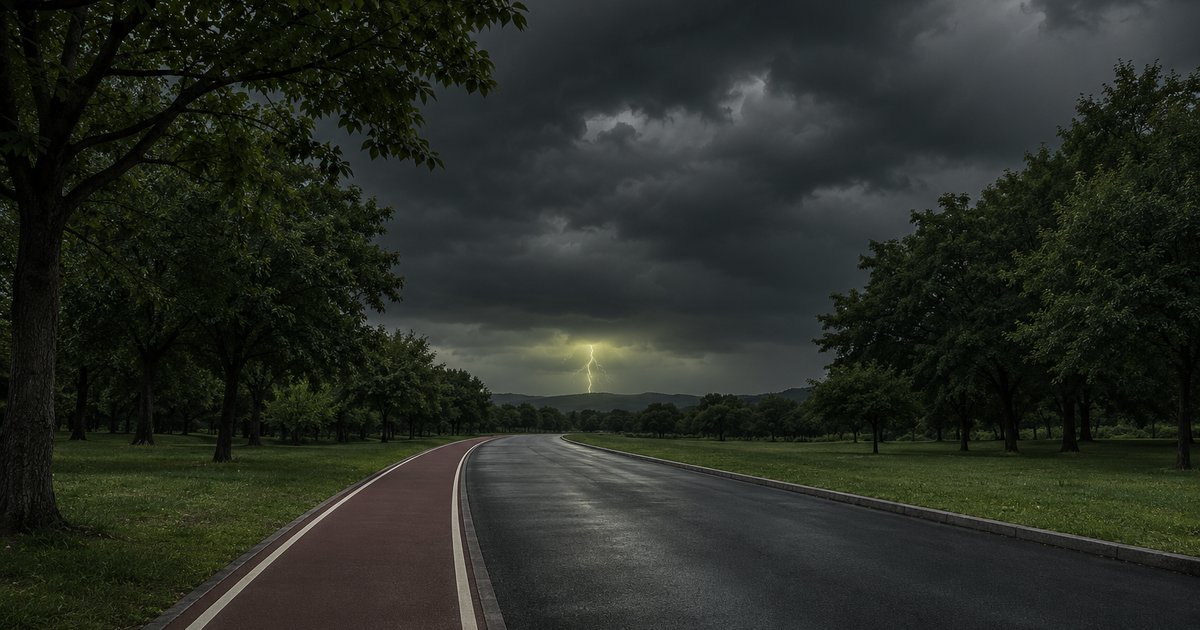
Do not start a run or ride when thunderstorms are forecast unless you can reach a substantial building or a hard-topped vehicle quickly from every point on the route, and head for shelter at the first thunder instead of finishing the workout. The National Weather Service (NWS) says no place outside protects you when a thunderstorm is in the area, and that someone caught outside should keep moving toward a building or hard-topped vehicle instead of crouching, a position the NWS stopped recommending in 2008. Runners and cyclists travel away from shelter by design, so the figure to know before you leave is how many minutes the farthest point of your route is from the nearest shelter.
What the death records show about runners and cyclists
The National Lightning Safety Council (NLSC) counted 492 lightning deaths in the United States from 2006 through 2024. In its January 2025 analysis, sports-related activities made up about 9 percent of all those deaths, and running accounted for 24 percent of the sports deaths, behind golf at 33 percent and soccer at 31 percent. The NLSC groups bicycles with motorcycles and ATVs: that category had 20 deaths, 4 percent of the total. The analysis does not report cyclists on their own, so how many of those 20 were on bicycles is unknown from this source.
Two other findings in the NLSC paper bear on planning. More than 72 percent of the deaths occurred in June, July and August, and the weekend days, particularly Saturday, had the most; weekend long runs and group rides fall in that window. And the paper's author noted that a few of the running victims were some distance from shelter and could have reached shelter sooner had they listened to the forecast and chosen a safer route. The route, in other words, is a decision you make before the first step. For sports in general, the NLSC found that a building or vehicle was nearby in most cases and many victims failed to react quickly.
Route planning: minutes to shelter matter more than miles
The National Weather Service (NWS) says a significant lightning threat extends outward from the base of a thunderstorm cloud about 6 to 10 miles, and it tells organizers of outdoor activities to account for the time it takes everyone to reach shelter. For a person on foot or on a bike, that time depends on speed and distance. The table is plain arithmetic, not NWS guidance: minutes equal miles divided by speed, times 60, at a steady speed on a direct path, with no allowance for hills, road crossings or tired legs.
| Pace or speed | 1 mile | 2 miles | 3 miles | 5 miles |
|---|---|---|---|---|
| Easy jog, 10:00 per mile (6 mph) | 10 min | 20 min | 30 min | 50 min |
| Steady run, 8:00 per mile (7.5 mph) | 8 min | 16 min | 24 min | 40 min |
| Relaxed ride, 12 mph | 5 min | 10 min | 15 min | 25 min |
| Brisk ride, 18 mph | 3 min | 7 min | 10 min | 17 min |
Read the table against the NWS figures. Thunder can usually be heard from about 10 miles away, so a runner who hears the first rumble 3 miles from the nearest building at an 8:00 pace still needs about 24 minutes to get there. How fast a particular storm approaches is a separate question that the table cannot answer; How to choose an alert radius works through the same arithmetic from the storm's side.
Four choices follow from the numbers:
- Keep qualifying shelter within reach. The NWS names office buildings, schools and homes as examples of substantial buildings with wiring and plumbing, and in one of its examples set at a ballpark, restroom buildings and vehicles are the shelter. It says dugouts, rain shelters and sheds do not protect you. Where to shelter from lightning covers the reasons.
- Favor loops over distant turnarounds. On an out-and-back route, the farthest point is also the one most minutes from shelter. A loop that passes buildings repeatedly, or short laps near home, keeps the worst case lower. This is a conclusion from the arithmetic, not an NWS rule.
- Start early in summer. The NWS says summer thunderstorms typically develop in the afternoon, when the sun heats the air near the ground. For mountain areas it advises starting early in the day and being down the mountain by noon; trail runners and mountain bikers can apply the same reasoning.
- Check the forecast for where you will be. The NWS notes that the forecast for a trail or park may differ from the one near your home. The NLSC adds that where shelter is not readily available and thunderstorms are forecast, the only option is to cancel or postpone.
Hearing and seeing a storm while you are moving
The NWS says thunder can usually be heard from about 10 miles away when there is no background noise, and that traffic, wind and precipitation may cut that range below 10 miles. The NLSC makes the same point more generally: background noise limits a person's ability to hear distant thunder, and mountains, trees or buildings can block the view of the horizon. Neither the NWS nor the NLSC text mentions headphones, but the reasoning carries over to music or a podcast in your ears. Flash to bang explains why hearing thunder at all is the signal, with the count of seconds as extra information.
When you do hear thunder, the NWS says the storm is likely within 10 miles. It also lists threatening skies as a reason to stop, because thunderstorms can develop directly overhead and some produce lightning just as they move into an area. The NLSC adds that cell phone technology and lightning notification services may help provide advance warning where noise or terrain limit what you can hear and see.
What to do when thunder starts during a run or ride
When you hear thunder, the NWS says to move immediately to a substantial building or an enclosed, metal-topped vehicle with the windows up. Its Lightning Myths page addresses the runner's question directly: crouching does not make you any safer outdoors, so run to a substantial building or hard-topped vehicle, and if you are caught outside, keep moving toward shelter instead of lying down.
For motorcyclists and bicyclists, the NWS adds two lines. Carry a portable NOAA Weather Radio or listen to commercial radio. And if you see threatening skies in the distance while you are near a building that qualifies as shelter, pull over and wait 30 minutes after the last rumble of thunder before resuming the ride.
A bicycle is not shelter. The NWS lists open vehicles among the places that do not protect you, and the NLSC notes that most people know the rubber tires on bicycles, motorcycles and ATVs do not protect a person from lightning, though some likely still believe otherwise. A following or support car counts only if it is a hard-topped metal vehicle with the windows closed. Riders also ask whether a metal frame attracts lightning. The NWS says height, pointy shape and isolation dominate where lightning strikes, and that metal makes no difference to where it strikes, although metal conducts, so stay away from metal fences and railings.
If no shelter is within reach
The NWS says there is little you can do to substantially reduce your risk outside in a thunderstorm, and that no place outside is protected. The steps below only lessen the threat, and they are for the moment after shelter has failed, not a substitute for it. The NWS list for someone caught with no shelter nearby:
- Get off hills, mountain ridges and peaks at once.
- Do not lie flat. The NWS says lying flat increases your chance of being affected by ground current, which Five ways lightning strikes people describes.
- Do not shelter under an isolated tree, a cliff or a rocky overhang.
- Get away from ponds, lakes and other bodies of water immediately.
- Stay away from objects that conduct electricity, such as barbed wire fences and power lines.
- In a group, spread out. The NWS gives two reasons on two pages: to avoid current traveling between members, and to improve the odds that survivors can help any victim.
The crouch is where sources disagree. The NWS stopped recommending it in 2008, saying it does not provide a significant level of protection. A British Red Cross page, quoting the Met Office, still advises that if you cannot find shelter you squat close to the ground with your hands on your knees and your head tucked between them. This article follows the NWS wording because it is written for U.S. readers.
Race-day and group-event lightning rules
The NWS recommends that organizers of outdoor activities have a lightning safety plan and follow it without exception. The plan should answer when activities stop, where people go, when they resume, who monitors the weather and decides, and what happens if someone is struck. Road races and relays publish their answers in very different forms. The table sets three documents side by side; they are examples, not a survey of races.
| Document | Delay or stop | What participants do | Restart |
|---|---|---|---|
| Road Runners Club of America (RRCA), event-director guidelines (undated) | A storm in the course area within 1 hour of the start is potentially life threatening to runners; a determination is made at the time to run as scheduled, delay or cancel | Send runners home if shelter for everyone is not adequate; trees are not shelter | No wait time given |
| Ringer Run 5K, Chester Springs, Pennsylvania, weather policy for the June 11, 2026 race | Start delayed at least 30 and at most 60 minutes after the last strike; may be canceled if the start is delayed more than one hour past the scheduled time; if lightning occurs during the race, the director makes the call to end it | Seek shelter in vehicles during delays; marshals try to alert runners when the race ends, after which participants continue at their own risk | At least 30 minutes after the last strike (start delays) |
| Market to Market Relay, lightning rule updated September 13, 2023 | A course official may delay a starting wave until lightning clears; lightning on the course takes the runner off the road | Get the runner into the team vehicle and note the time and place of leaving the course | Resume running at your own risk 30 minutes after the last strike |
At marathon scale, the Chicago Marathon’s event rules let officials delay, cancel or suspend the race for bad weather and require runners to leave the course when staff order them to. The Road Runners Club of America describes a course-closure plan in which marshals and aid stations pass the shutdown message to runners while aid stations stay open until the course is clear. The Boston Athletic Association tells participants to follow event officials and, if directed to emergency shelter, move to the closest location, which may be an event bus. USA Triathlon likewise says multisport directors must plan weather changes that could alter their event.
Two details matter. Both race documents count the wait from the last lightning strike, while the NWS counts 30 minutes from the last lightning or thunder, so a runner who hears thunder after the last strike should count from the thunder. And both use own-risk wording: Ringer Run says participants continue at their own risk once the race is over, and the Market to Market document says to resume running at your own risk 30 minutes after the last strike.
As a participant, read the weather policy in the race guide or on the event page before race day, note where shelter is near the start, the finish and along the course, and decide what you will do if the race is halted. This page summarizes published documents. It does not say what any race, club or insurer requires.
When officials hold or close a marathon course, follow their instructions about leaving it and reaching shelter. If thunder starts before an instruction reaches you, the NWS rule for an individual still applies: move immediately to a substantial building or an enclosed, metal-topped vehicle.
After the storm: when to restart
The NWS says many people go outside too soon after a storm has seemingly passed, often waiting only for the rain to lighten or stop, and it advises waiting 30 minutes after the last lightning or thunder before going back out. For a run or ride that was interrupted, the count belongs to the storm, not to your schedule; Why wait 30 minutes after the last strike? explains why it starts over each time.
Treadmills and indoor workouts
The NWS says that inside a building you should not touch anything plugged into an electrical outlet, plumbing or corded phones. The NWS indoor and overview pages do not name treadmills or gym equipment, so whether a given machine counts is a reading of that wording rather than NWS advice. A treadmill is plugged in, which puts it in the category the NWS says to stay off during a thunderstorm.
Using Lightning Tracker on a run or ride
Lightning Tracker is an iPhone app that shows recently detected lightning strikes on a live map, with the distance and direction to the nearest strike and how many minutes ago it was detected. You can save places, such as a trailhead, your home or the far end of a loop, each with its own alert radius; the default is 10 miles (16 km). The app alerts you when a strike is detected inside the radius and warns you when strikes are getting noticeably closer. Set the radius with the table above in mind, since it has to cover the minutes your farthest point needs; the app does not know your route.
The app works out the direction a storm is moving from the strikes it has observed. That is not a forecast, and when there is too little data the app says the movement is not determined. It has limits. Detection networks miss some strikes, especially weak ones, and data can arrive late; the app labels delayed or missing data instead of counting it as quiet. Alerts are local notifications, so iPhone settings such as Focus and Low Power Mode affect delivery, and in the background iOS decides when the app may check for data, so a closed app may see the latest strikes only when you open it. Five iPhone settings that decide when a storm alert arrives covers the settings. Treat an alert as one more warning sign: if you hear thunder, head for shelter whatever the app shows. The app does not replace official warnings or local procedures.
Not a substitute for official weather warnings.
If you hear thunder, seek shelter even if the app shows no nearby strike.
Sources
- National Weather Service, Lightning Safety and Outdoor Sports Activities
- National Weather Service, Lightning scenarios outdoors, including motorcyclists and bicyclists and last-resort tips
- National Weather Service, Lightning Tips
- National Weather Service, Lightning Myths
- National Weather Service, Lightning Safety Overview
- National Weather Service, The NWS stopped recommending the crouch in 2008
- National Weather Service, Lightning Indoors
- National Weather Service, Understanding Lightning: Thunderstorm Development
- National Lightning Safety Council, J. Jensenius, A Detailed Analysis of Lightning Deaths in the United States from 2006 through 2024 (PDF, January 2025)
- Road Runners Club of America, Event director guidelines for road and trail events, adverse weather section (undated)
- Bank of America Chicago Marathon, event rules
- Boston Athletic Association, emergency procedures
- USA Triathlon, Event Operations and Logistics: Weather Contingency Plan
- Ringer Run 5K via RunSignup, Ringer Run Weather Policy (page for the June 11, 2026 race)
- Market to Market Relay, Lightning Rule (PDF, last updated September 13, 2023)
- British Red Cross, Lightning thunderstorm advice page (quotes Met Office guidance)