 Lightning Tracker
App Store
Places and activities
What happens to a triathlon when lightning reaches the course?
November 15, 2026 · 9 min read
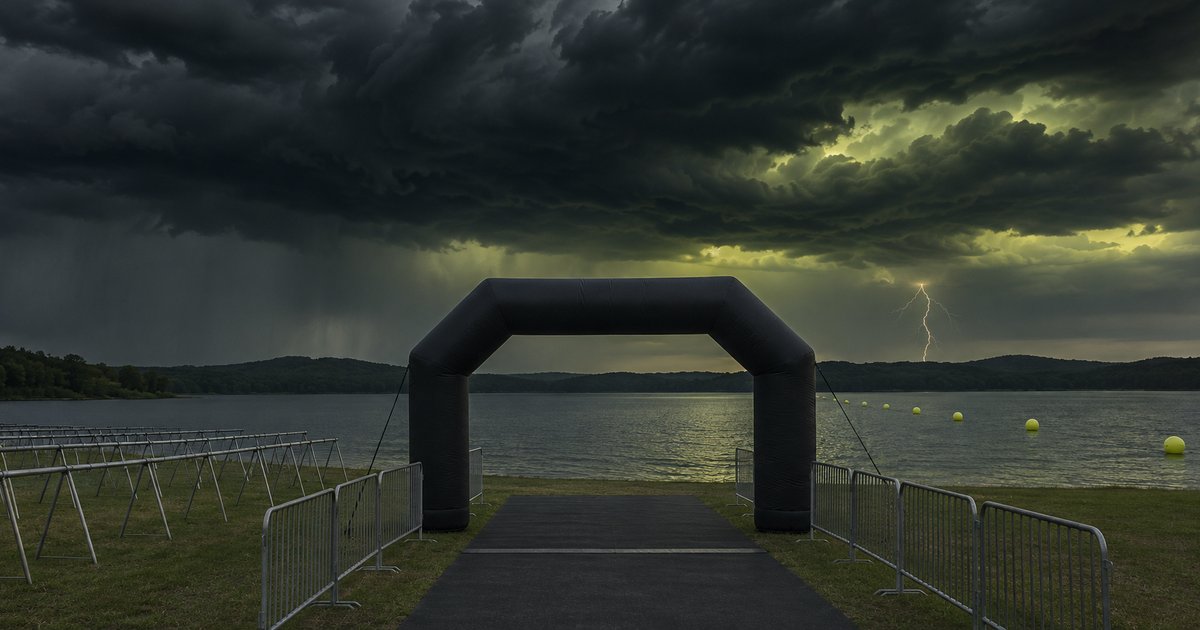
When lightning reaches a triathlon, the race director stops or delays the race, and athletes in the water, on the bike or on the run are stopped where they are or sent to shelter under that event’s own weather policy. The rulebooks differ on the trigger: World Triathlon’s rules name 3.1 miles (5 km), USA Triathlon’s 2026 rules name no distance, and many races publish their own.
The 2026 USA Triathlon rules give event management options but no lightning distance
The USA Triathlon Multisport Competition Rules, version 2026.01.01, say that responsibility for organizing and conducting an event lies with event management, and they bind everyone who enters a USA Triathlon-sanctioned event. Before the start, the rules let event management cancel the race, postpone the start, reroute a segment, change the manner of the start, or turn a triathlon into a duathlon, an aquathlon or another two-segment race. Once a race is under way, it may be suspended, resumed to completion or terminated. The rules frame these steps as responses to “exceptional circumstances.” The rules name no lightning distance or wait, so those come from somewhere else.
USA Triathlon’s race-director resources say directors must have a plan in case extreme weather forces changes to an event. The swim has its own clause: the Head Referee, after consulting event management or medical staff, may shorten or cancel the swim for athlete safety reasons. The clause lists water quality, waves, currents, winds, precipitation, humidity and regional adaptation as factors that may be considered, and its numeric guide covers air and water temperature. The clause does not name lightning.
World Triathlon’s rules name a distance: 3.1 miles (5 km)
The World Triathlon Competition Rules, in the edition dated December 13, 2025 with amendments marked through April 29, 2026, say that when lightning strikes are approaching the venue and are within 3.1 miles (5 km), the race should be stopped, the venue evacuated and the athletes taken to a protected area. Thirty minutes after the last lightning, the rule continues, activities may resume. The document says it applies to all events World Triathlon sanctions. Races under a USA Triathlon sanction are bound by USA Triathlon’s rules, which carry no such number.
The two distances in circulation measure different things. The National Weather Service (NWS) says a significant lightning threat extends outward from the base of a thunderstorm cloud about 6 to 10 miles, while the World Triathlon figure is how close approaching strikes must come to the venue before racing stops. By the NWS measure, then, a course can be under threat well before strikes reach the World Triathlon trigger.
The same World Triathlon rules say how a race is changed. A triathlon may become a duathlon, with the preferred option a duathlon whose first run is the shorter one, and once a race has started, only one segment may be shortened. If a standard-distance race or a shorter one is interrupted after the start and the leader has completed more than 50% of the last segment, athletes are ranked by their last recorded position. If every athlete is stopped before that point, the race is restarted if possible, at least 45 minutes after the interruption. Otherwise no results are produced.
IRONMAN’s 2026 rules treat a changed course as the prescribed course
The 2026 IRONMAN competition rules say that when the event officially modifies the prescribed course before the event, the modification becomes the new prescribed course and is communicated to all athletes before the start. Athletes must cover the prescribed course in its entirety. The document gives no lightning distance or wait time.
A race policy sets the number, and the numbers differ
The table sets the NWS guidance, two rulebooks, a 2006 guide and two race companies’ policies side by side as of November 2026. The race pages are undated, so each shows only what its page said when read.
| Document | Trigger | Wait or restart | What it is |
|---|---|---|---|
| NWS, outdoor sports page | Threat extends about 6 to 10 miles; stop criteria include seeing lightning, hearing thunder or threatening skies | At least 30 minutes after the last thunder | Guidance for organizers |
| World Triathlon rules (December 2025, amended to April 2026) | Approaching strikes within 3.1 miles (5 km): stop and evacuate | 30 minutes after the last lightning | Rule for World Triathlon events |
| USA Triathlon rules (2026) | None named; event management may suspend a race | None named | Rule for USA Triathlon-sanctioned events |
| USA Triathlon contingency plan (version 2, 2006) | Postpone as the flash-to-bang count nears 30 seconds (6 miles) | 30 minutes after the most recent thunder | A guide for race directors |
| Epic Races policy | 10 miles: monitor; 6 miles: possible delay; 3 miles: immediate suspension | 30 minutes after the last lightning or thunder, restarted by each new one | One race company’s policy |
| Zoom Multisport Racing policy | No distance; no racing or swimming with lightning present | Start delayed to at least 30 minutes after the last strike | One race company’s policy |
The clocks start from different events. The NWS counts from the last thunder, World Triathlon from the last lightning, and Epic Races from either one, with each new strike or thunderclap restarting the count. The 2006 USA Triathlon plan ties the stop to the flash-to-bang count: it recommends postponing all activities as the count approaches 30 seconds, which it equates with a flash 6 miles away, and says an event suspended on that basis should wait at least 30 minutes from the most recent thunder.
Swimmers in the water cannot shelter where they are
The NWS includes getting out and away from ponds, lakes and other bodies of water immediately in its last-resort tips for people caught outside, and it advises organizers to allow for the time it takes everyone to reach shelter. Race policies turn that into swim rules: Zoom Multisport Racing says racers will not be allowed to swim with lightning present, and Epic Races says participants may be stopped from starting or continuing the swim, bike or run. Epic Races lists what can happen to the swim: delayed, shortened, modified, converted to a time-trial start, replaced with a duathlon or alternate format, or cancelled entirely.
The National Lightning Safety Council’s March 2026 analysis of U.S. lightning deaths from 2006 through 2025 lists golf, soccer, running, baseball, football and disc golf among sports deaths; triathlon is not on that list. It also says that about 7% of the water-related victims had been swimming.
On the bike and run, athletes are stopped where they are or sent to shelter
The USA Triathlon rules describe a full course suspension as stopping all athletes still on the course, and they say athletes may resume only from the point where they were stopped. Athletes delayed by a full suspension do not get an adjustment of their race time, and the rules on outside assistance stay in effect during the suspension. Epic Races says athletes already on the course may be directed to the nearest shelter. Zoom Multisport Racing says it will stop the race and pull athletes off the course; athletes who wish to continue may get back on 30 minutes after the last lightning strike, and anyone who continues on the bike or run does so at their own risk.
The NWS says no place outside protects anyone when a thunderstorm is in the area. It says that a bicyclist near a building that qualifies as shelter should pull over and wait 30 minutes after the last rumble of thunder before resuming the ride, and that metal does not attract lightning but does conduct it, so riders should stay away from metal fences, railings and bleachers. How many minutes a rider or runner needs to reach shelter decides what a stop means on a long course, and a table of minutes to shelter by pace works that out for runners and cyclists.
Shelter at a race venue is a building or a hard-topped vehicle
The NWS says a substantial building with wiring and plumbing gives the greatest protection and that, without one, a hard-topped metal vehicle with the windows closed gives good protection. Epic Races lists fully enclosed buildings and hard-topped vehicles with the windows closed as acceptable shelter, and it lists tents, open pavilions, pop-up canopies, trees, transition areas and portable toilets as not acceptable. The transition area is on Epic Races’ list of places that are not shelter, even though it is where the bikes and gear are.
A suspended race ends as a restart, a shortened race or no result
The USA Triathlon rules say a race terminated before completion may be rescheduled and restarted from the beginning only with the concurrence of race management and the head referee. If a suspended race is not resumed, official results for a standard-distance race or shorter are produced if the lead athlete has completed more than 50% of the final segment, ranked by last recorded position. For middle distance and longer, athletes who completed at least two segments are ranked the same way, and athletes who completed fewer are listed as NC. If a race is shortened after the start by one segment, official results are produced when all competitive athletes raced the same course; if multiple segments are shortened, none are.
Race directors need a plan that names who decides, and the oldest guidance is dated
The NWS recommends that organizers of outdoor activities have a lightning safety plan and follow it without exception, and it says the plan should answer when to stop, where people go, when to resume, who monitors the weather and what happens if someone is struck. It adds that, when thunderstorms are forecast, organizers should consider canceling or postponing the event. The agency also recommends professional lightning detection equipment that alerts a group as lightning nears the site.
The USA Triathlon race contingency plan, labeled version 2 and dated 2006, lists four remedies in the order it recommends: change the start time on the scheduled date, modify the race format, change the race date, and cancel. It asks for a chain of command, a named weather watcher, a way to monitor forecasts and warnings, a list of protected locations, and specific criteria for suspension and resumption. It calls itself a guide and says the final decision rests with the race director. The plan also tells people with no shelter to find a grove of trees and crouch, advice the NWS says it stopped recommending in 2008. The plan is best read as a model of what a race plan must settle, not as a set of current instructions.
Where Lightning Tracker fits at a race
Lightning Tracker is an iPhone app that shows recently detected strikes on a live map, with the distance and direction to the nearest one and how many minutes ago it was detected. You can save a place such as the transition area or the finish line and set an alert radius for it; the app alerts you when a strike is detected inside that radius, and the default is 10 miles (16 km). The app’s 30-minute wait starts after the last strike detected inside your radius and restarts with each new one; when it ends, the app tells you what it observed and asks you to judge conditions yourself. It does not announce that a storm has ended.
Detection networks miss some strikes, especially weak ones, and data can arrive late, so the app labels delayed or missing data instead of treating it as quiet. The app does not replace official warnings or local procedures, and at a race those procedures belong to event management. Lightning Tracker is free on the App Store for iPhone; the free version covers the current location and 30 minutes of strike history, and Premium is a subscription that adds up to five saved places, 60 minutes of strike history and the storm forecast.
Not a substitute for official weather warnings.
If you hear thunder, seek shelter even if the app shows no nearby strike.
Sources
- USA Triathlon, Multisport Competition Rules, version 2026.01.01 (PDF)
- USA Triathlon, Race director resources: Event Operations and Logistics (undated page)
- USA Triathlon, Race Contingency Plan, version 2, 2006 (PDF)
- World Triathlon, Competition Rules, edition of December 13, 2025 with amendments through April 29, 2026 (PDF)
- IRONMAN, 2026 Competition Rules (PDF)
- National Weather Service, Lightning Safety and Outdoor Sports Activities
- National Weather Service, Lightning scenarios outdoors, including motorcyclists and bicyclists and last-resort tips
- National Weather Service, Lightning Tips
- National Weather Service, Lightning Myths
- National Weather Service, The NWS stopped recommending the crouch in 2008
- National Lightning Safety Council, J. Jensenius, A Detailed Analysis of Lightning Deaths in the United States from 2006 through 2025, March 2026 (PDF)
- Epic Races via RunSignup, Emergency and Contingency Plans (undated page)
- Zoom Multisport Racing, Inclement Weather, Emergency and Contingency Plans (undated page)