 Lightning Tracker
App Store
Places and activities
Kayaks, canoes and paddleboards in thunderstorm season
November 10, 2026 · 7 min read
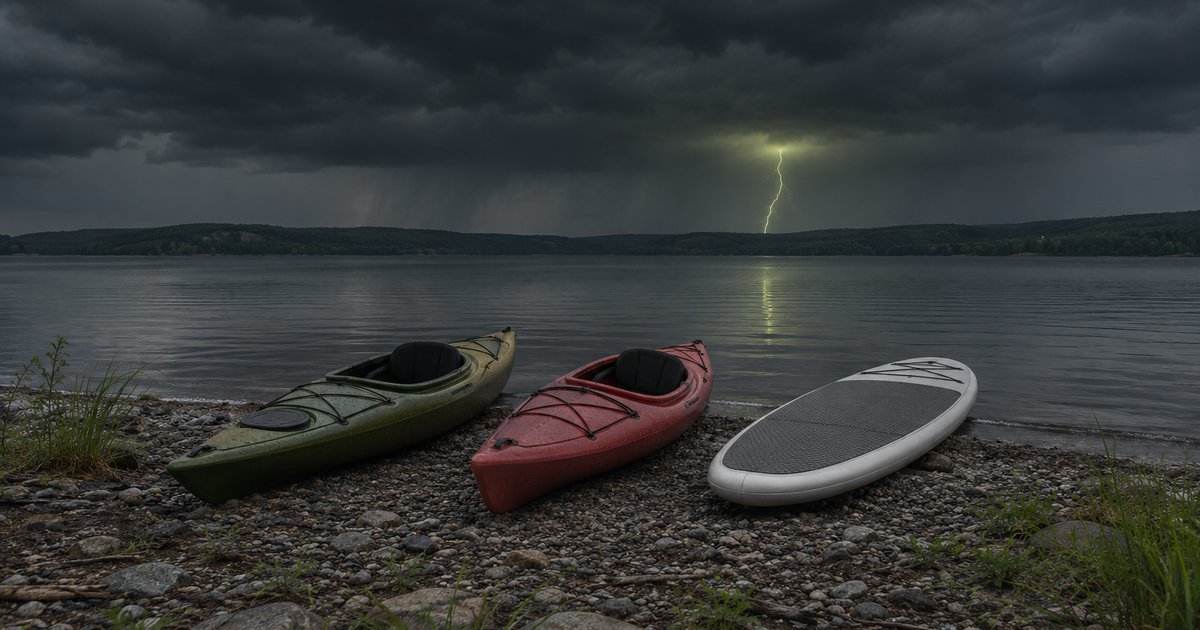
Stay off the water when thunderstorms are possible, and leave it as soon as you hear thunder. A kayak, canoe or paddleboard has no cabin or roof and may be a long paddle from land, and the National Weather Service (NWS) says no place outside is protected while a thunderstorm is in the area. What a paddler can control is the distance: how many minutes the nearest landing is away, and what is waiting there.
What the boating guidance covers, and what it leaves out
The NWS writes its thunderstorm advice for boaters around the cabin: with one, stay inside it, and without one, stay as low as you can in the boat. A kayak, canoe or paddleboard has no cabin, so the first half of that advice does not apply to it. In the same message the NWS says there are no separate warnings or advisories for lightning, even though every thunderstorm produces it, and that boaters are especially exposed because they may be unable to reach port quickly. Its recommendation is not to venture out when thunderstorms are possible, and to head in as quickly as possible once you recognize storms nearby. Thunderstorms also bring gusty winds and dangerous wave conditions, which is a separate problem for a small boat. This page covers lightning only.
The National Lightning Safety Council (NLSC) analysis of the 492 U.S. lightning deaths from 2006 through 2024, published in January 2025, counts 25 boating deaths. Its boating category covers power boats, jet skis, canoes, sailboats and tubes, and the report does not break out kayaks or paddleboards, so it gives no paddling-only count. What it does say applies to paddlers: boaters are likely to be in the open, motor or wave noise can keep them from hearing thunder, and they may need extra time to reach shelter. Many of the fishing and boating victims saw trouble coming and were heading in but did not react soon enough. Who gets struck by lightning has the full picture of the study.
The distance to the nearest landing is a time budget
The time a paddler needs to reach land is set by distance and pace, and the NWS tells organizers of outdoor activities to count that time when they decide when to stop. The NWS puts the significant lightning threat at about 6 to 10 miles out from the base of a thunderstorm cloud, and says thunder can usually be heard from about 10 miles away when there is no background noise. Wind, traffic and precipitation can cut that range, and the NLSC adds that wave or motor noise can mask thunder on the water. Counting the seconds from flash to bang, then dividing by five, gives the approximate distance in miles, as flash to bang explains, but the count only works while you can hear the thunder.
The table is plain arithmetic: minutes needed to cover a distance at two example paces. The paces are examples, not typical figures, and wind, waves, tiredness and the slowest boat in the group all change them.
| Distance to the nearest landing | At 2 miles an hour | At 3 miles an hour |
|---|---|---|
| ¼ mile (0.4 km) | About 8 minutes | 5 minutes |
| ½ mile (0.8 km) | 15 minutes | 10 minutes |
| 1 mile (1.6 km) | 30 minutes | 20 minutes |
| 2 miles (3.2 km) | 60 minutes | 40 minutes |
The sources we read give no figure for how long a storm takes to cover 10 miles, because storms differ, so this page does not invent one. The table shows how long each crossing takes at each example pace. A paddler a mile from land at 2 miles an hour needs 30 minutes to reach it. That is the case for deciding the turn-around point on shore, before launching, and for going earlier in the day when the forecast calls for storms: the NWS advises staying home or going earlier than normal when severe weather is predicted, and being ready to head to shore quickly.
The first strike of a storm can also come without warning. The NWS says it can come from a clear blue sky many miles ahead of an approaching thunderstorm cloud, and it names stopping all activity at the first lightning or when conditions look threatening.
The landing is the start of the next decision
Reaching the shore does not end the exposure, because the NWS says no place outside is protected during a thunderstorm. Its answer is a substantial building or an enclosed, metal-topped vehicle with the windows up, and its last-resort list for people caught outside includes getting out and away from ponds, lakes and other bodies of water, so the water's edge is not the destination. The NLSC found that in many camping deaths the victims were only steps from a vehicle that could have protected them. For a paddler, that argues for choosing launch and take-out points with a car or a building within reach, which is our reading of the NLSC finding, not an NLSC recommendation. Where to shelter from lightning explains what counts and what does not.
The NWS says to wait at least 30 minutes after the last thunder before resuming outdoor activities. A paddler who hears thunder at the 29-minute mark starts the count again, which why the clock restarts covers.
If you are caught on the water, the NWS inland boating guidance for a boat without a completely enclosed cabin is to stay low and keep arms and legs in the boat, because water conducts electricity from lightning. Those lines were written for boats. They do not address a board, where there is no boat to keep your legs in, and the NWS pages we read give no instruction specific to paddleboards. Treat them as a way to lower the risk while you keep moving toward land, not as shelter.
Where common paddling advice and the agencies differ
Paddling clubs and retailers publish lightning pages of their own, and several give instructions that no agency page we read repeats. The table sets three of them against the NWS and says where the sources disagree.
| Advice found on paddling pages | What the NWS says |
|---|---|
| Once ashore, crouch with feet together (San Diego Kayak Club, Bending Branches) | Crouching does not make you any safer outdoors. For a boat without a cabin, the NWS does say to stay low, which is advice for the boat, not a way to protect yourself on land. |
| Avoid metal or carbon paddles (Bending Branches); a carbon paddle is a lightning rod (San Diego Kayak Club) | Height, pointed shape and isolation decide where lightning strikes, and the presence of metal makes no difference. The pages we read do not address the material of a paddle, so what a paddle's material changes is not established. |
| Lightning 14 miles away justified staying on the water (a group the San Diego Kayak Club describes) | The NWS says bolts from the blue can strike 10 to 15 miles from the thunderstorm, and the club's page itself says to get off the water at the first sight of lightning or sound of thunder. |
| Lightning can strike up to 25 miles from its storm (a lightning-detector maker's blog) | The NWS gives 10 to 15 miles for bolts from the blue. The blog names no source, and the sources disagree. |
The disagreement matters less than the shared advice: every page we read, agency or not, tells paddlers to leave the water when thunder or lightning appears.
How a lightning map fits a paddling day
The NWS says some of the more advanced weather apps offer radar and lightning information that can be vital for boaters caught out when the weather changes. Lightning Tracker is an iPhone app that shows recent detected strikes on a live map, with the distance and direction to the nearest one and how many minutes ago it was detected. It alerts you when a strike is detected inside the radius you set for a place, 10 miles (16 km) by default, so the radius can be sized to the minutes your landing needs. How to choose an alert radius shows how.
Detection networks miss some strikes, especially weak ones, and data can arrive late, so the app labels a delay or a gap instead of counting it as quiet. When the app is closed, iOS decides when it can check the data, so a closed app may show the latest strikes only once you open it. The app does not replace official warnings, and a map reports strikes that have already been detected, so it cannot warn of the first one. If you hear thunder, that settles it, whatever the screen shows.
What is still unknown
- A paddling-only death count. The NLSC report groups canoes with other boats and does not name kayaks or paddleboards.
- A distance from shore that is acceptable. No agency page we read gives one, and this page does not make one up.
- Instructions for a paddleboard. The NWS boating text assumes a boat.
- How fast a particular storm will arrive. It varies by storm, and none of our sources puts a number on it.
Not a substitute for official weather warnings.
If you hear thunder, seek shelter even if the app shows no nearby strike.
Sources
- National Weather Service, Boating and thunderstorms: public service announcement
- National Weather Service, Inland Boating Tips
- National Weather Service, Lightning Safety and Outdoor Sports Activities
- National Weather Service, Lightning Myths
- National Weather Service, Lightning Tips
- National Weather Service, Lightning Safety Overview
- National Lightning Safety Council, J. Jensenius, A Detailed Analysis of Lightning Deaths in the United States from 2006 through 2024 (PDF, January 2025)
- San Diego Kayak Club, Lightning Strikes and Paddling
- Bending Branches, Canoeing and Kayaking Safety in Stormy Weather (March 24, 2022)
- TALOS Lightning Detectors, What Should You Do if You're Kayaking During a Thunderstorm?