 Lightning Tracker
App Store
Home and everyday
Does lightning travel through water? What is known and what is not
November 10, 2026 · 7 min read
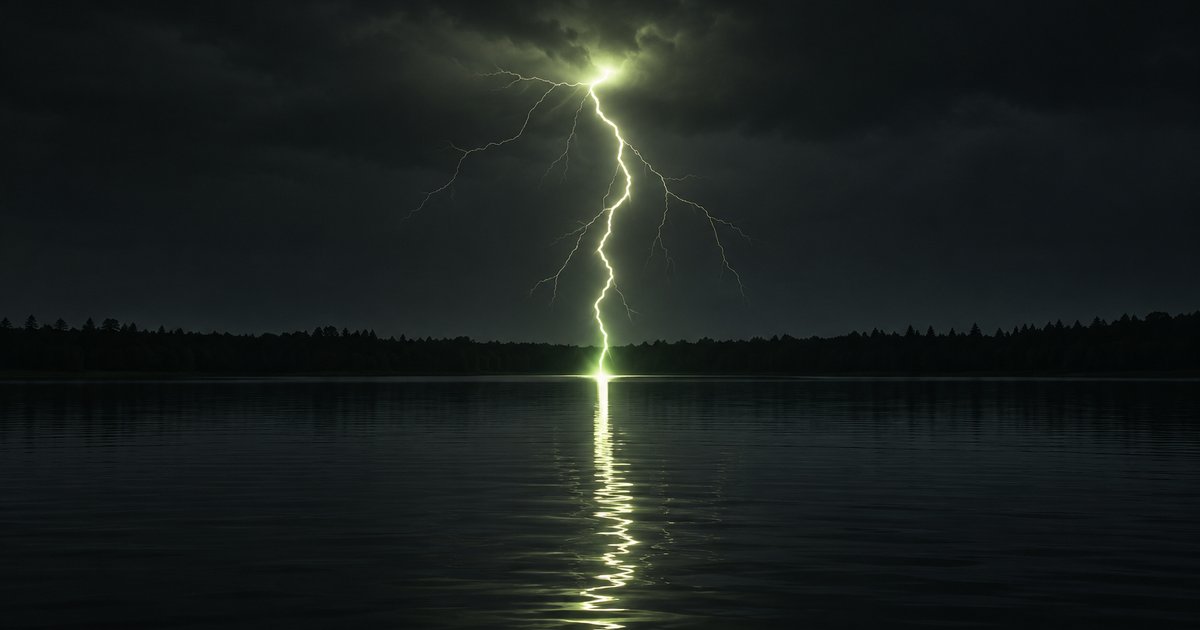
Yes. The National Weather Service says that when lightning hits a lake or the ocean, most of the discharge stays near the water's surface and spreads out from the strike point, and Environment and Climate Change Canada notes that people in or on the water have been killed or injured. What no agency has pinned down is how deep the current reaches or how far from the strike it can still hurt someone. The guidance does not depend on those numbers: leave the water when you hear thunder, and stay out until 30 minutes after the last rumble.
What happens when lightning hits a lake or the ocean
The National Weather Service (NWS) says bodies of water are frequently struck by lightning, and that a charge builds up along the water's surface before a strike. When the strike comes, most of the electrical discharge occurs near that surface. NOAA's Ocean Today video describes the result as lightning spreading out over the water, which acts as a conductor. Environment and Climate Change Canada, the Canadian government's weather and environment agency, says a strike on water travels along the surface in all directions. A Royal Meteorological Society explainer from August 2025 states it more firmly for the sea: the energy spreads rapidly across the surface, it says, and not deep into the water.
Water does not attract lightning. The NWS says the same of metal: both are excellent conductors that do not draw a strike, and the current from a flash can easily travel long distances through them. Where lightning lands depends on height, a pointed shape and isolation, according to the NWS, which is why the metal myth fails. Open water has nothing else tall on it, so a boat, a mast or a swimmer's head can be the tallest and most isolated object for a long way. That is our reading of the NWS rule, not an NWS statement about boats. It fits the Canadian agency's note that people on the water have been killed or injured by direct strikes as well as by ground current and side flash, two of the five ways lightning strikes people.
Strikes are less frequent over water than over land. NASA Earth Observatory's map of satellite observations from 1995 to 2013 shows lightning occurring more often over land than over the oceans. That is a statement about how many flashes an area of sea gets, not about the risk to a person already on it.
Where the evidence stops
The table sorts four common questions about lightning and water by how well the sources we read answer them, as of November 2026.
| Question | What the sources say | Where that leaves us |
|---|---|---|
| How deep does the discharge reach? | The NWS says scientists do not know exactly how deep it reaches. Environment and Climate Change Canada says it is not clear. The Royal Meteorological Society says the energy spreads across the surface and not deep into the water. | Unknown. The agencies are more cautious than the explainer. |
| How far along the surface can it hurt someone? | No distance appears in the NWS, NOAA or Canadian pages we read. A magazine answer reasoning from basic principles suggests "very close", within maybe tens of metres, for a person fully immersed. A 2014 conference paper simulated the spread of potential in water to work out a protective distance. | No agreed figure. Both estimates come from reasoning or simulation, not field measurement. |
| Does a strike kill the fish? | The NWS says most fish swim below the surface and are unaffected. NOAA's Ocean Today video says fish near the surface can be electrocuted. | Consistent: depth matters, and the surface layer is where harm is reported. |
| Is staying in the water better than staying on a boat? | A BBC Science Focus answer calls total immersion in sea water often a better bet than hiding out on a boat or surfboard. The NWS tells people to get out and away from ponds, lakes and other bodies of water. | The sources disagree. The NWS is the one to follow. |
The distance figures that circulate online are the weakest link. The magazine answer is one author's reasoning, and the 2014 paper, from Brno University of Technology, assumes a constant conductivity of the water and gives no figure in its abstract. Neither is a field measurement, and no agency has adopted either as a rule. So no distance is on offer for how far from a strike a person in the water is out of reach. Because the NWS calls swimming or boating during a thunderstorm very dangerous without attaching a distance, the guidance is about leaving the water, not measuring from it.
Why most lightning deaths on the water point to exposure and timing
The National Lightning Safety Council's analysis of the 492 U.S. lightning deaths from 2006 through 2024, published in January 2025, found that leisure activities made up 63 percent of the deaths and that water-related activities were 34 percent of those leisure deaths. Who gets struck by lightning lists the deadliest activities. Within the water-related group, the report puts fishing at 40 percent, boating (power boats, jet skis, canoes, sailboats and tubes) at 24 percent, beach activities at 29 percent and swimming at about 8 percent.
The report explains the fishing and boating deaths through exposure and timing. Anglers and boaters are likely to be in the open and more vulnerable to a direct strike, it says, motor and wave noise can keep them from hearing thunder, and they may need extra time to reach shelter. Many victims saw trouble coming and were heading for shelter but did not react soon enough. For beaches, it says the sound of the surf may have masked thunder. Nothing in the report separates these deaths by whether the current came through the water or from a direct strike, so the numbers cannot settle how far a strike spreads. They do show where the danger sits in practice: in the minutes before and after people leave the water.
What the National Weather Service tells people on or near water
- At a beach or lake. The NWS's own example has a family hearing distant thunder at the beach: go to the car, not to an open-sided picnic shelter, and wait 30 minutes after the last rumble of thunder before going back. If no building or car is reachable, its list of ways to lower the risk starts with getting out and away from ponds, lakes and other bodies of water. Where to shelter from lightning explains why picnic shelters do not count.
- On a boat. The NWS says the vast majority of lightning injuries and deaths on boats occur on small boats with no cabin, and that boaters should stay home if thunderstorms are forecast. A boater who cannot reach land is told to drop anchor and get as low as possible. Large boats with cabins, especially those with properly installed lightning protection systems, and metal vessels offer relatively good protection, and the NWS says to stay inside the cabin and away from metal surfaces. NOAA's Ocean Today video adds that people at sea should head for land, and if they cannot, stay low in the boat or retreat to a cabin and keep electronics off.
- Scuba diving. For a diver whose boat has no cabin, the NWS says diving deep for the length of the storm is the lesser risk. It is a last-resort line for one situation, and the only place we found the NWS recommending the water.
- Afterward. Environment and Climate Change Canada advises staying off and out of the water for 30 minutes after the last rumble of thunder, and says about one third of lightning-related casualties occur after the storm because people return too soon. Why the 30-minute wait restarts with every strike covers the reasoning.
On a boat or a beach, the usual cue is harder to catch. Engine and surf noise can hide thunder, and the NWS says that if you hear thunder you are likely within striking distance, so counting from flash to bang works only while you can hear.
Water inside the walls: pipes, showers and baths
The Centers for Disease Control and Prevention (CDC) says lightning can travel through plumbing and advises avoiding all water during a thunderstorm: no showering, bathing, washing dishes or washing hands. The CDC adds that the risk might be lower with plastic pipes than with metal ones, and still recommends avoiding plumbing and running water either way. The NWS gives the same instruction in its guidance for the inside of buildings, and says most indoor lightning casualties and some outdoor ones are due to conduction, current following wires, pipes and metal surfaces. Indoor pools and water-park rules have their own operating guidance, which this article does not cover.
Using a lightning map near water
Lightning Tracker is an iPhone app that shows recently detected strikes on a live map, with the distance and direction to the nearest one and how many minutes ago it was detected. It alerts you when a strike is detected inside a radius you set for each place; the default is 10 miles (16 km). Near water, the number worth setting is the time it takes to reach shelter: the National Lightning Safety Council says boaters and anglers may need extra time to get to a place that protects them, so a boat launch several minutes from the car asks for a wider radius than a backyard. How to choose an alert radius shows how to match the two.
The app has limits that matter on the water. Detection networks miss some strikes, especially weak ones, and data can arrive late; the app marks late or missing data instead of treating it as quiet. It does not replace official warnings or your own judgment, and it cannot tell you how far current spreads through water, because nobody can yet.
Not a substitute for official weather warnings.
If you hear thunder, seek shelter even if the app shows no nearby strike.
Sources
- National Weather Service, Lightning and Fish
- National Weather Service, Lightning Safety Outdoors
- National Weather Service, Lightning Tips
- National Weather Service, Lightning Myths
- National Weather Service, Lightning Safety Overview
- National Weather Service, Lightning Safety Indoors
- National Weather Service, Five Ways Lightning Strikes People
- NOAA Ocean Today, When Lightning Strikes
- Environment and Climate Change Canada, Lightning safety on the water
- National Lightning Safety Council, J. Jensenius, A Detailed Analysis of Lightning Deaths in the United States from 2006 through 2024 (PDF, January 2025)
- U.S. Centers for Disease Control and Prevention, Frequently Asked Questions About Lightning
- NASA Earth Observatory, Global Lightning Activity (March 31, 2015)
- Royal Meteorological Society, What happens when lightning strikes the ocean? (August 1, 2025), secondary source
- BBC Science Focus, How close do you have to be to a lightning strike in the sea for it to shock you?, secondary source
- Brno University of Technology, Krbal, Baxant, Škoda and Sumec, Electrical Parameters of Water at Lightning Impulse (2014 conference paper, abstract)