 Lightning Tracker
App Store
Places and activities
Lightning on farms and ranches: crews, fences and livestock
November 10, 2026 · 9 min read
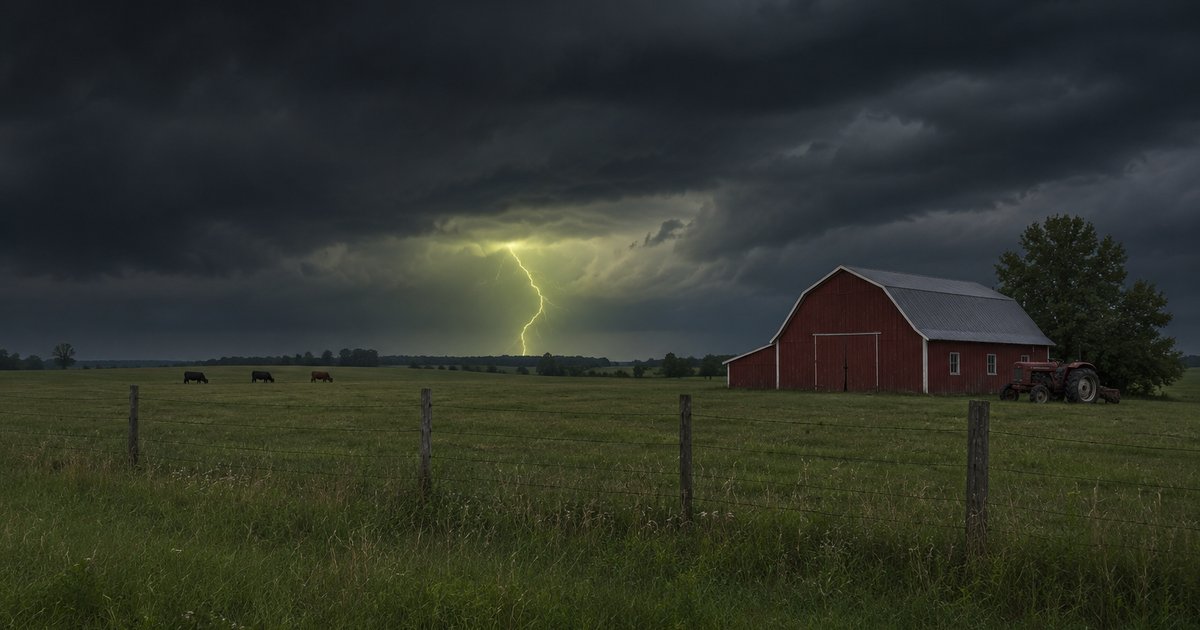
Farming and ranching caused 24 of the 492 U.S. lightning deaths from 2006 through 2024 that the National Lightning Safety Council analyzed, the most of any kind of work, and for most of those victims a vehicle or building was nearby. Livestock face a second danger that needs no direct hit: the National Weather Service says ground current from a nearby strike is often fatal to large farm animals. No national count of livestock lightning losses turned up in the sources read for this article.
Farming and ranching lead the count of work-related lightning deaths
The National Lightning Safety Council (NLSC) counted 24 farming or ranching deaths from 2006 through 2024, more than any other kind of work in its analysis of 492 U.S. lightning deaths, published in January 2025. That puts farming and ranching fourth among all activities, after fishing (42 deaths), beach activities (32) and boating (25). The study counts a death as work related when the activity provided a significant part of the victim's income, so the 24 are people who earned a significant part of their income from farming or ranching.
The NLSC author, John Jensenius, adds a detail that changes what the number means. For most farming and ranching victims, a vehicle or a building was nearby. The victims either did not recognize the warning signs soon enough or did not act promptly. For most of them, then, the record points to timing rather than a lack of shelter. The full study is summarized in Who gets struck by lightning?, and A lightning plan for outdoor work covers what employers are asked to write down.
The OSHA and NOAA fact sheet on working outdoors, dated May 2016, names farming and field labor among the higher-risk kinds of work. It also warns that lightning can strike outside the heaviest rain or even up to 10 miles from any rainfall, so a dry field is not proof that the storm is far away. The fact sheet tells crews not to begin any task they cannot quickly stop once signs of a thunderstorm appear.
Ground current can kill a whole group of animals without a direct hit
Ground current is the energy of a strike spreading outward through and along the ground, and the National Weather Service (NWS) says it causes the most lightning deaths and injuries among people. The NWS adds that it also kills many farm animals. The current enters the body at the contact point closest to the strike and leaves at the point farthest from it, and the greater the distance between those points, the greater the chance of death or serious injury. Large farm animals have a wide body span, so the NWS calls ground current from a nearby strike often fatal to livestock. Five ways lightning strikes people explains the same mechanism for human victims.
Two cases show the scale. On a Saturday in May 2024, a strike killed a rancher in Jackson County, Colorado, and 32 of his cattle as he tossed hay from the back of a trailer, the county coroner told the Colorado Sun; the sheriff's office later put the toll at 34 cattle, as CBS Colorado reported. About 100 cows and calves were standing around the trailer; the coroner said they were bunched up around it and that the strike hit them all. Around August 23, 2026, a strike killed 220 sheep in the Gravelly Mountains of Montana, according to Steve Primm of the Heart of the Rockies Initiative, quoted by The Madisonian on September 6, 2026. The Colorado Sun and Madisonian reports do not say how the current reached the animals. CBS Colorado quoted Steven Clark, president of the Lightning Data Center at St. Anthony Hospital in Lakewood, saying that in cases like this it is more often than not a ground current. That fits the NWS description, but it is an expert's general statement about such cases, not a finding about either incident.
A 2025 conference paper by Chandima Gomes and Siow Chun Lim reviews documented herd deaths and names the factors that raise the risk for animals: terrain conductivity, moisture, herd density, how animals shelter, open fields, water bodies and metal fencing. The full text was not freely available, so this article cannot report the paper's models or numbers.
Tractors and farm equipment are not listed as shelter, and no page rates a closed cab
The shelter standard from OSHA, NOAA and the NWS is narrow, and much of what a farm crew works in or on falls outside it. The table lists what the sources say about places and machines a farm crew meets.
| Where the crew is | What the sources say | Source |
|---|---|---|
| Fully enclosed, substantial building with wiring and plumbing | The first choice for shelter | OSHA and NOAA |
| Hard-topped metal vehicle, windows rolled up | The fallback when no building is reachable | OSHA and NOAA |
| Tractor or other farm equipment | Get off it; the page makes no exception for cabs | NWS Jackson, Mississippi |
| ATV, lawn mower, motorcycle, scooter or bicycle | Does not count as shelter; avoid it when storms are in the area | NLSC, NWS Jackson |
| Small shed, pavilion, tent or covered porch | Does not protect from lightning | OSHA and NOAA, NWS |
| Fully enclosed tractor or combine cab | Not rated in the pages read for this article | None |
The last row is a gap, not a verdict. The NWS office in Jackson, Mississippi tells people to get off tractors and other farm equipment, and the NWS and OSHA describe hard-topped metal vehicles as shelter. No page read for this article says whether a closed tractor or combine cab counts as one of those vehicles or as an exception to the instruction, so this article does not call one protected or unprotected. Barns are not named either. The test the agencies give is a fully enclosed, substantial building with wiring or plumbing. On that test, an open-sided hay or machine shed falls with the small sheds the NWS says do not protect, which is our reading, not a statement from the agencies. The same sources say to stay in the shelter until 30 minutes have passed since the last thunder; why the clock restarts explains the rule, and where to shelter covers the rest of the list.
Metal fences can carry lightning, and the federal pages say to stay away
Metal fencing conducts lightning, and the federal pages tell anyone caught outdoors to stay away from it. The NWS says metal does not attract lightning but gives it a path to follow, and that lightning can travel long distances in wires and other metal surfaces. Its Lightning Tips page lists barbed wire fences among the conductors to stay away from, the Jackson, Mississippi office adds wire fences and other metallic paths that could carry lightning to a person, and the OSHA and NOAA fact sheet says to avoid wiring, plumbing and fencing. These tips are written as last-resort measures for people who cannot reach shelter, and the NWS also says no place outside is protected during a thunderstorm.
Our reading of those pages is that a person mending or walking a fence line when thunder sounds is next to a conductor that can run a long way from where a strike lands. How far a hazardous current travels along a fence is not stated in any source used here, and neither is whether grounding rods or electric fence energizers change the risk. Fences matter for animals too: a 2015 veterinary note from Riverina Local Land Services in Australia says it is natural for herding animals to move toward fences or under trees as a storm approaches, which can leave several animals along the same fence.
No national count of livestock lightning losses was found
No national figure for livestock lightning losses turned up in the sources read for this article, and the sources weigh the problem differently. The Australian veterinary note calls lightning a relatively uncommon cause of trauma in domesticated animals. A Belgian study published in 2015 in The Veterinary Journal calls it an important cause of sudden death in livestock on pasture and among the main reasons insurance companies consult an expert veterinarian. The same study says scientific information on the subject is limited.
A figure circulates online that lightning causes about 80 percent of accidental livestock deaths. Backpacker magazine stated it in an article updated July 2, 2025, and attributed it to USDA data, without naming a USDA publication. This article could not trace the number to a USDA publication, so it does not use it.
The Belgian study also shows why a dead animal is hard to attribute. Its authors reviewed 410 declarations examined by one expert veterinarian in Flanders between 1998 and 2012. Singe lesions, burn marks that point specifically to lightning, were present in 43 percent of the 194 confirmed reports, and a tree or open water nearby was one of the factors tied to lightning deaths. Relying only on lightning location data flagged 91.3 percent of the confirmed cases but correctly rejected just 41.2 percent of the cases that were not lightning, so the authors warn that a negative case could wrongly be accepted. Combining the veterinary findings with detection of cloud-to-ground lightning at the time and place of death gave the best results. In short, a strike on a map is evidence, not proof of what killed an animal.
The sources read report no measured effect for any protective measure. The Gomes and Lim abstract lists shelters, herd management to reduce clustering, early warning systems and grounded protection in high-risk areas as proposals. The Australian note says that changing fences and trees to reduce losses is unlikely to be feasible for most producers and is worth considering mainly for valuable livestock or places with frequent lightning. Neither source says how much any measure reduces losses.
A farm crew needs a written time-to-shelter, not a guess
OSHA and NOAA ask employers to put the response time for each worker in the emergency action plan: how long it takes everyone to reach a shelter, who warns the crew, and when work stops and starts. On a farm, that points to measuring the walk or drive from the far end of each field to the nearest building or hard-topped vehicle, and doing it for the slowest person on the crew. The NLSC finding that shelter was usually nearby suggests that, for most victims, leaving in time was the problem.
The fact sheet also limits what detection can do. It says that no system can detect the first strike, detect all lightning or predict lightning strikes, and it tells workers to watch the sky for storms developing overhead or nearby.
How Lightning Tracker fits a farm plan
Lightning Tracker is an iPhone app that shows recently detected strikes on a live map, with the distance and direction to the nearest one and how many minutes ago it was detected. Saving the farmyard, the far pasture and the shop as separate places lets each have its own alert radius. The app alerts you when a strike is detected inside the radius set for a place, 10 miles (16 km) by default. How to choose an alert radius shows how to match the radius to the time your farthest field needs.
After the last strike inside the radius, the app starts a 30-minute wait and restarts it with each new strike. When the wait ends, it reports what it observed and asks you to judge conditions yourself; it does not announce that the storm is over. Detection networks miss some strikes, data can arrive late, and iOS decides when a closed app may check in the background, so a closed app may show the latest strikes only when you open it. Lightning Tracker does not replace official warnings or local procedures.
Not a substitute for official weather warnings.
If you hear thunder, seek shelter even if the app shows no nearby strike.
Sources
- National Lightning Safety Council, J. Jensenius, A Detailed Analysis of Lightning Deaths in the United States from 2006 through 2024 (PDF, January 2025)
- OSHA and NOAA, Fact Sheet: Lightning Safety When Working Outdoors (PDF, May 2016)
- National Weather Service, Lightning Science: Five Ways Lightning Strikes People
- National Weather Service, Lightning Tips
- National Weather Service, Lightning Safety Overview
- National Weather Service Jackson, Mississippi, Severe Weather Preparedness Week Day 5: Lightning
- National Lightning Safety Council, Lightning and Cars
- E. Vanneste and colleagues, Lightning related fatalities in livestock: veterinary expertise and the added value of lightning location data, The Veterinary Journal, 2015 (abstract)
- C. Gomes and S. C. Lim, Understanding and Mitigating Lightning-Related Animal Fatalities: Case Studies, Injury Pathways, and Protection Measures, 13th Asia-Pacific International Conference on Lightning, 2025 (abstract)
- Riverina Local Land Services, R. Shankar and E. Braddon, Lightning strike in the Riverina, Flock & Herd, March 2015
- The Colorado Sun, Lightning strike kills northern Colorado rancher, more than 30 cattle (May 26, 2024)
- CBS Colorado, Community mourns Colorado rancher killed in lightning strike (May 2024)
- The Madisonian, 220 sheep killed by lightning strike in Gravelly Mountains (September 6, 2026)
- Backpacker, A Single Lightning Bolt Just Killed 34 Cows in Colorado. Here's What Hikers Can Learn. (updated July 2, 2025), cited only for an unverified figure