 Lightning Tracker
App Store
Storm basics
The 323 reindeer killed by lightning in Norway: what happened
November 19, 2026 · 7 min read
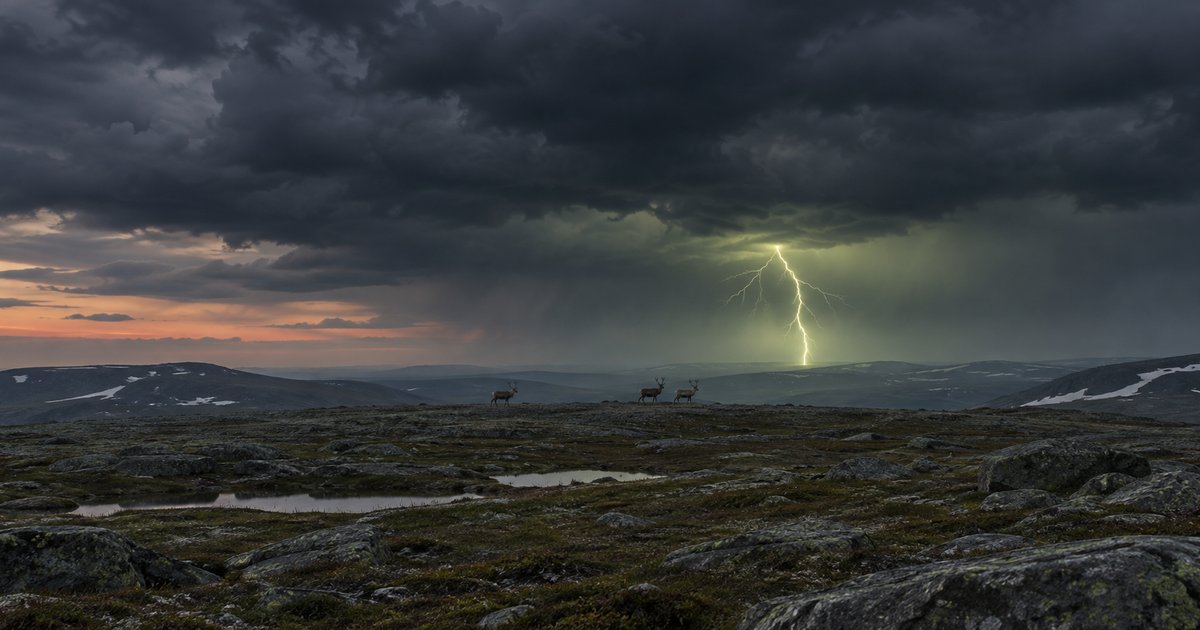
Lightning killed 323 wild reindeer, nearly an entire herd, on Norway’s Hardangervidda plateau in August 2016, and rangers from the Norwegian Environment Agency found them on Friday, August 26 after bad weather. The agency named no mechanism beyond lightning itself; the usual explanation for animals dying side by side is ground current, and the scientists who studied the site afterward looked at what the carcasses did to the tundra.
The Norwegian Environment Agency counted 323 dead reindeer, 70 of them calves
On August 28, 2016, the Norwegian Environment Agency (Miljødirektoratet) published a news item, since removed from its website, saying that its field staff, the Norwegian Nature Inspectorate (SNO), came across the herd on Friday, August 26, near Vesle Saure in Vinje municipality. The agency wrote that the weather in the area had been bad and that SNO was out on patrol linked to the wild reindeer hunt. Rangers counted 323 animals of both sexes, 70 of them calves, and a photo caption on the page says the dead bulls, cows and calves lay fairly concentrated in an area of roughly 164 to 262 feet (50 to 80 meters). A later update on the same page gives the toll as 323 dead animals, five of which rangers had to put down; the first version of the page said four.
The scale surprised the agency. National Geographic reported on August 29, 2016 that agency spokesperson Kjartan Knutsen told the Associated Press the loss was unprecedented in Norway: “We have not heard about such numbers before.” The same report describes Hardangervidda as the largest high mountain plateau in northern Europe and says the national park around it covers some 3,088 square miles (8,000 square kilometers) and is home to 10,000 to 11,000 wild reindeer. The 2020 and 2018 field papers place the study site at about 4,000 feet (1,220 meters) above sea level.
Experts point to ground current, but the sources do not confirm it for this herd
Ground current is the energy of a strike spreading outward through and along the ground, and the National Weather Service (NWS) says it is the cause of most lightning deaths and injuries among people. The NWS adds that ground current also kills many farm animals: the current enters the body at the contact point closest to the strike, travels through the cardiovascular and nervous systems, and exits at the point farthest away. The greater the distance between those points, the greater the chance of death or serious injury, and because large farm animals have a relatively large body span, the NWS calls ground current from a nearby strike often fatal to livestock.
The Merck Veterinary Manual, in an entry fully reviewed in July 2025 by a University of California, Davis veterinary school author, ranks step potential, the current that spreads on and in the ground away from the strike, as the most common way lightning injures animals. It offers a hypothesis for why four-legged animals fare worse than standing people: current passing between forelimbs, or between a forelimb and a hindlimb, crosses the heart, while in a standing person the heart is far from the path between the feet. It also says larger animals have greater differences in electrical potential between front and hind feet. The manual adds that few conditions in livestock kill many animals at once, clustered in a small area, the way lightning does.
Outside magazine, on August 29, 2016, asked physicist Joseph Dwyer of the University of New Hampshire, a lightning researcher, how this could happen. He said it was possible that a single ground strike dropped the animals, though impossible to know for sure, and that the answer depends on how much current flowed. He thought step voltages were the likely mechanism and said a very large flash over the right ground conductivity could plausibly kill many animals, assuming they were all huddled close together. That is an expert’s judgment from the reports, given in a phone interview days after the event, not a finding from an examination of the site. The agency’s own page names no mechanism.
Accounts of how the herd stood differ. National Geographic wrote that it was likely the dead reindeer had huddled together to weather the storm, while adding that specifics were still unknown. Outside quoted Olav Strand, a senior researcher at the Norwegian Institute for Nature Research (NINA), who had told The New York Times that the animals were standing on a hill, moving up it, and seemed to have fallen dead where they stood. The researchers who later mapped the site give the spread of the carcasses as about about 787 by 328 feet (240 by 100 meters), with the highest concentration within roughly 164 by 164 feet (50 by 50 meters). A New York Times report of August 17, 2018 states as fact that the animals died by lightning that coursed through the wet ground, climbed up their legs and jolted their hearts.
The sources read here report no result from a necropsy. The agency said SNO and researchers would examine the animals further, and that samples from the heads were going to the Norwegian Veterinary Institute for chronic wasting disease testing, part of a national survey under way that autumn. The Merck manual explains why the cause of a cluster like this is often argued from circumstance: it says a diagnosis might depend on the location of groups of affected animals and the lack of other signs of disease, and that injury from step potential is less likely to involve specific lesions.
Rangers left the carcasses where they lay, which is rare in Europe
The agency’s 2016 page says it is normal for nature to take its course when animals die in the mountains, but called this case somewhat special because of the number of animals and the chronic wasting disease that had recently been found in wild reindeer in the Nordfjella area, just north of Hardangervidda. It said the final decision would wait for the test results, and that the herd lay in an area with little traffic. The field papers report what followed: officials removed all the heads for disease screening, and everything else stayed. The Guardian noted on July 8, 2020 that European laws mean carcasses have to be removed in most instances, so this kind of decay is something most people never see.
Three studies followed the carcasses and left the strike itself alone
The researchers who studied the site treat the lightning as the given and ask what a one-time load of dead reindeer does to an alpine ecosystem. The New York Times reported on August 17, 2018 that the scientists turned the die-off into a self-funded project called REINCAR. Three papers from that work, by overlapping author groups, are compared below.
| Paper | Published | What was recorded | What the authors report |
|---|---|---|---|
| Steyaert and colleagues, Biology Letters | August 2018 | Droppings of scavengers and viable plant seeds around the carcasses | Bird and fox droppings were concentrated around carcasses, and the droppings of corvids (the crow family) commonly held viable crowberry seeds |
| Badia and colleagues, Ornis Norvegica | December 2019 | Birds at the site in 2017 | Five passerine (perching) bird species, led by meadow pipit, foraged on arthropods such as blowfly adults and larvae |
| Frank and colleagues, Royal Society Open Science | June 2020 | Droppings of rodents and larger scavengers over two years | Rodents showed the strongest avoidance toward changes in raven abundance |
The 2020 paper counted droppings on 59 survey plots of one square meter (about 11 square feet) each. Bird droppings fell from 84 in 2017 to 4 in 2018, while rodent droppings, almost absent from the densest carcass area in 2017, spread across nearly the whole study area in 2018. The authors read this as evidence that carcasses can create a temporary “landscape of fear” for rodents, and they say the effect on individual animals and populations depends on factors such as how many carcasses there are and which scavengers come. The 2018 paper found rodent droppings more common farther from the carcass concentration and offered two explanations, a scavenger-induced landscape of fear or a lack of vegetation at the decomposition sites; it does not choose between them.
Earlier mass livestock deaths were smaller, and Norway sees little lightning
National Geographic listed three earlier herd deaths in its 2016 report: 30 cattle in Orange County, Virginia in 1990, 68 cows at a dairy farm near Dorrigo, New South Wales in 2005, and 52 cattle in a paddock near Montevideo, Uruguay in 2008, where lightning had struck the paddock’s wire fence. Steve Goodman, a scientist with NOAA’s satellite service, told the magazine he had heard of groups of cows killed when lightning hits the ground, and that “The lightning can spread for hundreds and hundreds of meters, for sure.” The report adds that Goodman noted Norway is not particularly prone to severe lightning, and that NASA satellite data show fewer than one strike per square kilometer in an average year in southern Norway, which is fewer than about 2.6 per square mile.
Reindeer have no building to run to, and people usually do
Dwyer told Outside in 2016 that people have a choice but reindeer have to stay outside. The National Weather Service says in its lightning safety overview that no place outside protects anyone when thunderstorms are in the area, and that hearing thunder means you are likely within striking distance of the storm. The overview names substantial buildings and hard-topped vehicles as the options and says rain shelters, small sheds and open vehicles are not.
Lightning Tracker is a free iPhone app on the App Store that shows recently detected strikes on a live map and alerts you when one is detected inside a radius you set for a place.
Not a substitute for official weather warnings.
If you hear thunder, seek shelter even if the app shows no nearby strike.
Sources
- Norwegian Environment Agency (Miljødirektoratet), 323 villrein drept av lynet, August 28, 2016 (removed from the agency’s site; Internet Archive copy captured December 3, 2018)
- National Geographic, Lightning Kills More Than 300 Reindeer in Rare Mass Death, August 29, 2016
- Outside, How Did a Lightning Strike Kill 323 Reindeer?, August 29, 2016
- The New York Times, Hundreds of Reindeer Died by Lightning. Their Carcasses Became a Laboratory., August 17, 2018
- The Guardian, ‘Landscape of fear’: what a mass of rotting reindeer carcasses taught scientists, July 8, 2020
- Steyaert et al., Special delivery: scavengers direct seed dispersal towards ungulate carcasses, Biology Letters, August 2018
- Badia et al., Reindeer carcasses provide foraging habitat for insectivorous birds of the alpine tundra, Ornis Norvegica, December 2019
- Frank et al., Fear the reaper: ungulate carcasses may generate an ephemeral landscape of fear for rodents, Royal Society Open Science, June 2020
- National Weather Service, Lightning Victims: how lightning strikes people
- National Weather Service, Overview: Lightning Safety
- Merck Veterinary Manual, Lightning Strike and Electrical Injury in Animals, full review July 2025