 Lightning Tracker
App Store
Storm basics
Does lightning kill fish in a lake or ocean?
November 19, 2026 · 3 min read
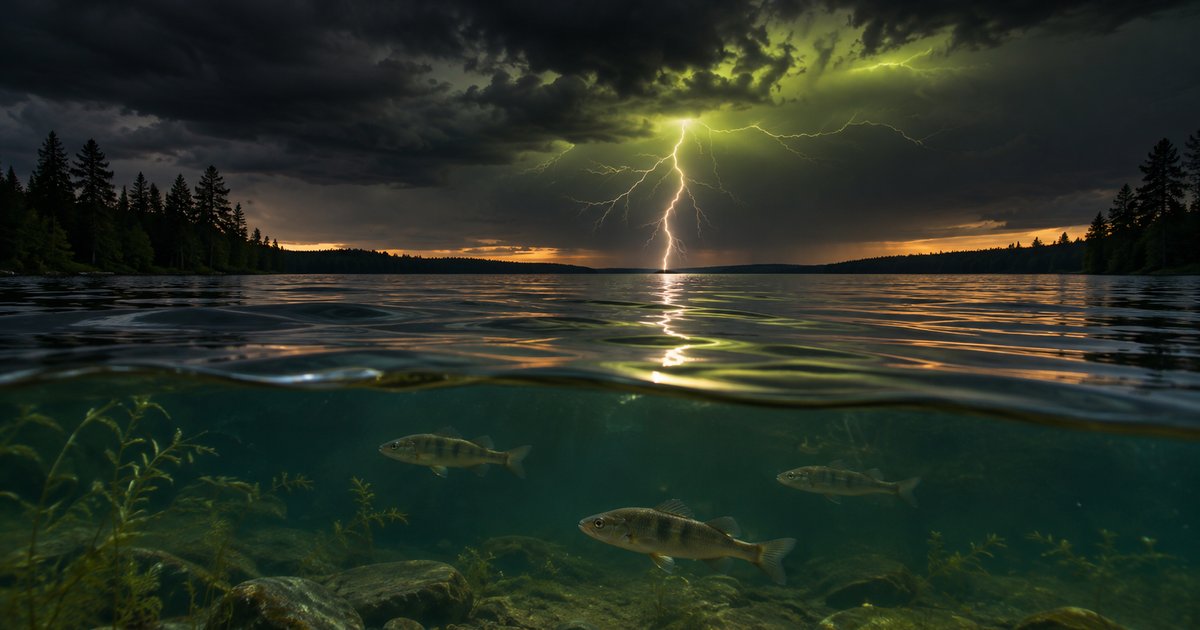
Yes, lightning can kill fish near a water strike, but it does not kill every fish in a lake or ocean. The National Weather Service says most of a strike’s electrical discharge occurs near the surface and most fish swim below it. Oklahoma State University Extension listed lightning among infrequent fish-kill causes in its December 2021 pond guide.
Why one strike does not kill every fish
The National Weather Service says bodies of water are struck frequently, yet most fish remain unaffected. Its explanation is about where the discharge goes: charge builds along the water surface before a strike, and most of the electrical discharge then occurs near that surface. Most fish swim below it. The current can still reach a fish close to the strike.
The Weather Service’s Gray, Maine, lightning awareness statement likewise says most electrical energy from a water strike is discharged along the surface. That is why it contrasts fish swimming well below the surface with people who normally swim at it. A strike can therefore kill some fish without killing the whole population.
Can an individual fish be killed?
Oklahoma State University Extension lists lightning strikes among the infrequent causes of fish kills in its December 2021 pond-management sheet. A fish close to the strike at the water’s surface can be exposed to the discharge the Weather Service describes.
The extension sheet also names other causes of fish kills, including disease, spawning stress, prolonged ice cover and water-quality problems. Seeing dead fish after a storm does not by itself identify lightning as the cause. The timing may prompt an investigation, but the sheet’s list shows why a fish kill needs evidence beyond the presence of a thunderstorm. The same December 2021 guide identifies low dissolved oxygen as the leading cause of pond fish kills. For a sudden die-off, it tells pond owners to consider low oxygen or a toxic substance, and to look for water-color changes or fish gulping air at the surface in the early morning. Those observations help test another explanation before assigning the loss to lightning.
Does the answer change in a pond, lake, or ocean?
The National Weather Service’s fish explanation applies to bodies of water generally: most discharge occurs near the surface. No agency publishes a depth below which fish are unharmed.
The Royal Meteorological Society’s August 2025 ocean explainer agrees that fish near the surface can be harmed while animals deeper down are less likely to be affected. It suggests smaller waters can expose a larger share of their inhabitants.
| Source | What it says |
|---|---|
| National Weather Service | Bodies of water are struck frequently, most of the discharge occurs near the surface, and most fish swim below it and are unaffected |
| National Weather Service, Gray, Maine | Most electrical energy from a water strike is discharged along the surface, where people normally swim and fish do not |
| Oklahoma State University Extension, December 2021 | Lightning is among the infrequent causes of pond fish kills; low dissolved oxygen is the leading cause |
| Agencies cited on this page | No agency publishes a depth below which fish are unharmed |
| Royal Meteorological Society, August 2025 | Fish near the surface can be harmed while animals deeper down are less likely to be affected; smaller waters can expose a larger share of their inhabitants |
Why the fish answer cannot guide a swimmer
The National Weather Service explicitly warns that swimming and boating during a thunderstorm are very dangerous even though most fish remain below the surface. People normally swim at the part of the water where the agency says most discharge occurs. A swimmer cannot use the survival of deeper fish to infer that the surface is protected. Lightning traveling through water matters because the electrical path, rather than the visible splash, is the hazard.
The Weather Service advises people who hear thunder to get inside a substantial building or hard-topped vehicle, and to wait 30 minutes after the last lightning or thunder before going back outside. Its outdoor guidance says to avoid water and says most boating injuries and deaths occur on small boats without a cabin. For anyone fishing during a thunderstorm or on an open boat, the fish’s usual depth is irrelevant to the decision to leave the water.
Before a swim or fishing trip, Lightning Tracker’s iPhone map can show recently detected strikes, but it does not replace official weather warnings.
Not a substitute for official weather warnings.
If you hear thunder, seek shelter even if the app shows no nearby strike.
Sources
- National Weather Service, Lightning and Fish
- National Weather Service Gray, Lightning Awareness Week
- Oklahoma State University Extension, Fish Kills
- Royal Meteorological Society, What happens when lightning strikes the ocean?
- National Weather Service, Lightning Safety Overview
- National Weather Service, Lightning Outdoors